
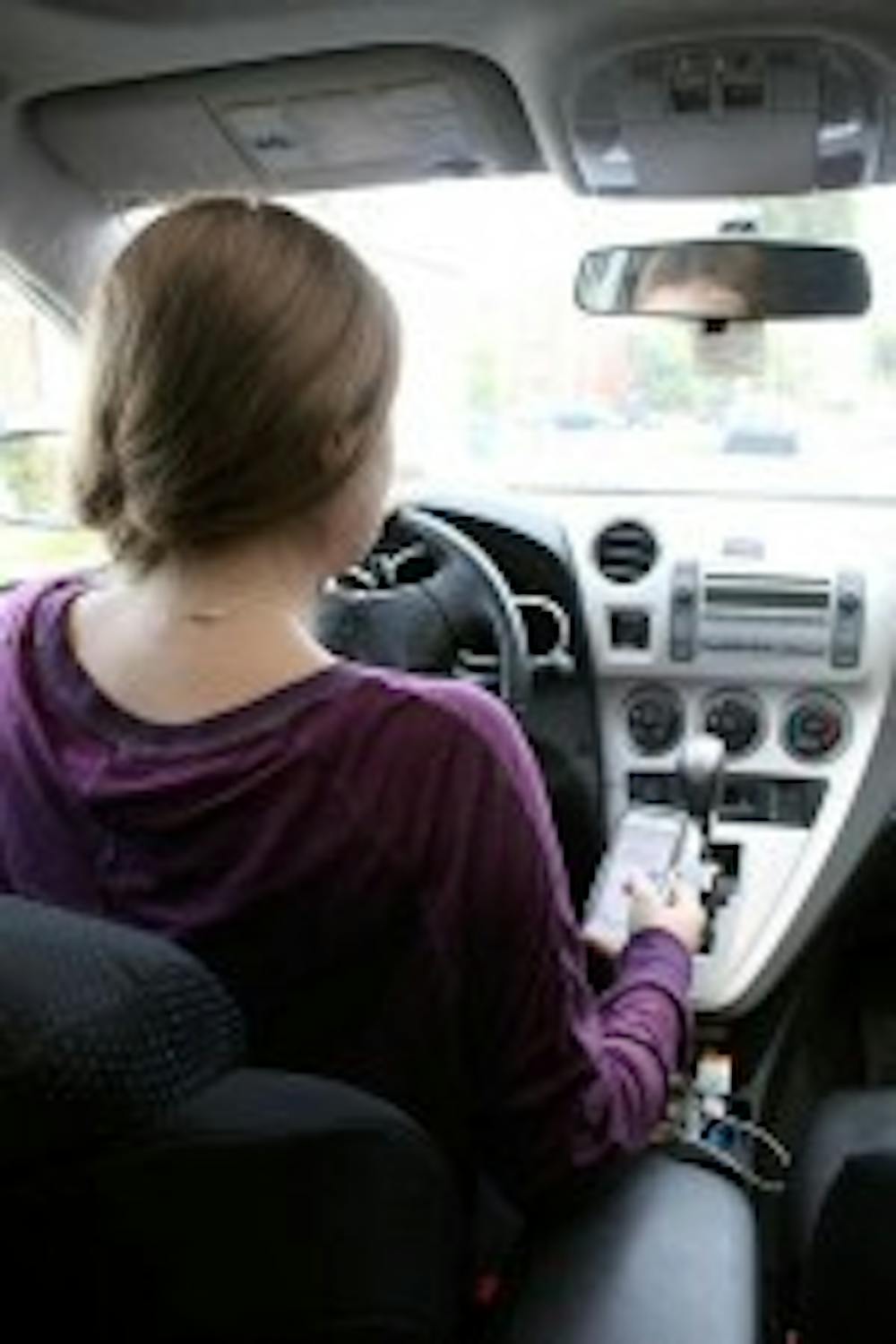
Each day in the United States, more than nine people are killed and 1,060 are injured in crashes that involve a distracted driver, according to the Centers for Disease Control and Prevention.
A new law has increased fines and penalties for distracted driving in New York State. The law, which took effect on July 26, is part of Gov. Andrew Cuomo's effort to increase the safety of roads by applying stricter penalties to distracted driving violations.
Most college students text on a regular basis, and the new restrictions are affecting their driving habits and the University Police's (UPD) way of enforcing the law.
"We're really going to do whatever we can to make our campus community safe," said UPD Chief Gerald Schoenle. "Young people sometimes make bad choices - they're inexperienced drivers - and we don't want to see anyone get hurt."
The increased penalties have received mixed reactions on campus. Some students are happy about the changes.
"Every time when I drive, I always look at my phone and text," said Dana Schultz, a junior Spanish, psychology and sociology major. "[The new restrictions] definitely make me text less but don't stop me from texting. I don't think that a law is going to stop texting ... But it'll definitely put a damper on it and make people think twice about doing it."
Texting and driving has replaced drunk driving as the leading cause of death among teenagers, according to researchers at Cohen Children's Medical Center in New Hyde Park.
"I think it's good," said Brian Belluscio, a graduate architecture student. "[Texting and driving] is very dangerous, it's just as bad as drunk driving."
Monica Farrar, a UB alumna, is the director and counselor of Amherst's Resource Training Center, which has a program to educate traffic violators. Farrar feels the new penalties are legitimate but, in her experience educating violators under the age of 25, she has noticed some still find the law unfair.
Law enforcement on campus is placing a greater emphasis on identifying and ticketing distracted drivers.
"Texting [while driving] on campus seems to be a big problem," Schoenle said. "We're actively advising students when we do traffic checkpoints. We're not trying to be sneaky. We don't want to give tickets, we want people to comply for their own safety."
First-time violators in New York State now have to pay a minimum of $50 and a maximum of $150. The maximum fine increases to $200 for drivers who text and drive twice within 18 months. With any subsequent violations, the maximum increases to $400, according to the New York State Department of Motor Vehicles.
With the new law, distracted driving violations - which include eating, putting on makeup and looking at a device in your hand like a GPS or iPod - will now cost drivers five points on their licenses, an increase from three points.
"The previous penalty was more like a slap on the wrist," said Alex Kaufman, a senior history major. "Upping the penalty with more points on your license and a bigger fine is definitely going to help people stop [texting and driving]. I know I'm definitely not going to use my phone in the car anymore."
The number of cellphone-related car accidents in the state increased 143 percent from 2005 to 2011, according to The Buffalo News. The state has tried to respond to this increase. There were 30,000 tickets issued for distracted driving in 2012 - a 234 percent increase from the year prior.
The changes in the law are also being buoyed by an increase in undercover enforcement operations, including unmarked police vehicles.
Though texting while driving may be tempting, some students are coming up with their own solutions to avoid the urge.
"What I do a lot is I put my phone in my backpack so I can't see it," Kaufman said.
Mobile device companies and service providers have also taken steps in helping to discourage texting and driving. Apps like Textecution disables texting services if its GPS system recognizes the user is moving faster than 10 mph and, once at rest, the texting feature is enabled. DriveSafe.ly, another app, reads text messages and emails aloud.
As nine people are killed and 1,060 people are injured in crashes from distracting driving on a daily basis, some of the UB community is working to lower those statistics.
email: news@ubspectrum.com



