
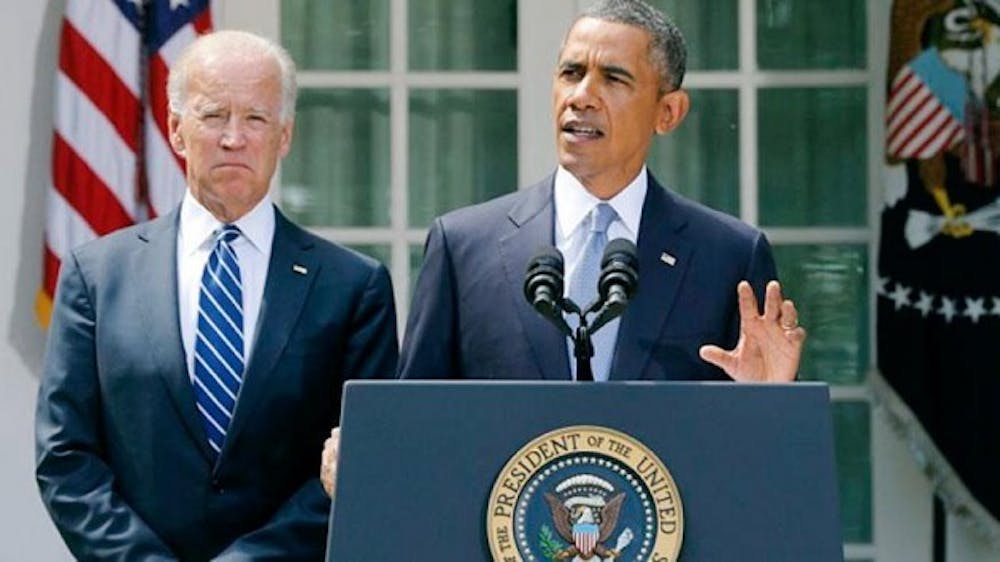
On Saturday, President Barack Obama announced he is seeking congressional authorization to take military action in punitive strikes against the Syrian government for alleged use of chemical weapons.
In his speech, Obama laid out that the United States has a "moral responsibility to respond forcefully" to the situation. A decision will be reached when Congress reviews the matter upon its return from recess on Sept. 9. Americans, including the UB community, are debating the decision and its implications.
James Ingram, a junior political science major and former communication director of the College Republicans, believes the president acknowledging the legislative branch, even though he does not have to, is an important aspect of democracy.
"I think as an American, as a citizen, I always think it's great when the president passes down an important decision like this to Congress," Ingram said. "We elect our Congress. It takes it down into more of a localized fashion. I feel like the people get more of a say versus just one executive."
Michael Calliste, a junior economics and political science major and member of the College Democrats, agrees with Ingram and finds Obama's call on Congress "impressive."
Calliste believes the issue is important not only because of its impact on the United States but also because of the debated moral obligation that comes with it.
"Despite Congress' inability to pass major laws, I think that going to them with a humanitarian issue of this magnitude - representatives of the states - is always the best matter," Calliste said.
With just a few days before the House and Senate reconvene, there are many questions that need to be answered about the potential effects of a military intervention.
In April 2011, peaceful protests challenged the leadership of Syria. Reports indicated that the government responded to the protestors by kidnapping, raping, torturing and killing activists - including children. There were also reports of dumping and leaving mutated bodies at the side of the road.
Civilians took matters into their own hands, arming themselves and organizing rebel groups.
Over the last two years, these events have escalated quickly. The death toll has reached over 100,000 and the number of refugees over 2 million, according to The Portland Press Herald.
With tension running high in the Middle East, international attention has shifted toward the United States and whether it will intervene in the ongoing crisis.
On Aug. 21, the Syrian government allegedly unleashed sarin gas, a chemical agent, in Ghouta, an agricultural belt around the capital of Damascus. Over 1,400 people were murdered, including more than 426 children, according to a statement by Secretary of State John Kerry.
Some of America's long-time allies have expressed opposition.
British Prime Minister David Cameron supports Obama's decision; the British Parliament, however, voted against providing military aid.
Phillip Arena, an assistant professor of international politics, said the United Kingdom's ruling might have a big impact on the United States' decision. He said some Americans fear the Syrian situation could be another potential Iraq.
"A lot of people would say it's just the specter of Iraq - after having fought a war against a country that we believed was stockpiling weapons and clearly wasn't," Arena said. "Although there's not much dispute that there actually are chemical weapons in Syria, it's not all clear that they're a threat to the [United States] and [United Kingdom]."
Ingram believes the United States has embraced the role of a civil protector in the world. He thinks the moral implications of the Syrian conflict may fall into this title.
"It's just the fact of the matter that we really, over time, have become the [country] that is going to step in when we have evidence of human rights violations," Ingram said. "People turn to the [United States] for help. And that's just the role we've kind of taken over in our history and I guess that's where we kind of are now. All eyes are kind of on us."
House leaders have debated whether it's a good idea for the United States to get involved. There has also been support for more drastic measures than the president has proposed.
Senator John McCain and Senator Lindsey Graham are in favor of wider military strikes and would like a broader, extensive effort to end the 2-year-old civil war.
Members of both parties have expressed that action must be taken to limit the capabilities of President Bashar al-Assad.
Calliste said the question of whether to intervene does not have an easy answer. He said there are a lot of factors to consider with such a major decision.
Russia and China have vocalized opposition to taking collective action in their roles in the United Nations Security Council.
"I'm still unsure myself, but I do know that the [United States] can't let chemical weapons be used freely in international conflict," Calliste said. "It's against the law and the way the [United Nations] Security Council is right now, currently. It means we can't intervene freely because of the Russian president and Chinese president vote on the council."
In the meantime, President Obama awaits Congress' decision.
Until then, the president hopes for less resistance from Congress than he has seen in the past to carry out his agenda. He has expressed confidence that they will cooperate on the issue.
Obama will take a three-day trip overseas to Russia and Sweden before returning to meet with Congress next week Monday.Email: news@ubspectrum.com



