
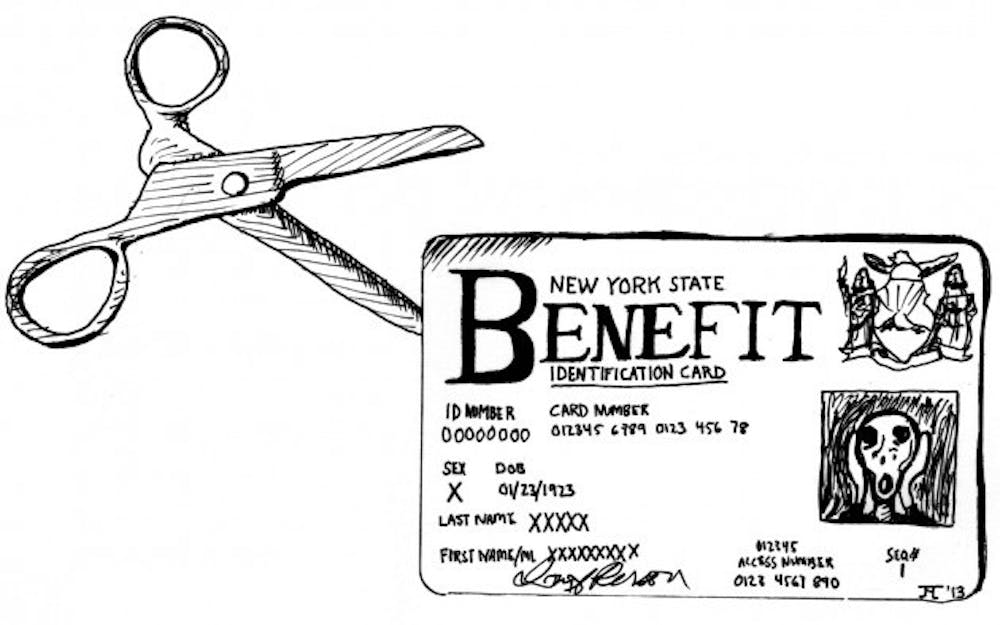
Last week, House Republicans passed a bill slashing billions of dollars from the food stamp program, showing a complete disregard for those who need help - especially in times of widespread economic hardship.
Despite opposition from Democrats and a veto threat from President Obama, they moved forward to narrowly push a vote of 217-210. If the bill were to get signed into law, it would throw 3.8 million Americans out of the Supplemental Nutrition Assistance Program (SNAP), according to The New York Times. Of course, the bill won't pass the Senate and will never even reach the president's desk, but the gesture is a plain and simple insult to the poor.
As recent data released by the Census Bureau reveals that there are currently 47 million people living in poverty (nearly the highest level in two decades), we find the timing of this effort exceptionally perplexing. This most recent bill is a bleak and profound example of misplaced priorities in Washington.
These misplaced priorities come out of a misleading rationale that some Republicans have been arguing for years. The rationale that safety-net programs - such as food stamps - foster beneficiaries to become dependent on them, and thus, hinder social mobility.
We find this line of reasoning deeply troubling. It is preposterous to believe that by making those already on the brink of the economic strata poorer and more desperate, you are somehow helping them help themselves - that you are doing poor people a favor by cutting the few assistance programs they have.
Republicans who contend that inflicting cuts on SNAP is a way to help people living in poverty are operating under an invalid argument.
It is built on the premise that those who receive these benefits choose these safety nets, and in consequence prefer them to choosing to work. As Paul Ryan derisively called the safety net: "a hammock that lulls able-bodied people into lives of dependency and complacency."
Ryan ignores several statistical realities in his assessment. Nearly two-thirds of SNAP beneficiaries are disabled, elderly or children. And 85 percent of Medicaid spending goes to the disabled, elderly or children, as well, according to the Congressional Budget Office (CBO).
The CBO also projects that economic improvement would coincide with fewer beneficiaries on food stamps. With more jobs available, more people are able to find work. The size of SNAP depends on the size of the economy, and it is virtually understood amongst economists that the increase in beneficiaries over the last five years has been caused by the recession.
And what cannot be ignored is the number of people safety-net programs have helped during a prolonged period of economic distress. The recent data released from the census shows that safety-net programs helped lift 18 million Americans out of poverty in 2011.
In fact, it also says that 9.4 percent of the nation would have been in deeper poverty without Medicaid and food stamps, and that these assistance programs reduced that rate to 5.2 percent.
So, the argument of those pushing to cut food stamps just doesn't line up with the facts. They have no justification for inflicting these steep cuts that ignore those who are most vulnerable.
Email: editorial@ubspectrum.com
 Photo: The Spectrum Archives


