
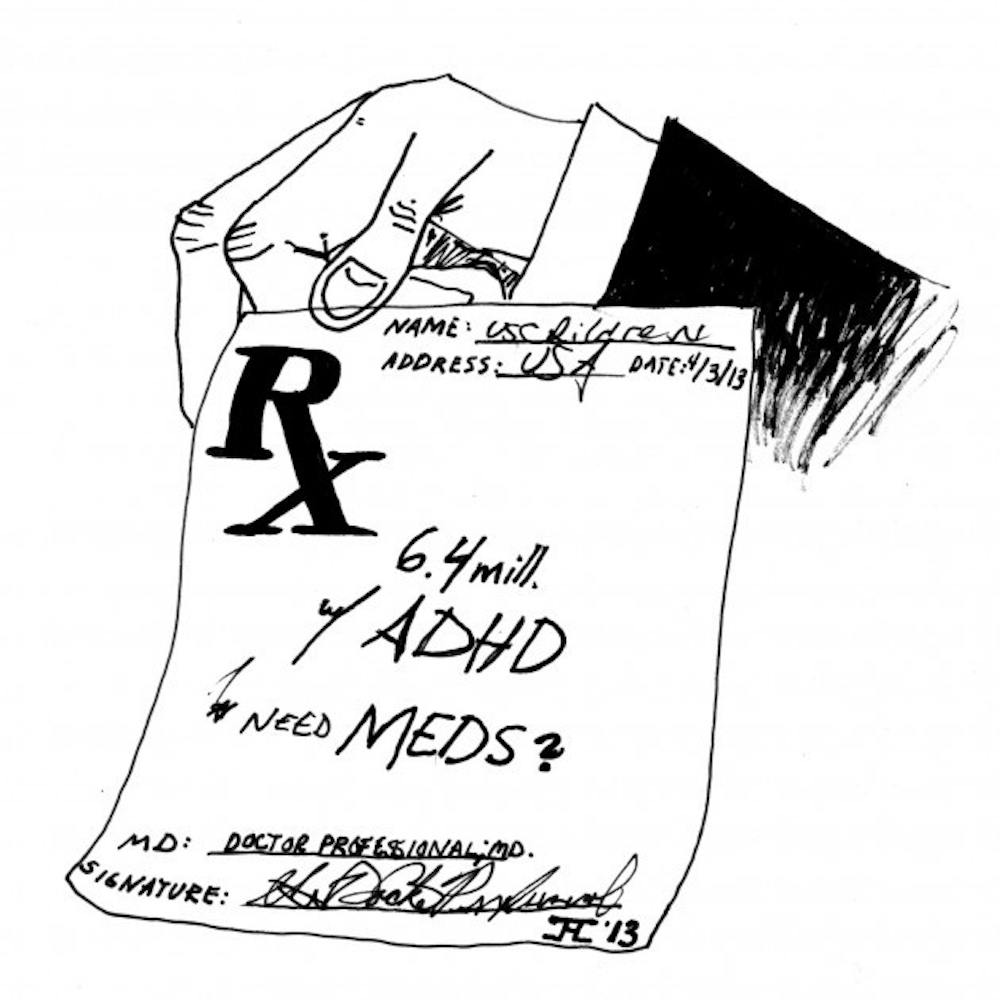
Recent data released from the Center for Disease Control and Protection has revealed that 11 percent of school-age children in the United States have been medically diagnosed with attention deficit hyperactivity disorder. Six-point-four million children between the ages of 4 and 17 have been diagnosed, marking a 16 percent increase since 2007. Many are subsequently prescribed stimulants such as Ritalin, Concerta or Adderall.
The question pervading the medical community in the wake of these statistics is whether the ADHD diagnosis and its medications are being issued too carelessly, too often.
Dr. William Graf, a pediatric neurologist and professor at Yale School of Medicine, told The New York Times: "Mild symptoms are being diagnosed so readily, which goes well beyond the disorder and beyond the zone of ambiguity to pure enhancement of children who are otherwise healthy."
It wasn't so long ago that many parents feared there was a stigma attached to their child receiving a diagnosis. Some may recall an episode of the popular HBO television series The Sopranos in which Tony and Carmela experience immediate pangs of anxiety and trepidation upon a school administrator informing them their son may suffer from the condition.
Those kind feelings have largely receded from the culture.
'ADD' and 'ADHD' are terms that have now been inserted into modern American idiomatic language - as both nouns and verbs. While changes in attitude have occurred during the last decade, many wonder if the heightened prevalence of the condition's diagnosis reflects too casual a process doctors are taking for identifying it in their patients or if the condition is in fact more common than many initially thought.
While it is difficult to determine the veracity of either of these claims with any certainty, it seems plausible to state certain factors in culture have impacted our collective ability to pay attention.
The speed at which life operates in post-industrial America, where technology is utterly ubiquitous and the culture is largely media saturated, children growing up today are constantly overloaded with perpetual stimuli. An adolescent who grows up playing his Game Boy while watching TV and surfing the Internet will no doubt develop a dependency on being interminably entertained.
Parents should make it a serious priority to try to avert their children from this kind of formation. Children should have structure that instills in them a sense of nourishment and fulfillment from activities that provide satisfaction later down the road, like the kind that comes from reading a difficult novel or even doing homework. Children should be debunked of any notions that you should obey all your impulses and gratify all your desires. Because the truth that adults learn down the line is that kind of behavior does not result in happiness.
As college students, soon to be the preceding generation, we should inform our output with that intellect. We should think about what kind of impression we incorporate into the culture.
As much as these trends in society do not help cultivate a more productive general public, it should not desensitize us to the seriousness of a condition that many struggle with daily. The way in which culture hinders the public's collective capacity to control one's attention is unrelated to those whose biology generates symptoms of ADD/ADHD.
The focus should be on parents and doctors. Parents should be more active in trying to help their children develop ways to direct their focus and attention, while doctors should maintain a closer observation of their patients.
Many children step into a doctor's office once, for anywhere from 15 minutes to an hour, receive a diagnosis and a prescription and then proceed without the proper amount of extended medical attention. A continued exchange between doctors and child patients can help properly identify whether these rising statistics are a result of overuse.
In the meantime, we should pay attention to the way we contribute to the culture if we want to affect the way the next generation participates in it.
Email: editorial@ubspectrum.com
 Photo: The Spectrum Archives


