
"You're in charge of your own safety."
That's one of the main points on UB's Off-Campus Student services page and the highlight of the last few weeks of our nearly one-sided conversation.
In other words, as Vice President for University Life and Services Dennis Black so encouragingly puts it, "We're not in the protection business."
Several articles, editorials and interviews later, The Spectrum's question remains the same: Should UB take responsibility for the University Heights? And so does the answer:
Yes.
The higher-ups clearly disagree, but if UB shouldn't take responsibility and the Heights aren't really a problem, then why have our inboxes been flooded with messages that say otherwise?
So to help them out and save them yet another public relations strategy meeting, here are five things The Spectrum feels could - no, need to - be done on the topic of the Heights.
1. Acknowledge there is a problem
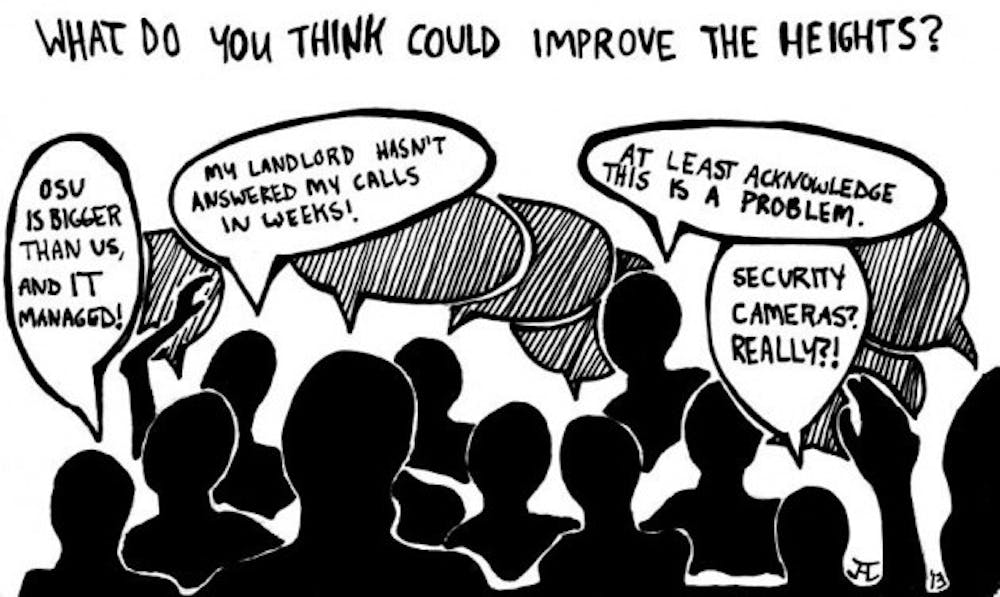
When we asked President Satish Tripathi last week to respond to the aforementioned question, hisanswer was one of little substance. Despite all the underlined and accented implications of unit, there is nothing in its contents that instills confidence in UB's students - off campus or on - that they will be safe. No promises, no suggestions - just, as one commenter said, "a lot of pretty words." And that unity only exists in writing. Otherwise, we would not be having this conversation. There would be no talking of rising crime rates or of South Campus falling behind North Campus if we were all in this together.
Consider this UB's intervention. The first step is admitting you have a problem. It takes credit for the good and pushes the bad into the "deal with later" pile. Except it never actually gets dealt with. Not once have the students heard anything that resembles responsibility, nor do they feel like the university is even interested in what they have to say. Instead, it finds the easiest possible way out of the situation: blame games and carefully worded letters that say "we'll take care of it, don't worry about it" rather than "this is what we're going to do to take care of it."
Because of that, the student residents get the blame for what is done and not done in the neighborhood. Part of UB's plan for safety is to help students realize what they're doing wrong. They're told to keep their porch lights on and be hospitable and warm to their neighbors and are given brochures on how to be a better person. They're told if they don't feel safe in the Heights but need a cheap option, they should go live in other neighborhoods like Allentown, even if accessibility and transportation is not available to them. They're told the Heights aren't that bad by people who are only there for a couple of hours on the weekend. What they're not told is how the school will help them if they need it.
"The problem is that nobody takes ownership for the students in the University Heights. The university doesn't, the community does to some extent, as long as they're well-behaving," said Fred Brace, University District Housing Court liaison and Heights resident of 25 years. "For some, it's a priority for the police because they consider it to be just kids acting up and they're stupid walking around at 1 o'clock in the morning. You blame the victim is what it basically boils down to."
UB even blames the students on its University Heights FAQ, citing vandalism and other "nuisance crimes" and referring to more serious incidents as rare - if your definition of rare equates to over 500 crimes of homicide, assault, rape, larceny, robbery, burglary and vehicle theft recorded last year. And Black told The Spectrum he thinks most crimes in the Heights are student-on-student, which is just untrue.
2. Own up to its size
In case you haven't noticed during your morning cram into a Stampede bus to the Student Union, UB is not a small school. However, it's noticeable by their actions - or lack thereof - our higher-ups believe the opposite. The Heights FAQ addresses this when mentioning why it doesn't buy properties in the Heights: "UB simply doesn't possess the resources needed to purchase large numbers of private residences and then provide the services required for this type of student housing."
Most likely untrue, especially when we're paying our president more than we've spent on the Heights. UB has spent approximately $150,000 in the Heights on things like security cameras, doorhangers and police patrols on peak weekends. University of Pennsylvania, a slightly smaller school but with admittedly bigger pockets, has spent $185.7 million on its off-campus residences. Canisius has also made efforts in its surrounding neighborhoods.
Unfortunately for UB, nobody believes for a second that this is too big of a deal for it to handle, especially when it's shoveling students' money into expansion programs and upgrades elsewhere.
3. Give University Police joint jurisdiction in the Heights
In warmer months, the Buffalo Police Department and University Police Department share a joint bike patrol on Main Street. But it's Buffalo, so do the math on how long that actually is. The only other times the departments share jurisdiction is during the first few weeks of the academic year and on Halloween weekend.
Besides that ... well, good luck.
Instead of the security cameras installed that UB seems to be obsessed with talking about (which only help long after an incident, if someone can even make out the blurry image on the tape), it is essential that UPD be given joint jurisdiction in the Heights.
We've already mentioned a couple of major moves by other universities. Ohio State University agreed on joint jurisdiction with the City of Columbus and has seen a crime rate decrease of 5 percent. But because one of UB's many excuses for this and for Heights housing is that it's a state school, it's fair to compare us to New York's other state schools, especially the other SUNY university centers - Albany, Binghamton and Stony Brook.
In Albany, the university works with the city, other local colleges and neighborhood associations on the issue of student safety and does not endorse or recommend any areas off campus as UB does with the Heights. While Albany City Police and East Greenbush Police have main jurisdiction in off-campus residences, the school has multiple safety programs in its Pine Hills neighborhood, where many off-campus residents live.
In 2011, the Binghamton Police Department put the Police & Neighborhood Partnership for a Safer Binghamton in place. Police and city leaders meet on a monthly basis with different underrepresented communities, including students in local institutions living off campus, to figure out what needs to be improved upon.
The only one of the centers that doesn't make up the difference is Stony Brook. Like UB, it doesn't operate or sanction any off-campus student housing or organization facilities, nor does it share any kind of jurisdiction. However, Stony Brook also has a B grade on CollegeProwler's Health and Safety rankings, a D- on American School Search's Crime and Safety rankings and a walkway by campus apartments many students refer to as the "rape trail."
If the problem is politics - which we fear it is - between BPD and UPD and students are suffering as a result, then that's unacceptable, especially as crime rates increase and more students begin to feel unsafe. This is a state university, the crown jewel of the SUNY system and a large school with plenty of opportunities to be funded. All it will take is a level head and some actual conversation.
4. Help international students
There are 5,500-plus international students at UB. Tripathi has made it part of his mission to increase that number. John Wood, senior associate vice provost for international education, told The Spectrum many, if not most, of them live in the Heights. And why shouldn't they? It's cheap, right off South Campus and has "university" in the name. How bad could it be?
Pretty bad, as they find out rather quickly.
It's not until these international students get to orientation that they find out the Heights could be "potentially" dangerous and are told to be careful renting homes. By then, they've already found the listings on Sub-Board, Inc., and signed the leases, only to be left to figure out on their own that their houses' conditions are deplorable or their street isn't safe mid-afternoon, let alone late at night, or their landlord doesn't even live in Buffalo.
This is not a difficult situation to fix; it's just one you have to be willing to fix. Don't leave it up to orientation brochures. Make more available to students (all students) once they're accepted and they begin looking for housing options.
5. Buy the houses in the Heights.
Better yet, how about if UB just purchases houses in the Heights for students?
Eighty-two percent of 760 students polled felt UB should do more to improve living conditions for students in the Heights. Those conditions include over 750 violations to landlords in the past two years, including - but definitely not limited to - nonexistent carbon monoxide detectors, collapsing ceilings, bed bugs and inadequate plumbing.
Off-Campus Student Services Director Dan Ryan and Buffalo building inspectors started doing housing blitzes in 2011 to see if homes are up to code, but as Brace puts it, Ryan is just one man doing "a job for Jesus," especially as the conditions are coupled with negligent landlords and the fact that only houses that are actually registered are inspected.
Instead of relying on a single representative to do the job of the entire university, UB has an option in which it needs to invest: Buy houses in the Heights for student use. Both UPenn (which partnered with local businesses to buy homes in University City) and Canisius College (which has since stopped buying houses but makes up for it by meeting with and monitoring landlords) have done this.
We understand the benefits of not doing anything. UB is profiting off of those who decide to stay on campus rather than spend their money elsewhere. These are the students who buy from campus dining services and pour their tuition into residence halls. These are the people UB cares about. But it would also profit from buying homes in the Heights because it would get back the money the landlords are making by taking advantage of the school's students - hundreds of thousands of dollars.
In conclusion
Nobody seems to understand that students living in the Heights aren't looking for lavish homes and gated communities; they're looking for the bare essentials. Safety and shelter are not the outlandish requests UB is making them out to be. They are necessities, not luxuries, and all entirely obtainable.
Email: editorial@ubspectrum.com



