
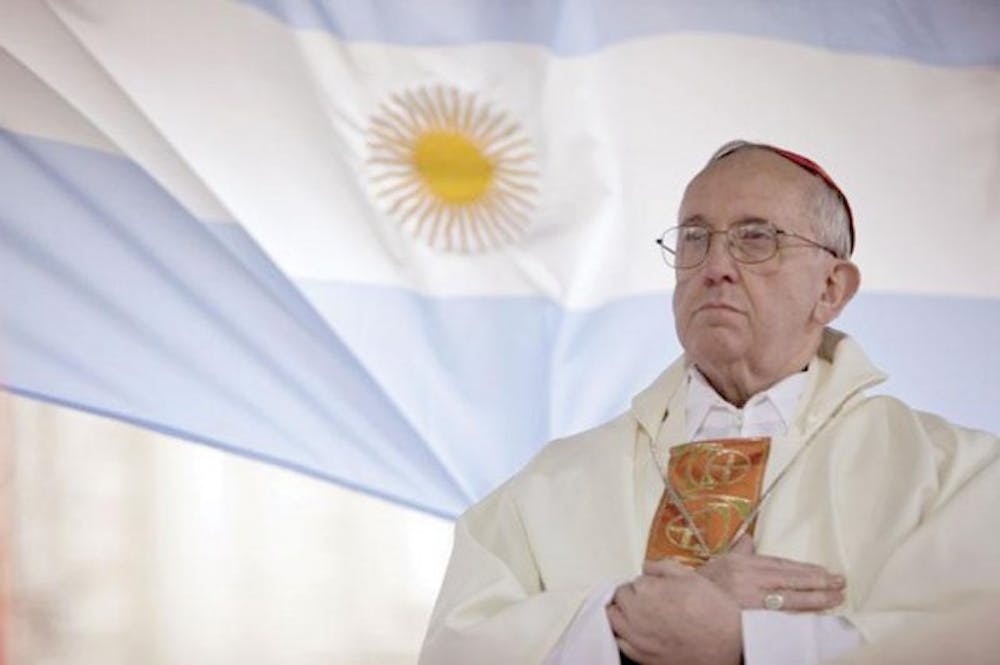
A month after a pope resigned for the first time in over 600 years, Jorge Mario Bergoglio took his place. He is the first pope in the history of the Catholic Church to come from South America.
On March 13, as a puff of white smoke emerged from the chimney of the Sistine Chapel, members of the UB community experienced a diverse array of responses as Catholic cardinals selected a new pope to lead the church during challenging times.
The Argentina native will be called Francis. He chose his name in honor of St. Francis of Assisi, one of the most revered religious figures in history, noted for his acts of charity and embrace of those living in poverty.
Father Patrick Keleher, director of the Newman Center at UB: Catholic Campus Ministry, expressed a desire for the new pope to "change the melody, but not the words."
He also stated he was pleased to see the Cardinals pick someone from Latin America and that, at age 76, Pope Francis is both old enough to have the wisdom for the papacy and young enough to have the ambition to change the trajectory of the church.
"I think he will be less discriminating," Keleher said. "Let's hope he's more welcoming."
But Jamie Gugino, a junior English and psychology major, doesn't really see how the pope could "make a significant change with what is going on today in this world."
Gugino, a native of Buffalo, grew up as a Roman Catholic and attended parochial school but later in life decided she wanted to look elsewhere for religious and spiritual guidance.
"When I was 19 or 20 years old, I tried to study all the religions so that I could pick something," she said. "I went to Catholic school my whole life, but when I was done, I picked a religion, or tried to. I thought Buddhism and Taoism were probably the closest to what I think."
Gugino feels the Catholic Church is not a cohesive enough institution to make a substantial impact on current affairs and the role of the pope is largely irrelevant in the modern world.
"I think between all the conspiracy theories and things [that] have been going on, that religions are kind of falling apart all over the world," Gugino said. "I think that people are questioning what is real and what's going on, and I think that a pope is unnecessary. Just like I think that a president is unnecessary. I don't think we need someone like that to represent the people. I think that's kind of stupid."
Gugino said with all the problems the church is currently facing, including a shortage of priests, a sexual abuse crisis and a growing animosity from those who support abortion rights and same-sex marriage, the new pope will need to lead the church in a new direction.
Christian Andzel, president of UB Students for Life, an anti-abortion club on campus, would like to see Pope Francis proclaim a contemporary vision for the church that leads it in a direction to help the poor and unify the church. He doesn't think it should stray from conservative values.
"He has shown in the past that he will help the poor," Andzel said. "I think this is important because those who are conservative are painted as 'anti-poor,' and I think if there is a strong clerical message that says: 'We will help the poor,' and if we are going to walk the walk, that would be really important and I really want to see that."
Andzel said the pope's influence is "insurmountable" and the new pope should instigate an effort of instructing priests to go out in their communities more often, encouraging members of the church to "help out with food drives, housing for the poor and city missions."
Along with the difficulties of governing the Vatican itself, the new pope will have to decide how he wants to manage his presence in a society where technology is becoming more and more ubiquitous.
His predecessor, Pope Benedict XVI, embraced the growing trends within a media-saturated culture by activating a Twitter account.
Andzel feels the pope should sustain a public presence but would prefer Pope Francis retain the sacred and mysterious quality of the papacy by being more traditional and abstaining from online social networking services.
"I think the pope needs to be more visible," Andzel said. "He should be out in public, with the cameras on him, doing good work."
Keleher said he doesn't expect the pope to "come out and say it's all right to have same-sex marriages or abortions," but he thinks the pope will help the church adopt an attitude of an inclusion.
"I was moved to see that he blessed the feet of those AIDS patients," Keleher said. "We need that kind of compassion, and it has always been a part of the church doctrines."
He noted while the pope's job is "to traditionally be conservative," Pope Francis will be able to reach his heart out to those who feel marginalized. Keleher wouldn't be surprised if the pope calls an ecumenical council, a group of bishops who meet and discuss Catholic matters, the way Pope John XXIII did in 1962.
While Gugino finds the pope's role extraneous to modern society, Andzel and Keleher have hopes he will make important impacts.
In the meantime, Catholics await how Pope Francis will proceed as the leader of a worldwide church.
Email: news@ubspectrum.com



