
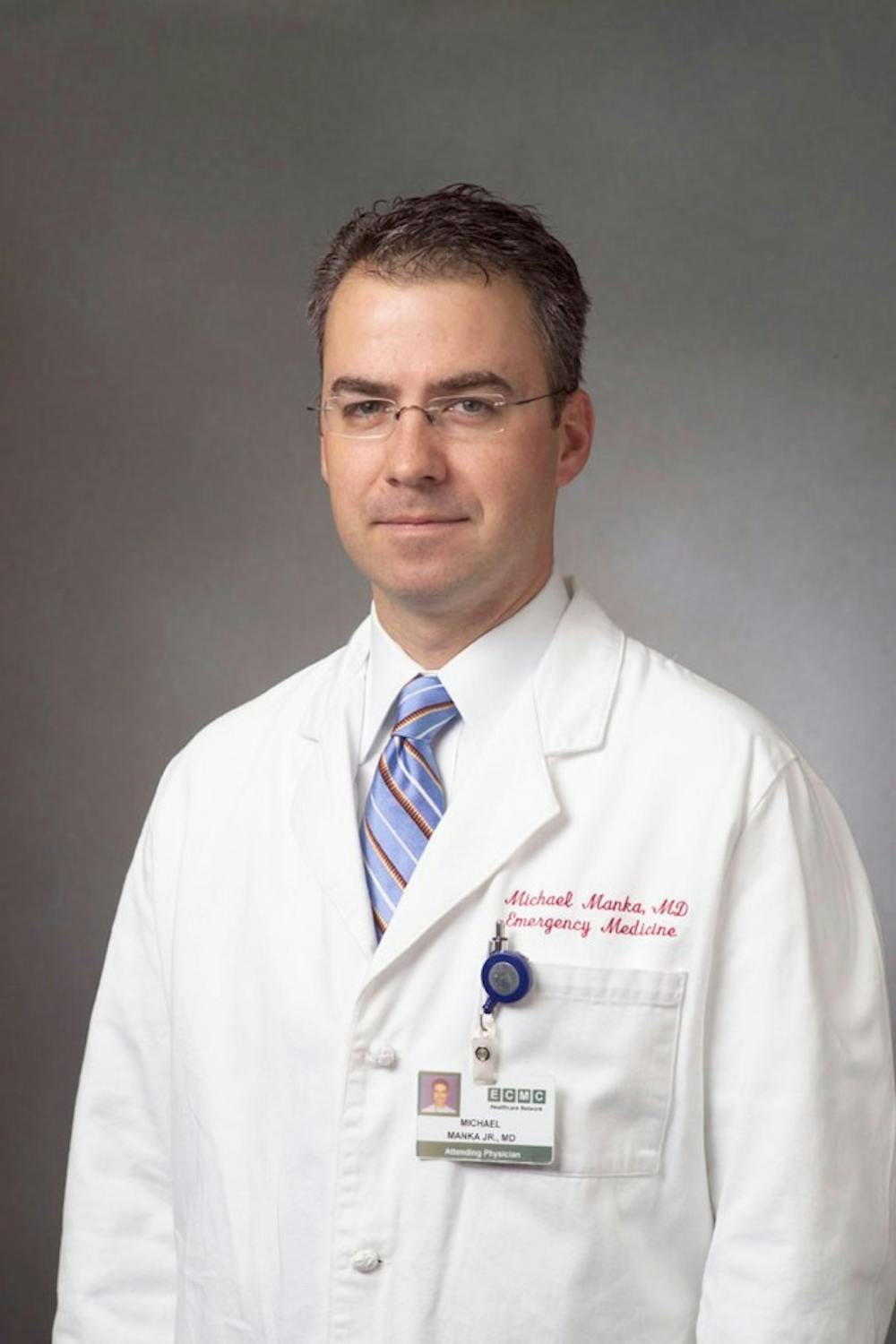
Earlier this week, a young woman with a 7-month-old child was in a car accident. She was rushed to Erie County Medical Center (ECMC), but her baby was taken elsewhere. The woman did not know the fate of her child, but Dr. Michael Manka did.
It was his job to deliver the bad news.
"Every day, every shift just about, there is a case of a patient who has some tragedy happen - whether it is a bad injury or being diagnosed with a bad illness," Manka said. "And I think what that does to you is it hardens you just a little bit to that side of medicine so that it becomes part of your day."
For Manka, the most important thing he does for patients is remembering - for them and their families - this is a traumatic day. The hardest part of his job is telling families a loved one has died.
Manka, 41, is the chief of Emergency Medicine at ECMC, where he has worked since graduating from the UB School of Medicine and Biomedical Sciences (SMBS)in 1996. He is also an assistant professor of clinical emergency medicine at SMBS.
Manka said his choice in specialty reflects his personality and skill set. He has a professional and to-the-point mentality, never wasting his words on what doesn't matter.
Although his job is not gratifying every day, certain parts of it remind Manka of why he is an emergency physician. He believes his position is crucial in saving lives of those who have been critically injured or ill.
"I think there are cases on a somewhat regular basis where being an emergency physician and being the first doctor to treat the patient with the condition can really have a huge impact on the patient's outcome," Manka said. "If someone is critically ill or critically injured, we play a huge role in helping them get through that illness or injury."
Despite his success in his profession, Manka said he questions his choice of specialty at times. The lack of primary care available for patients, one of the biggest issues within the medical system, puts a "remarkable burden" on emergency medicine departments, Manka said.
Manka said he particularly enjoys treating patients regardless of their socioeconomic background and was drawn to the wide range of people admitted to an emergency room.
"Our doors are open 24 hours a day, 365 days a year for anything that walks up to our department," Manka said. "For me, that was really the essence of what being a doctor was all about: being able to take care of anything a patient complained of and stabilize that problem."
However, there is a downside to working in emergency medicine. The ER accepts everyone who needs care, which leaves some people who cannot, or do not, receive primary care using the ER to get access to doctors - and Manka said that is what frustrates him most about working in the ER.
Though he didn't plan to leave his native Western New York permanently, he left to earn his undergraduate degree at the University of Michigan and graduated in 1992. He was then accepted to medical school as a sophomore through UB's Early Assurance Program (EAP).
His early acceptance allowed him to skip the MCATs and focus his time on classes that interested him. But the EAP was one of the reasons that Manka returned to Westen New York.
Manka was drawn to being around his friends and family who still lived in the area. He also liked the perks UB's medical school offers. Because UB has no university hospital, medical students do their rotations at hospitals like Millard Fillmore Suburban Hospital, Buffalo General Hospital and others around the area, which gave Manka access to experiences in a variety of different demographics.
After his first year of medical school, Manka was given the opportunity to do clinical research at ECMC. This was his first taste of emergency medicine. He was hooked.
UB gave Manka the opportunities he needed to be an emergency physician, which he said is the most important thing any school could do.
For the doctor, his career and life have come full circle. He returned to Western New York after spending his undergraduate years in Ann Arbor, Mich. He is helping people, just as he intended.
Email: news@ubspectrum.com



