
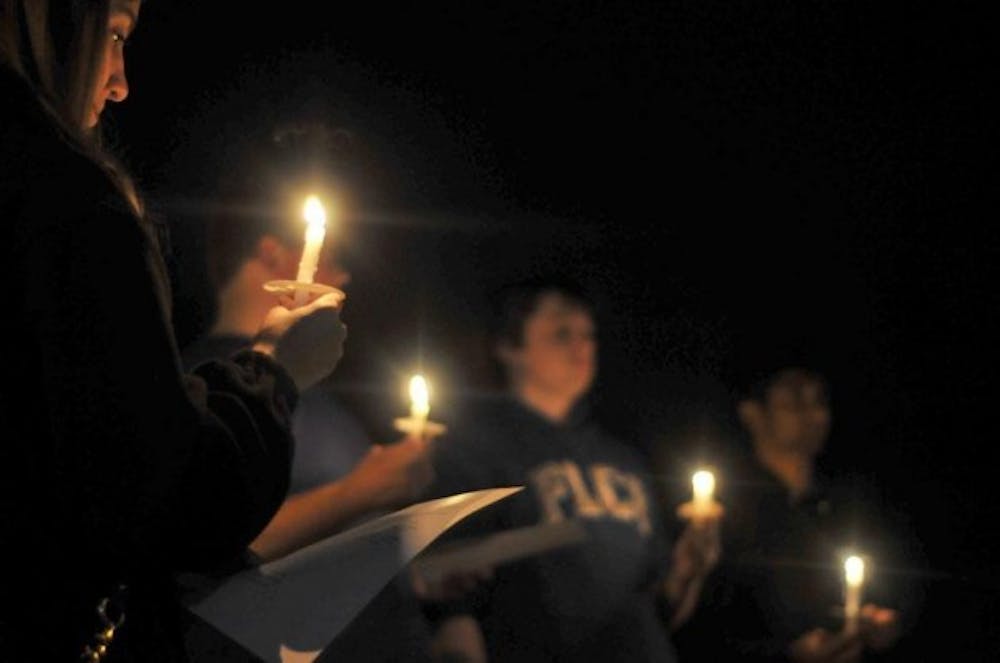
On Tuesday night, students gathered in the small clearing between Bell Hall and the Student Union; they assembled around small flags staked in the ground that read "USA" and "9/11."
Thirteen students stood in remembrance, sharing their memories and experiences from Sept. 11, 2001.
The candlelight vigil was hosted by the UB Conservatives to honor the tragedy's victims. But the way Americans choose to remember this tragedy is changing beyond memorial services, and professor Tyler Williams and his AMS 375: 9/11: Event & Memory class epitomizes the ongoing shift.
The class serves as a semester-long remembrance of one of the most difficult days in American history. It gives space for students to learn about Sept. 11 from the perspective of many different people.
"The point of this class is to study these narratives that attempt to give meaning to Sept. 11," Williams said. "But in order to do this, the class must refrain from instituting or endorsing its own system of memory."
Williams said in order to successfully study 9/11, individuals have to keep their minds open to all the ways the events affected people around the globe. He strives to make his students put aside their own experiences and view the tragedy from all possible perspectives.
Williams leads his small class in analyzing novels in the context of 9/11.
The class doesn't take place in a lecture hall of 300 students, but an intimate group of 8. The atmosphere allows for deep class discussion; Williams talks with students, rather than at them.
"The ways in which the events are remembered are constantly changing," Williams said. "By reading literature, it makes that change obvious."
Students in the class are exposed to elements of 9/11 they probably wouldn't have previously considered. Students from Buffalo, the New York City area and even the United Kingdom come together to discuss the tragic event within their Fillmore classroom.
"It takes away from a personal perspective and gives a well-rounded view," said sophomore business major Trevor Sokolowski. "We are trying to come to one singular meaning instead of thousands and thousands of people's personal opinions and meanings of it. We are trying to find one standard meaning of what we all can come to terms with for 9/11."
Sokolowksi's view on the class doesn't stand alone. Senior psychology major Jonathon Spiegel is from New York City and appreciates hearing the opinions of those who were not able to see the impacts of 9/11 firsthand.
"I've always wanted to know what people thought about 9/11 who weren't from New York City, and this allows me to get a different view of events," Spiegel said.
Jack Gaches, a junior American studies major and international student from the United Kingdom, brings a unique view to the class. In the United Kingdom, the coverage of 9/11 was romanticized, highlighting those most affected and not those indirectly affected, Gaches said.
Gaches didn't realize how much Sept. 11 affected "normal people," and the class is deepening his understanding of the tragedy.
The class serves to change the way that its students remember 9/11. Instead of "Never Forgetting," all those involved are challenging themselves to find how the events of 9/11 affected the world, not just individuals.
"We watched a documentary last week that really brought to term that all these pictures - that you see that are so romanticized - are actual people," said senior American studies major Ryan Mik. "That was a person's life that was ended that day, this was a person's life that was permanently changed that day and it just puts into perspective how many people had some part or their whole life changed that day."
By keeping an open mind to the events of Sept. 11 and how it has affected America and the world, Williams and his students are finding new ways to memorialize and remember the estimated 3,000 people who died 11 years ago.
Email: news@ubspectrum.com



