
Typically, professors don't play Frisbee with their students over the summer or host Christmas parties for them at their homes during winter break.
Piero Bianco is not a typical professor.
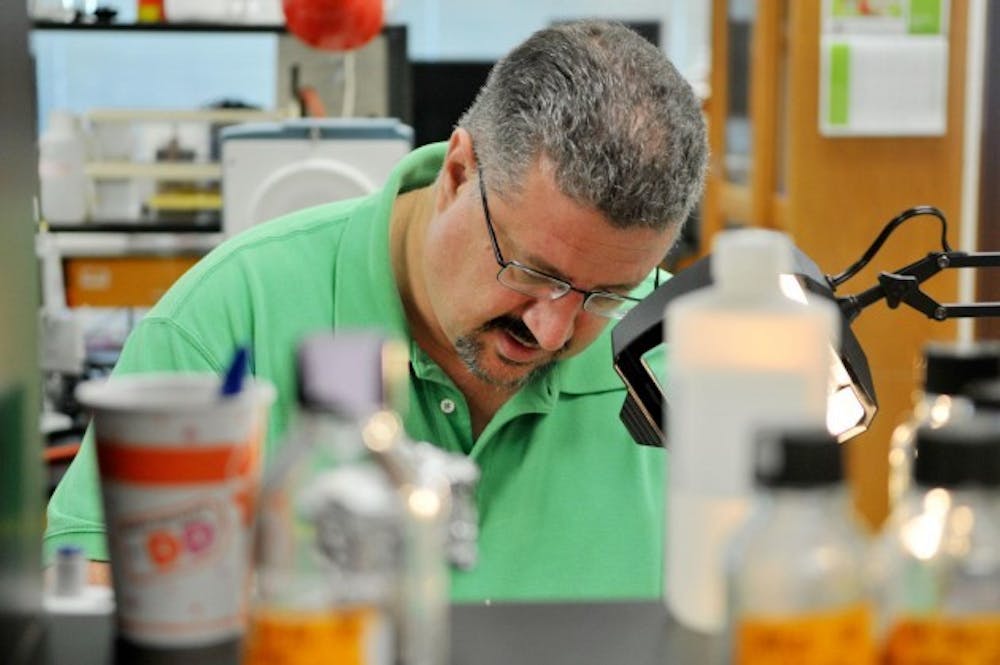
Bianco, an associate professor of microbiology and immunology with a lab in Cary Hall on South Campus, has a reputation for possessing an unfiltered enthusiasm for lab research and teaching. He's also known for being open to allowing undergraduate students to work in his research lab, a position ordinarily given to graduate students.
Bianco is close with his students; during summer sessions, he would take his students out of the classroom and into the field - a playfield, that is. While the weather was nice, on Friday afternoon, Bianco and his students would have lunch outside and play Frisbee. He called it "Frisbee Friday."
"It is important to have a good relationship with students," Bianco said. "Work and play need to be incorporated into a healthy environment."
Bianco also hosted a Christmas party at his house for the students who worked in his lab. To make sure the students without cars could attend, he picked them up from North Campus and then dropped them back off after the party was done.
"He really talks to you more like you're his friend than his student," said Shruti Phadke, a junior biotechnology major and one of Bianco's students. "It's really nice."
A South Africa native, Bianco moved to the United States by himself when he was 18. He entered the biology program at Abilene Christian University in Texas and later attended the University of Texas at Houston medical school.
"The first couple of weeks [in America] were wild because you feel like you're walking around in a movie because it's all you've seen of America," Bianco said. "The first song I heard on the radio was this Huey Lewis song, "I Want a New Drug" and I went, 'Wow! They sing about drugs on the radio here?' Then it sort of hits you where you are, that you're really far away from home and that next month or two are really hard, and then you get used to it."
He started teaching at UB in Oct. 2001 and is currently researching how protein helps repair damaged DNA. While others consider what he does a job, Bianco just considers it "having fun."
"One of my undergraduate students came to me [after the course was completed] and said to me, 'Why can't all the professors be like you? I've never seen anybody be so excited about what they're doing,'" Bianco said.
As an undergraduate biology student at Abilene, Bianco was inspired to enter microbiology by the encyclopedic knowledge of his professor, Clarke Stevens.
"He walked in every day, same routine," Bianco said. "He'd put the textbook down on the desk, close [it], and he would lecture without it. He had a story for every single bacteria and he would never even open that textbook."
Bianco's passion for his research is matched by his passion for teaching, especially on an individual level. He said he loves working with students one on one, seeing them work hard for days and then finally seeing that light bulb turn on in their brains.
He aims to accept undergraduate students to help him with his research.
"It's uncommon for undergraduates to be working in the lab here," said Christopher Cohan, a professor in the department of pathology and anatomical sciences. "He's willing to offer that opportunity to them. Working in a research lab provides an important part of [an undergraduate's] educational experience, and I think it hasn't been developed so well.
"Our faculty has not been so aware [lab research] is a popular thing with undergraduates. Using universities that are research based and have research labs as educational tools and opportunities for undergraduates, has really not been taken advantage of very much because the people that come in to do research in colleges and universities are the graduate students."
Bianco's contact with undergrads stems from working with the Center for Undergraduate Research and Creative Activities (CURCA), presenting his work to undergraduates in the biochemistry program, speaking in honors classes and news of his undergraduate-friendly lab spreading by word of mouth.
"Not only do they work hard but they have a lot of fun doing it," Bianco said. "I treat each one of my undergraduate students pretty much the way I would a graduate student. I work with them one on one but also give them the independence to make mistakes and learn from their mistakes."
In order for undergraduates to work in Bianco's lab they must agree to work there 20 hours per week for two semesters. If they are not committed, Bianco will not take them, he said.
The reward is more than worth the work, according to his students. Phadke discovered Bianco's lab when he spoke in her honors cell bio course. She worked with Bianco from fall 2011 through last summer. She said Bianco's teaching style alone justifies the amount of work.
"He really takes the time to make sure you understand the lab work, while most other professors have other research, which takes up their time," Phadke said. "As an undergraduate working in a lab it's really hard and [the experiments] don't always work ... [Bianco's tough] and he'll tell you if you messed up but he's also very encouraging and is always telling you to go back and look at something that happened."
"
Email: features@ubspetrum.com



