
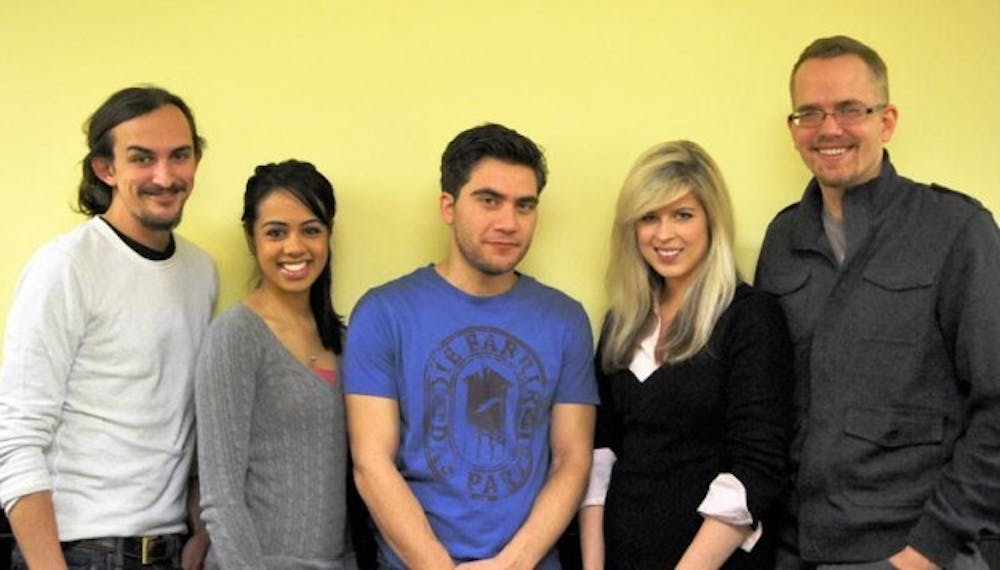
Thanks to a team of UB law students, many "major-minority" voters could now have a louder voice in the election process.
A group of first-year law students – Matthew Burrows, Andrew Dean, Jacob Drum, Nutan Sewdath, Lauren Skompinski, and Eric Tabache – competed in the 2012 New York Redistricting Project at Fordham University, a national competition that calls for teams to illustrate new congressional district maps, and they won.
The group separated itself in the competition by retaining communities throughout New York State and preserving districts based on socio-economic, cultural, and geographical characteristics; they were announced as the winners on Jan. 17.
"There was a lot of criteria that the competition organizers laid out that we had to follow," Dean said. "They were serious about it. The criteria were contiguity, compactness, compliance with the voting rights act, equal population (one man, one vote), maintaining political competiveness in the district, and statewide political proportionality."
With so many tasks to follow in the competition, the team had to compromise in order to create a successful plan. One of the elements the team struggled with was making sure that it kept people who shared the same interests together.
Team members explained that the most important factor was maintaining cultural communities – areas and regions with coherent cultural and political identities. One strategy was keeping people who read the same local newspaper in the same district, team members said.
The first-year law students were able to create their map using District Builder, a free program that allows citizens to create legal redistricting plans.
"We had to master the software and its overlays," Dean said.
District Builder provides population data for every political subdivision in New York State. It even provides subdivisions at the block level, and it can tell where large ethnic populations are located.
The highlight of the law students' project was the proposal of two majority Hispanic congressional districts in the Bronx and upper Manhattan. Their goal was to give ethnic minority voters a stronger tie in future election processes.
"At first I don't think we envisioned any kind of district," Skompinski said. "We played around with and got our foot in the door with the software, and once we got more comfortable with it, the districts followed in place. We were pleasantly surprised that we could get two major majority Hispanic districts out of it, and we were obviously happy with that and thought that was extremely important to keep."
Dean explained that the districts were not discovered in the past because of the now-larger Hispanic population.
"I think the reason we were able to do it this year and not 12 years ago was because in the Bronx, Hispanics share a lot of communities with African Americans," Dean said. "To get a community with a 51 percent or greater Hispanic voting age majority requires a number of population that I don't think was there 12 years ago. It could have been, but this year, demographically, their numbers had surged so much in the city that we were comfortable with expanding Hispanic representation in the congressional delegation."
The group is proud of its accomplishment, especially because it was done during the first semester of law school for the students.
"It just wasn't real to me," Tabache said. "Going to the conference, I didn't know how big it could get, and I am glad that we were able to represent the university."
The team's congressional map remains an idea at the moment, but the fact that it was locally and nationally recognized could possibly lead to implementation in the future. The team's initial intent was not to win awards or reach personal goals. The main point was to make a difference in the state of New York and to represent the UB community, as well as the law program.
"It just makes you realize that these prizes are out there for whoever makes a real attempt to achieve them," Dean said. "If you just work hard at something, you stand a good chance at succeeding."
Email: news@ubspectrum.com



