
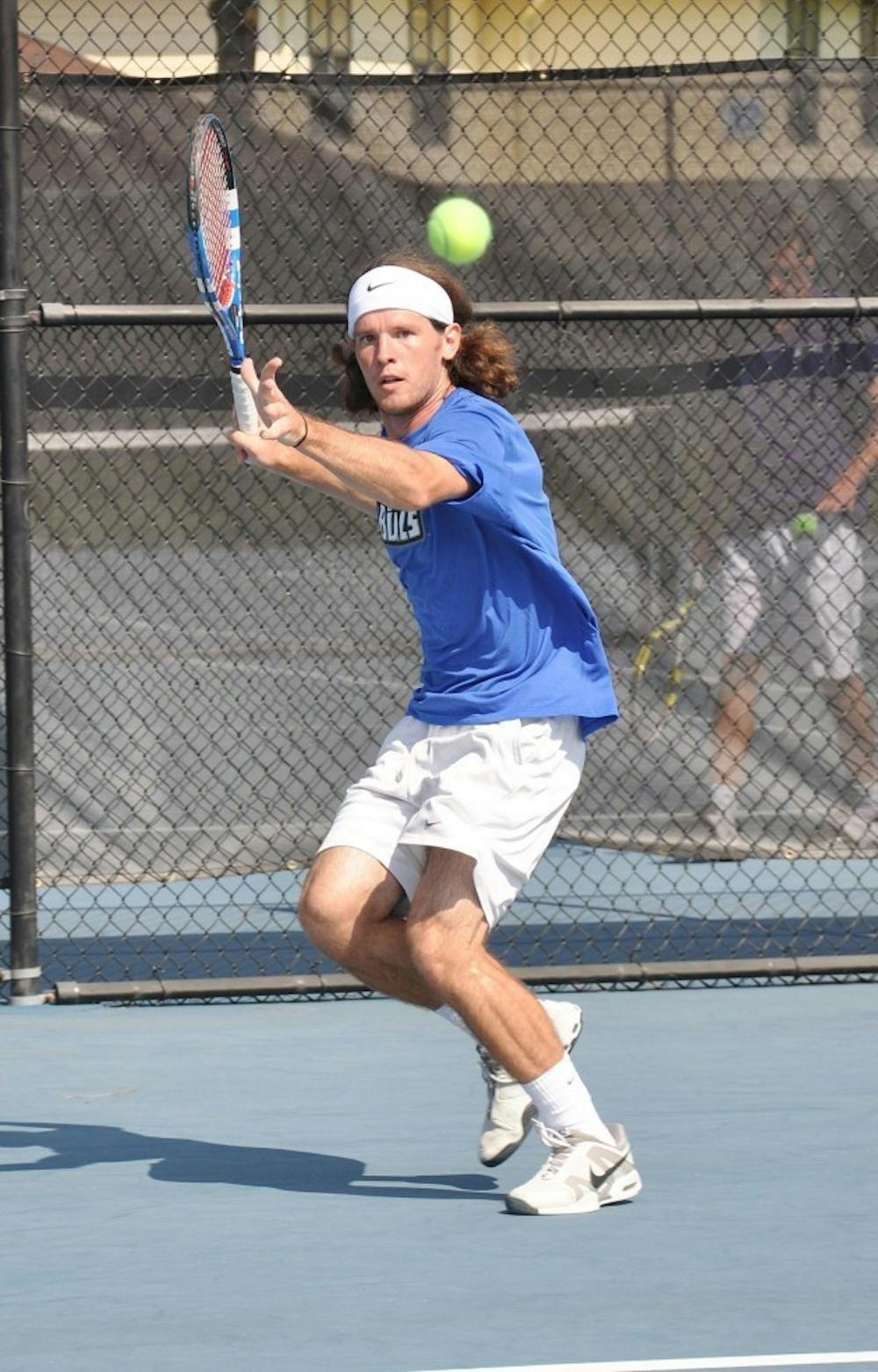
The men's tennis team finished with a disappointing 12-8 record last season; the squad considered itself a contender for the Mid-American Conference championship.
The Bulls have already won six individual titles at fall invitational tournaments this year, and they seek vengeance with a newfound fervor this season. However, there is more to this team than wins and losses.
This squad – comprised of six international players and four players from the U.S.– is a brotherhood.
Instead of focusing on what makes them different, the team has united through long road trips, never-ending hours of dedication, and tear-jerking losses.
"Coach [Jordie Kindervater] and I will lay the ground work for them and then they step up and keep each other accountable," said head coach Lee Nickell. "When we mess up, as we will, we pay the consequences and keep working at it, and these guys are good at accepting responsibility and they really do a good job."
Buffalo has historically hosted a majority of international students on its tennis team. Nickell wanted to have about half international and half domestic players, so last summer he looked up results online and watched videos of players from around the world.
Nickell even traveled to Europe to get a first-hand look at some international talent. Nickell feels he has a good fusion of international and domestic talent, and his belief is well deserved. He acquired two international freshmen in Canada's Damien David and Russia's Ivan Vereshchaga, and he also added Long Island native Jason Simon, who transferred from Oklahoma.
The international players are just as excited to be at Buffalo as their coach is to have them. They all had different motivations for leaving their home countries to play tennis in Buffalo. Vereshchaga believes Russian universities are more strenuous on students than in the United States, and he believes that he'll have a better chance of getting a degree in the United States.
"In Russia you have to be very smart to finish university. Here you just have to study and you will get a degree," Vereshchaga said. "But in Russia, it's not possible. I wouldn't be able to finish the Russian university, [or at least] a strong one."
Junior Vusa Hove won a national championship in Zimbabwe but left his home country to play tennis on a higher level. He felt that the best way to further his tennis career was to play collegiate tennis in the United States. Hove took it upon himself to seek out the coaches at Buffalo; he did the work himself.
Hove is majoring in pharmacology, and he's enormously excited for the opportunity he's been given by working in the science lab. He explained that there is a lot of equipment and knowledge he would not have experienced if he went to school in Zimbabwe.
Hove works hard on the court, too. He finished with a team-best 21 wins last year, and he was named to the all-MAC second team at the end of the season.
From time to time, however, the international players have problems adjusting to life in the United States. Practice, workouts and classes can be stressful for a local student to adjust to, but they're even harder when you are thousands of miles from home.
The international players use Skype, email and phone calls to stay in touch with their families and friends from home on a regular basis. But if they're ever having problems that these things cannot help with, they usually turn to older, experienced international players – like seniors Alex Kalinin, from Russia, and Wojciech Starakiewicz, from Poland.
In addition, the coaches and team advisors create a positive, supportive environment to help the newcomers adjust to life at Buffalo.
The players normally spend about 20 hours a week together between practice and workouts. Factor in eight more hours of mandatory study hall, and you'd figure the players would be sick of each other. Quite the contrary, the athletes also get together in their spare time to attend community events and have team dinners.
The long trips in a 10-person van create close quarters for the team. Players go around the van talking to one another, ensuring each player receives some razzing. Nickell believes that long trips make the experience more memorable for everyone.
"When you get past [the long drives], you look back on it fondly," Nickell said. "It's a grind for sure, but these guys make it fun with the conversations."
The international players must get a 79 on an English test to be accepted to Buffalo, so communication among teammates and coaches is outstanding. Everyone on the team is also careful to say things properly to ensure the international students are learning the language correctly.
Recruiting is risky because tennis can be seen as an individual sport. It is hard to tell a player's personality simply by looking at results or video of him on the court. Still, Buffalo has had success this year because the players have come together despite their cultural and personal differences.
"We've done a good job of recruiting characters…It's a good experience for our guys to go through, to have different cultures and different attitudes," Nickell said. "You watch them on the court, but off the court they could be totally different, totally goofy and we've experienced that."
With 10 diverse players come 10 very different personalities. The two players that stick out on the team as characters are Hove and Starakiewicz. The two bring a lighter approach to the game, which helps their team relax during the matches. Hove has been given the title of "comedian" by his teammates, and he embraces it. However, he said that his favorite person to watch on the court is Starakiewicz.
"He's a very eccentric player. Just the way he carries himself," Hove said. "He's a very crafty player and he adds a level of humor to the game."
Regardless of a player's personality, Nickell has made it clear that he will not accept unprofessional behavior from the players. He says his players do an incredible job of controlling their emotions during competition.
The coaches have very high expectations for the players, but the players have even higher expectations for themselves. The amount of time the players spend together allows them to be open with each other to ensure that everybody reaches their full potential both on and off the court.
While comparing his team's chemistry to that of other teams, sophomore Nick Sarles says there's only one proper way to describe his squad: "a family."
With the way the players selflessly thrive on all their differences and idiosyncrasies, ensuring every member succeeds, there's no other way to describe the 2011 men's tennis team.
Email: sports@ubspectrum.com


 Photo: Paul Hokanson/UB Athletics
