
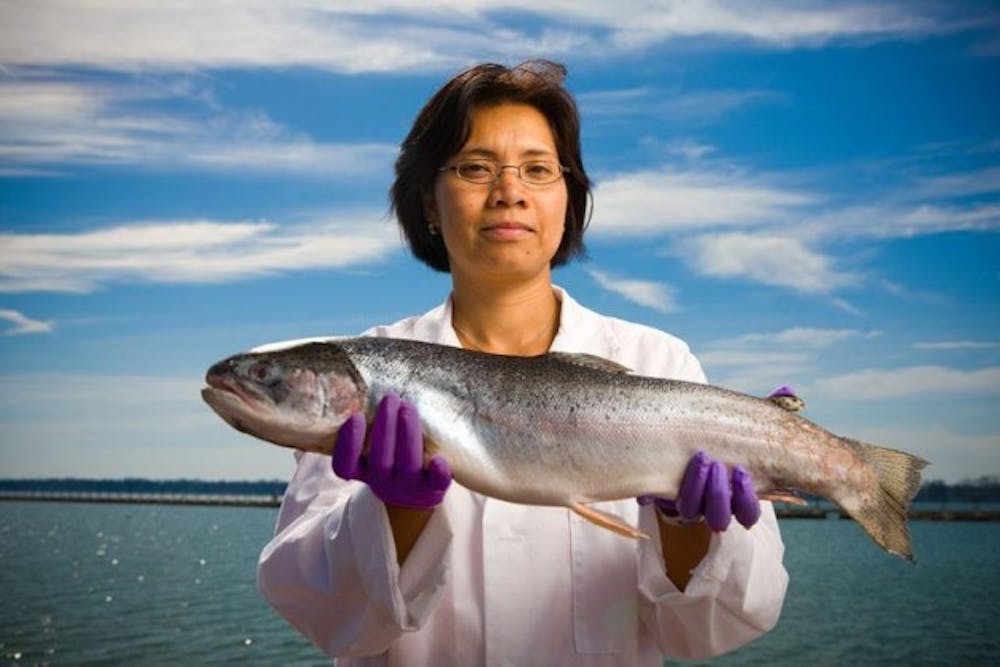
When the warm months come around in Buffalo, many students take to the outdoors to enjoy the temperate weather while it lasts. For some, the thawing of lake ice offers an opportunity to break out their rods and tackle boxes to go fishing.
However, a recently released study may cause some anglers to think twice before taking home their stringer of caught fish for a meal.
In a report published in September 2010 in Chemosphere, an international peer-review scientific journal, University at Buffalo chemistry professor Diana Aga, along with several colleagues from both Western New York and Canada, released the results of a study she conducted in Lake Erie.
The team tested a sample of carp caught along the eastern shore of Lake Erie against a control sample of carp taken from two nearby lakes. The report showed that the carp from Lake Erie contained high levels of two organic compounds – polychlorinated biphenyls (PCBs) and polybrominated diphenyl ethers (PBDEs) – while the carp from the other lakes contained no trace of the chemicals at all.
PCBs were common chemicals used in many adhesives, paints, plastics, and flame retardants until their banning in the late 1970s. PBDEs were then introduced, and while some varieties have been outlawed, many are still in use in personal computers due to their ability to last a long time. Alicia Perez-Fuentetaja, biology professor, member of the Great Lakes Center at Buffalo State College, and project director for the study, discusses the detrimental effects of PCB and PBDE on humans if absorbed from eating contaminated species.
"It is a serious health hazard and it can develop issues in the nervous and endocrine systems for… all children and adults." Perez-Fuentetaja said,
With the published results of this study of carp, Perez-Fuentetaja, Aga, and their colleagues recently launched a second and more expansive study, looking at the Lake Erie food web to see how the concentrations of these chemicals become more and more toxic as one travels up the food chain.
Perez-Fuentetaja explained that this new study will examine various kinds of fish, from plankton to the sportfish of Lake Erie, such as bass, trout, steel head, and walleye – which are often consumed by humans. Aga pointed out that although the study is still underway, preliminary testing and results reveal a directly proportional relationship in the chemical concentration as one travels up the food web.
The procedure for testing these animals took the research team nearly two years of development to create. Aga explains that the process involves grinding the species down into chunks and then using a process called accelerated solvent extraction to create a concentrated solution of the animal contents.
This solution is then concentrated once again before being placed into a gas chromatography mass spectrometer (GCMS), which provides a readout that breaks down the contents of the sample into different chemicals. From this readout, Aga and her colleagues are able to determine how much of the hazardous chemical the fish contains.
Bruce McCombe, the dean of the College of Arts and Sciences, helped to speed up these studies by issuing a grant in April 2010 that allowed for the purchase of a state-of-the-art GCMS that is sensitive enough to detect even the smallest concentrations of these chemicals in some samples. Prior to this grant, samples had to be sent to the Environment Canada labs in Burlington, Ontario in order to be analyzed. With this endowment, specimens can be collected and analyzed in a timelier manner.
Perez-Fuentetaja concluded that the results of these studies can be instrumental to future legislation.
"[We] cannot change policies until there is evidence," Perez-Fuentetaja said.
She explained that for the time being, alerting the public to this issue, which greatly affects many individuals, is the first step to a resolution.
Aga believes that "providing historical data" of the chemical levels in the lake would allow future studies to show how successful alternative chemicals would be in cutting down on the harmful pollutants in Lake Erie.
E-mail: news@ubspectrum.com



