
Tall, fast and agile are adjectives usually associated with the Buffalo Bulls basketball teams. However, these traits can now be pinned to the University Police Department, as well.
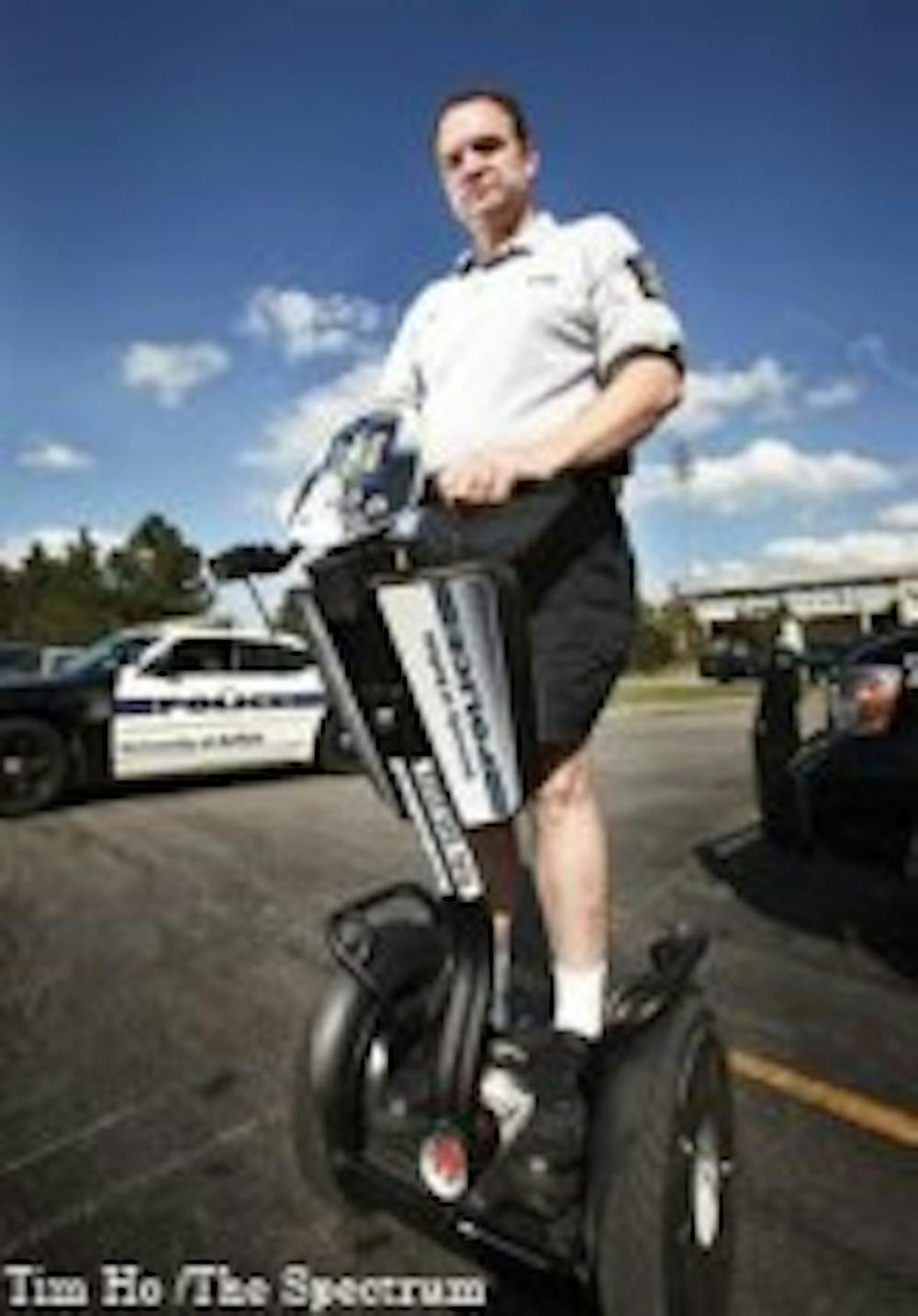
UPD officers can now zoom around campus and the University Heights with the use of two new Segway Personal Transporters to ensure the safety of students and the community.
Already equipped with bicycles, marked and unmarked patrol cars, the UPD added the Segways in an effort to be innovative and proactive with their security force.
The Segways – essentially a motorized scooter for grown ups – come well equipped and are battery operated to help decrease emissions.
'We've had them for about two weeks now,' said University Police Chief Gerald Schoenle. 'We just started using them with our Main Street detail that we are running on Thursday, Friday and Saturday nights with the Buffalo Police and we're also using them for special events.'
The Segways are useful during large events such as football games because an officer's height increases by about 12 inches over the crowd, adding a better field of vision, and they can move much quicker.
Although a Segway could never replace a patrol car, they do make beats easier in areas like the North Campus bike path and Founders Plaza, where a patrol car cannot fit.
'They definitely have a great purpose in a university setting,' Schoenle said. 'They can go up and down curbs … I would describe it as one more tool. We use a lot of bike patrol and the bikes are great, but this is just one more way to reach out to the community.'
Learning how to use a Segway is a lot like learning how to use a bike. It takes some practice – the more an officer uses the Segway, the more comfortable they will get with them, according to Schoenle.
The UPD recently developed a Segway policy and is in the process of training officers on how to use them. In most cases a training period of two to four hours is enough for an officer to be sufficiently comfortable with the Segway, Schoenle said.
'It's a gravity operation,' Schoenle said. 'Really all you do is lean forward and you'll go forward, lean backward and you go backward. It's really pretty simple. It's just getting your initial balance on them, then your ready to go.'
UB is not the first police department to add Segways to its arsenal, Schoenle said. Many other universities, police stations and security companies have started using Segways as a way to enhance their patrols.
'Its just one more way of us … using the best type of equipment that we have out there for our jobs,' Schoenle said.
The Segways cost just over $5,000 per unit, according to Schoenle, but so far the maintenance costs are very low and, because they are battery operated, they are more eco-friendly as well. The battery lasts up to seven hours, which covers the majority of an officer's shift.
'When you think of what a patrol car costs when compared to one of these … we just thought it was a great tool,' Schoenle said. 'Obviously [Segways] can't replace a patrol car, but its certainly better than an officer walking.'
Although the Segways have not yet aided in any arrests, officers have issued several citations, according to Schoenle. He also said the UPD does not have immediate plans to add any more Segways to the fleet.
'We'll see how it goes, how they work out and what kind of costs they have,' Schoenle said.
E-mail: spectrum-features@buffalo.edu



