
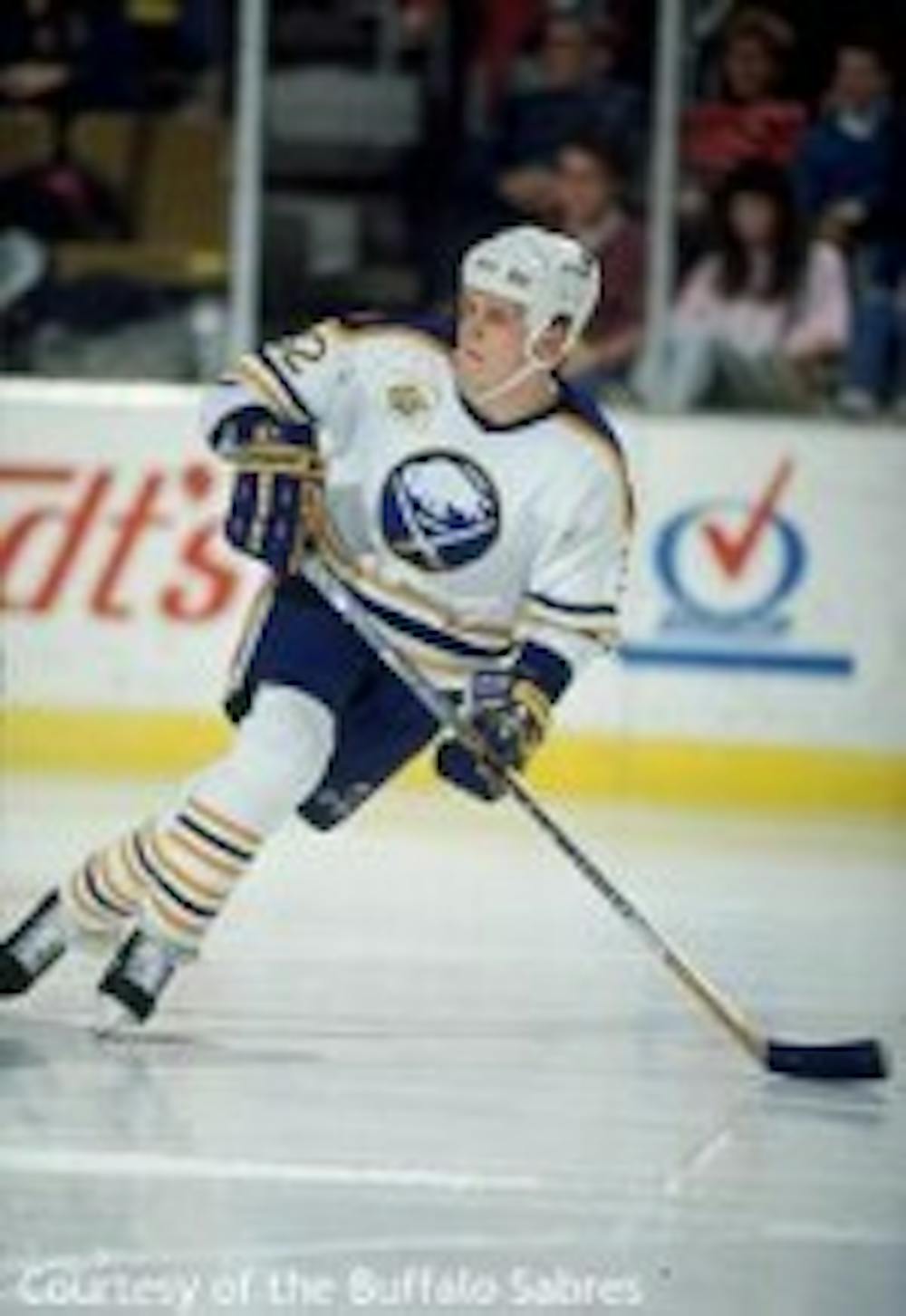
Today many people know Rob Ray as the Buffalo Sabres version of a sideline reporter. But Ray carved out a 15-year career in the NHL by using his fists and developing a strategy that has since been outlawed by the NHL. Ray currently sits sixth on the NHL's all-time penalty list, most of which came from fighting.
While Ray is well known for an incident during his rookie year with the Sabres when he took justice into his own hands and continually punched a fan that strayed onto the ice near Buffalo's bench, he also made famous the art of ripping off the jersey during a hockey fight. That act has since been banned by the NHL, and is appropriately nicknamed the "Rob Ray rule."
"Back then, guys used Velcro sleeves...they'd have stuff sprayed all over them so you couldn't hang on. It was an art back then, and everybody tried to get one hand on the next guy. A couple times the jersey came off, and I realized when that happens and you're shoulder pads aren't there, they have nothing to hang on to," Ray said. "I ended up using the shoulder pads that were Velcroed to your jersey so I didn't have the straps to hold them on...and without a t-shirt or anything they have no leverage. They have no way of keeping balance, and you've got them in a pretty vulnerable spot. Trust me, it took a lot of time, and a lot of trial and error to come up with something that actually worked for you."
Despite Ray's strategy, his main motivation during a game was fear. This fear possessed him to enter a state of mind where he would look back and wonder what just happened.
"Every time you did it, I didn't care if it was the biggest guy on the ice or the smallest guy, I always played with fear. I always felt that at any given time you could be knocked out, you could be carried off, you could be beat up. I always played with that fear, and fought with that fear," Ray said. "...It made you angry, and it made you sometimes to the level of 'What-the-hell-did-I-just-do?' type thing. I felt that I had to be like that, I had to be in that stage, or that mental state, to do what I had to do...There were so many nights you were stunned, and you were feeling dizzy, and you can barely stand up, and the blood's coming out of your nose, and you're just like 'Get me to the box, just get me to the box.' You didn't want to go down; you didn't want to look bad in front of anybody."
After being drafted by the Buffalo Sabres in 1988, Ray spent two years with Buffalo's minor league team, the Rochester Americans, where he amassed over 700 penalty minutes in just 125 games. Despite Ray's talent for fighting, he was not always comfortable with his role.
"It was not a good job, and it's not (something) that you look forward to, 'Yeah, I'm going to get in a fight tonight! Can't wait!' Anybody who says that is BS-ing you, and just showing off," Ray said. "It's the worst job in the world, and I thought I had to be in a mental state to be able to go out and play that way."
After Ray retired in 2003-04, he turned to broadcasting. During his playing days Ray had a weekly radio show on different stations, but he never thought of it as a career post-retirement. However, four days before the 2004 season, Buffalo Sabres' managing partner Larry Quinn called him to ask if he wanted a role with the Sabres television team.
During the 2006-07 season, Ray became the sideline reporter, standing in between the home and visiting benches. This allowed for one of the most memorable moments in recent years. During the infamous brawl between Buffalo and Ottawa, Ray was put in the position of standing between head coaches Lindy Ruff and Brian Murray as they yelled back and forth at each other, and looked about ready to fight themselves.
"We went live that night for the very first time, and I could hear R.J. [Sabres play-by-play announcer Rick Jeanneret] talking, 'Cover the mic! Cover the mic!' I was trying to just stay back, out of the way, and tried being as professional as possible. It was interesting to be down there. It was something that a lot of people talk about...It kind of brought you back to being in the game," Ray said.
Ray remembers a similar occurrence during his playing days, when he and his teammates came to the aide of former captain Pat LaFontaine, much like Buffalo came to the aid of Chris Drury against Ottawa.
"Years ago when Patty LaFontaine got his jaw broken against Calgary, that next game back here in Buffalo...there was a lot of attention to it. That night we had a frickin' all-out line brawl. We ended up being in their bench. I was right in by the trainers in the Calgary bench. That was probably the one that was an emotional fight. For a team, that was it."
Ray's position in-between the benches also allowed him to get a close view of Florida Panthers forward Richard Zednik, as he skated to the bench immediately after being slashed by his teammate's skate.
"By far that was the worst thing I've ever seen," Ray said. "I've seen guys swallow their tongues, and going into convulsions and turning blue...they go out and put a stick in their mouth to pry it open to pull their tongue out...but nothing like that. That was the most disgusting display I've ever seen in my life."
Despite Ray's reputation as a fighter, he accomplished a feat that most players have not, by scoring on his first and last shift of his career.
"Well you do briefly (think about scoring a lot of goals). Then reality sets in quick. But, yeah I scored [on my] first goal, first shift, first shot...statistically, it was the best game I ever had. I had a goal, an assist, and I was plus-three," Ray said. "You're sitting there going, 'this is easy. What took me so long to get here?'...then once you settle in, you really understand what your role is and how difficult it was. But I was able to score on my first shift and last shift in the NHL, so that was pretty cool."



