
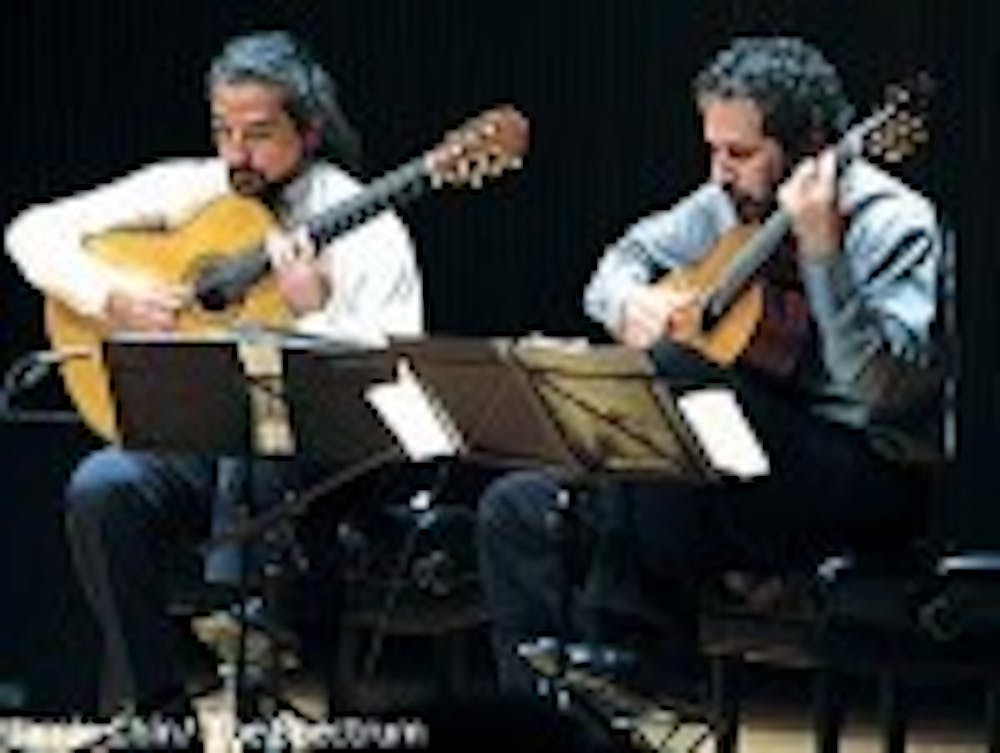
Not much can deter University at Buffalo students from schoolin' it; even the bracing winter chill isn't substantial enough to keep them under their sheets. It was almost as if there were classes this past Sunday, with hordes of students seen trudging through the seemingly sub arctic temperatures. They were on their way to Slee Hall to see renowned guitarists Sergio and Odair Assad and their accompanying violinist Nadja Salerno-Sonnenberg.
UB's music department's visiting artist series was held in Lippes Concert Hall this past Sunday. Sergio and Odair are Brazilian born brothers whose fingers flutter around the fret board of a classical guitar much like Fred Astaire in tap shoes.
Born only two years apart, as a duo they have established themselves as true artists in the realm of contemporary music. They have played with such great musicians as Yo-Yo Ma and with orchestras across Europe, and have toured on every major continent around the world.
Sunday's performance featured the works of famous composers such as Johann Sebastian Bach, Bela Bartok and even the silent-film era comedian Charlie Chaplin, whose comedic mastery often overshadowed his genius in music. Sergio Assad arranged each of the pieces with the intent of it being performed by two guitars and a violin.
The non-original arrangements were particularly brilliant, considering that they were composed for full orchestras or a piano, not for a trio of two guitars and a violin.
The three began the concert with an original composition by Sergio called "Gypsy Songs," in a two-act exposition.
They moved on to Bach's festive "Sonata in E Major," which begins with a jolt and ends delicately.
The next piece was called "Milonga per Tre," by Piazzolla, and was nothing short of gripping. If music without words can reach profundity, this piece had it from the first strum, through every pulse and cadence, right to the last twang.
Plucking on their guitars with such flawless precision, the Assad Brothers cohesively synced with both the written music and each other that their eyes would leave the page and sink into the back of their heads. They seemed to be playing by instinct and intuition alone.
After the intermission they played a medley of Charlie Chaplin's, work including a famous piece called "Smile," which was used in at least two of Chaplin's timeless classics, 1952's "Limelight" and "The Gold Rush" from 1925.
"Two Argentinean Tangos" followed the Chaplin session, with two pieces called "Invierno Porteno" and "Escualo." Appropriately enough, "invierno" in Spanish means "winter." The violinist, Salerno-Sonneberg, said, "you people know about winter here," but later admitted that the piece, to her, reflected nothing of the season.
Composed by Sergio Assad's daughter, the next piece, which was also the last, was Bartok's "Rumanian Folk Dances," which was brilliantly arranged for the two guitars and a violin.
"I thought Sergio Assad did a really good job with the arrangements," said Chris Funke, a music performance major. "He stayed true to the meaning of the pieces."
Though the Assad brothers were the main attraction, Nadja Salerno-Sonnenberg was superb on the violin as well. She played the instrument so intensely that her facial expressions fluctuated with every stroke and the violin seemed to take on a life of its own.
The combined effort of the Assad's dexterous talent and the scintillating passion of Salerno-Sonneberg completed a perfect trio of pure, raw energy and genius.
"The trio played so tight as an ensemble that it almost sounded like one instrument," Funke said.
The trio received an unrelenting standing ovation whose applauses were well deserved.



