
UB scientists are doing technological research that may one day stop a speeding bullet, or even go as far as to decrease the impact of explosions on structures.
Physics Professor Surajit Sen Ph.D. said that granular systems, a shock absorption technology, could be a revolutionary step in the field.
Granular systems are macroscopic objects characterized by elastic constants, and can be slightly altered while offering stiff resistances and retaining their original shape, both characteristics aiding in efficient shock absorption.
"Shock absorption problems are very important issues," Sen said. "Scientists and engineers haven't yet mastered ways to mitigate shockwaves associated with earthquakes, bombs, bullets and fast moving sharp objects. We are researching ways to break down shockwaves in a way that will decrease damage."
Previous research in shock absorption has been done with liquids and gases, but using such methods is limited because a change in temperature might cause the liquids or gases to change phases, for instance a gas cooling and condensing into a liquid. These "phase changes" limit the effectiveness of liquid and gaseous "shock absorption."
Granular systems, however, pose an advantage because they are solids but can also behave like liquids or gases. Sen gave the examples of sand grains or small seeds as elastic granular objects.
"These systems are very weird. Suppose you have a bowl of poppy seeds. They will act like a solid and not make any changes to their shape," he said. "But if you throw them in the air, you expect the seeds to flow."
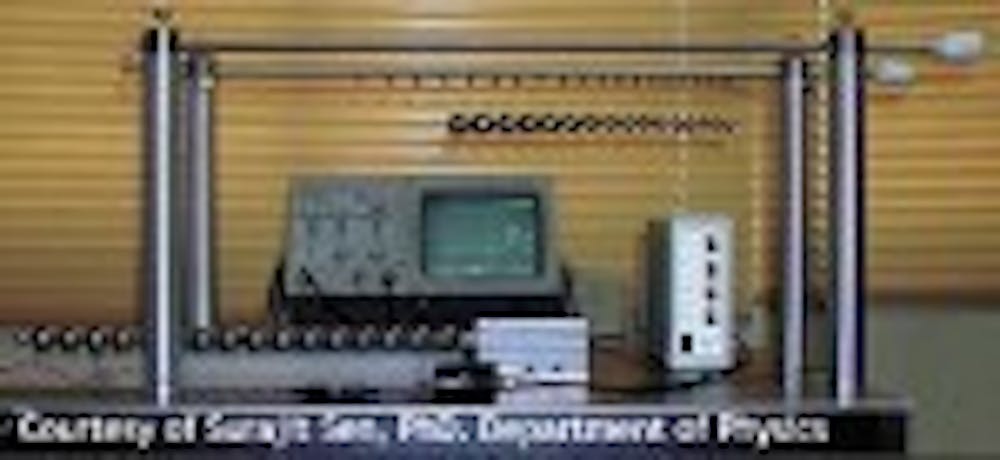
Real life absorption experiments were done to show how simple granular systems work, with the classic desktop diversion "Newton's Cradle," consisting of several pendulums.
"If you pick up one pendulum and swing it, the pendulum on the opposite end will swing. The whole thing does quite an interesting dance," Sen said. "They are spheres, typically made of some kind of metal, and are just about the best shock transmitters in the world."
Another example experiment is the "tapered chain" shock absorber, which consists of a line of metal spheres that get progressively smaller from one end to the other. The largest ball is set in motion by an "incident shock pulse" and the smallest sphere is designed to repeatedly run into an end wall.
"The largest sphere gives momentum to the smaller spheres and the smaller spheres move faster to make up for their lesser mass," Sen said. "Momentum is broken down as it reaches each adjacent sphere in the path of the propagating shock front, progressively breaking down the shock wave and making it more manageable."
This research is now being used in simulations to test how well granular systems would work in real life circumstances, such as the shock absorption in combat situations.
"These were simulations of very large shock absorptions, traveling at several hundred meters per second," he said. "They show that these systems could work in real life situations."
Simulations are necessary because constructing actual systems to study large-scale shocks can become expensive. Better designs for simulation are still being developed to study shock absorption of the highest possible magnitudes encountered in practical situations.
Sen also explained that these systems are very scalable.
"The spheres can be made much larger or smaller. They can be used to make automobile bumpers or anything that requires shock absorption," Sen said. "They don't always have to be used for armor applications."
Sen's collaborators include Robert Doney Ph.D., a UB scientist at the US Army Research Labs in Aberdeen, Maryland, Jan P. Fannes, a former UB student who now teaches in Germany and also experimentalists from NASA, the University of Santiago in Chile, the Colorado School of Mines and the Superior Institute of Mechanics in Paris, France.
This research has raised the interest of several government agencies and is funded by the US Army Research Office.



