
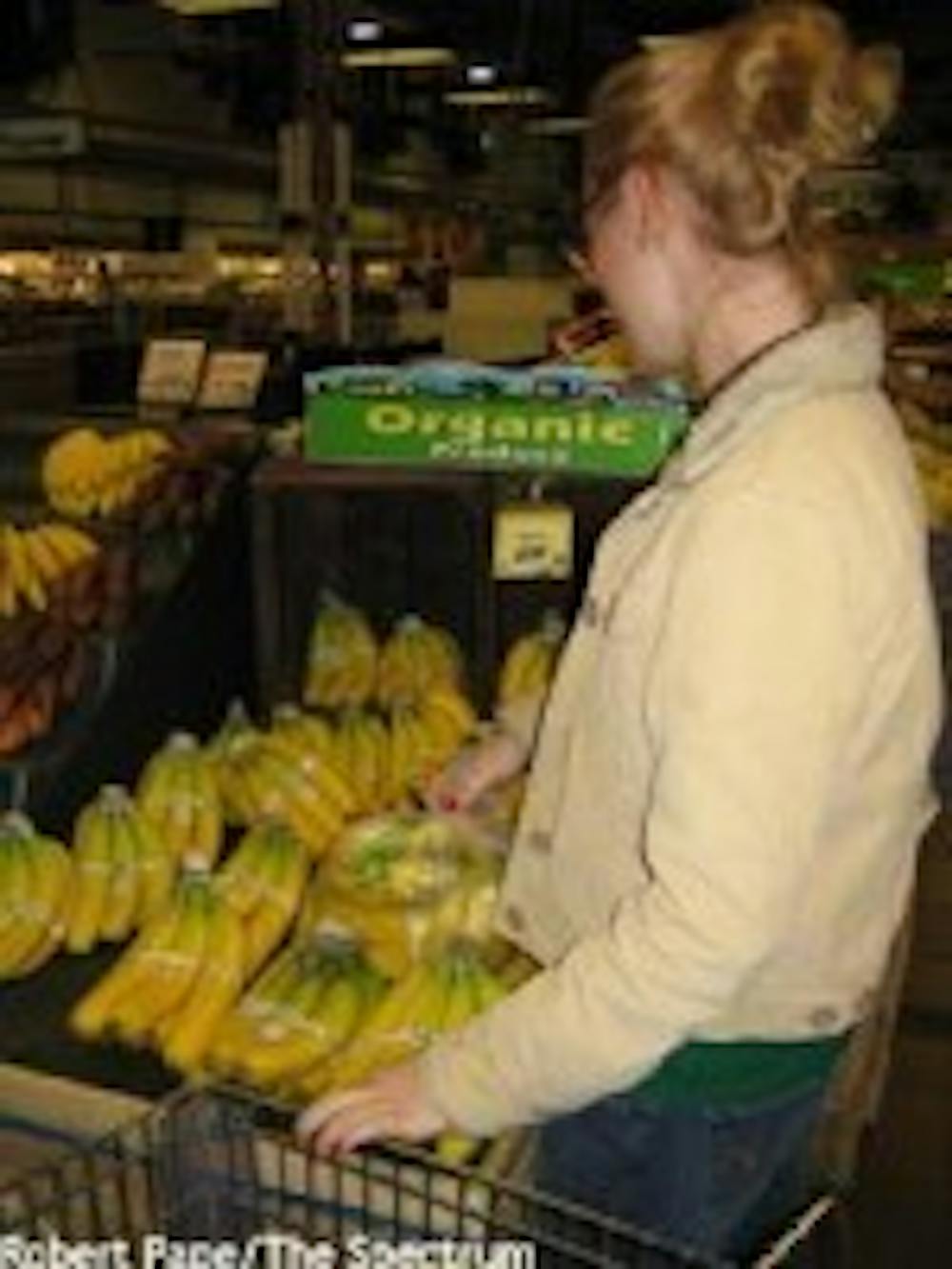
Organic sections are sprouting up everywhere - they are invading the produce section, the cereal aisle, the dairy aisle and yes, even the cookie aisle. But what the heck is it?
Organic products and foods, by definition, are grown and produced without synthetic pesticides, fertilizers, antibiotics or growth hormones.
Farmers are not allowed to use hormones or antibiotics in the animal's feed, or inject them into the animal. Additionally, they cannot produce food using any kind of genetic modification.
By USDA organic standards, they must be as low as possible in synthetic chemicals to provide a safer, less toxic environment for both farm workers and consumers. Instead, farmers are left to revert to pre-chemical revolution methods of farming, pulling out weeds by hand, by machine or by burning them.
"Food grown organically has more phyto-chemicals in them, which help protect you against cancer, heart disease and other diseases," said Barb Bowen, a registered dietician who teaches classes on environmental nutrition through Blue Cross Blue Shield.
"It helps preserve our land and our water sources so we're not going to have the run off of pesticides infecting them," she said. "It decreases the agricultural synthetics our body is exposed to."
Bowen regularly consumes organic products, keeping 12 varieties of fruits and vegetables in her fridge at all times. She drinks organic wine, fed her three-year-old toddler organic baby food as an infant and has an organic turkey on order for Thanksgiving day.
As a result, she said she doesn't have to worry about getting sick, has improved digestion and peace of mind.
"I can't say I see a difference between organic and non-organic except psychologically," Bowen said, though organic eggs have a better taste in her opinion.
According to the Environmental Working Group, the FDA tests only one percent of food for pesticide residue, and the average apple has 20 to 30 poisons on its skin even after washing.
Simply peeling the skin off isn't the answer either, Bowen said. The chemicals penetrate to the intracellular level.
If that isn't enough to scare consumers, 90 percent of the chemicals applied to food have not been thoroughly tested for their long-term side effects on health, according to the National Academy of Sciences.
"We're so disconnected from where that food came from, where it was grown," said Janice Cochran, a nutritionist and dietician with Student Health and Wellness.
According to Cochran and the book, Newman's Own Organics, Guide to a Good Life by Nell Newman, organic sales are increasing by the rate of 20 percent per year.
Locally, the organic food industry is growing with leaps and bounds. An organic milk processing facility in Elma was recently opened by the company Steuben Foods, in association with Horizon Organic, as part of an $18 million dollar expansion project, according to an article in the Buffalo News.
"Industrial agriculture is one of the biggest polluters in the country right now," said Tim Bartlett, general manager at the Lexington Cooperative Market on Elmwood, a grocery store that sells primarily foods that are organic or locally produced.
Jenny Bruce, the office manager at the Lexington Co-op, said she supports organic because it means the farm workers weren't exposed to dangerous chemicals.
"Attention has been paid to where and how they were grown," she said.
Although organic costs more, students can find ways to make it affordable by cutting down on eating out and alcohol.
"I'm a college student, I can still do it," said Kimberly Davis, a junior arts major at Buffalo State College, and a team produce leader at the Lexington Co-op. "It's basically quality over quantity. Eat seasonally, locally and consciously."
Learning about organic eating while living in Colorado after high school, Davis discovered the environmental and physical impacts of chemicals in a diet. These experiences have opened her eyes to the ways food can impact her health.
"You really have to pay attention to what you put in your body," she said. "I think that my energy levels are a lot better. I think better."
While Bowen is an advocate for organic, she admits it is impossible to be 100 percent organic and still live a normal life. Restaurants, parties and, well, things like brownies sometimes get in the way. If students are going to purchase organic, it should be what they eat the most of to lessen the processed, chemical laden foods they consume.
According to Bowen, purchasing organic milk should be high on the list of priorities. Along with steroids and antibiotics, milk may also contain the bovine growth hormone, which is given to cows to increase their milk production.
Bowen also recommends eating organic or low fat meat, because it contains less dioxins from industrial waste, which binds to fat. She also said not to be afraid of fruit that isn't shiny or perfectly round, the bumps mean that it fought off a critter and is stronger because of it, with more phyto-chemicals.
"It's really about steps," Cochran said. "It's a level of fine tuning the diet. It's okay to do what you can. The least amount of processing the better."
Interested in reading more? We recommend the following:
Diet for a Small Planet, by Frances Moore Lappe
The Balanced Plate, by Renee Loux
Newman's Own Organics, Guide to a Good Life, by Nell Newman
1001 All-Natural Secrets to a Pest-Free Property, by Myles Bader
Agrarian Dreams: The Paradox of Organic Farming in California, by Julie Guthman
Environmental Nutrition or The Green Guide magazines
Nutrition Action Health Letter



