
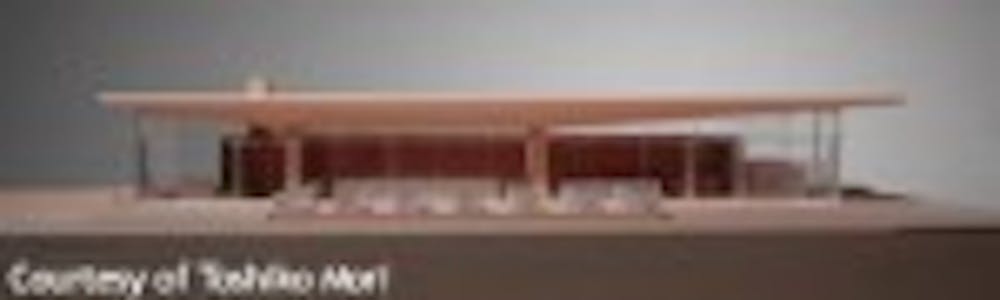
Taking a modern approach to the Darwin Martin House's new visitor's center, architect Toshiko Mori hopes that innovation, rather than imitation, is the greatest form of flattery.
Mori, the architect for the Darwin D. Martin House Complex's new visitor's center, hopes to maximize the beauty of what many consider one of Frank Lloyd Wright's greatest works. During a lecture in Crosby Hall this past Wednesday, Mori discussed her strategies for her update to the uniquely designed house, as well as other projects she is working on.
"I have to do something for them (previous architects), as in recapturing their spirit," Mori said.
The speech was a part of the 2006 lecture series hosted by the UB School of Architecture and Planning.
The visionary Mori joked about having dreams of celebrated dead architects being upset that she had not done justice to their innovations.
Mori's initiative for her contribution to the Martin House is to enhance the complex through modern technology, rather than restore it through imitation.
Also featured at the lecture was the private premier of the "lost buildings" of the Martin House Complex. This included the pergola, conservatory, carriage and greenhouse, presented by the Martin House Restoration Corporation.
In addition to her project in Buffalo, Mori is also working on projects at Syracuse University for the Center for Excellence and Link Hall. Remodeling in these buildings will show off Mori's novel ideas of energy-conserving techniques, which rely on the elements for power instead of electricity.
Mori's residential designs also feature this style of architecture. The houses, which are mostly built in cold climates such as Connecticut, upstate N.Y. and Maine, use glass architecture and heavy snowfall to heat and cool the buildings. The houses, built with features such as snow accumulation insulators, also use snow as daylight reflectors to help to heat the buildings and save on heating costs.
Mori spoke of a house in Maine she designed that actually overheated one winter using these techniques, and had to have its windows open during the cold weather. Snow insulators also help to cool houses in the summer, virtually taking away the need for air conditioners.
Mori also mentioned the idea of a "compact house" at the lecture, which conserves space in order to preserve energy.
"I try to persuade my clients to opt for more economically sound houses rather than huge mansions," Mori said. "It makes for smaller electricity bills. Shrinking the house size is working in the favor of the people."
Mori's houses are not only energy efficient, but are also contemporary in their style. Many of her houses can be found in nature-based settings, which aim to preserve the splendor of the location.
"As opposed to opaque or white houses, glass houses blend in with the environment and do not interfere with the general beauty of the site," Mori said.
The visual presentation of Mori's projects showed the innovation of her work, but concealed the fact that these buildings are also self-sustaining and environmentally friendly.
"Architects have to be magicians. They cannot tell their tricks," Mori said.
The lecture series continues on Oct. 6 with a presentation by Andrea Zittel, an eclectic dystopian installation artist, in which she will talk about the exhibit of her first solo project called "Critical Space." The exhibition was organized by New York's New Museum of Contemporary Art and the Contemporary Arts Museum in Huston and will travel on display until Jan. 7, 2007.



