
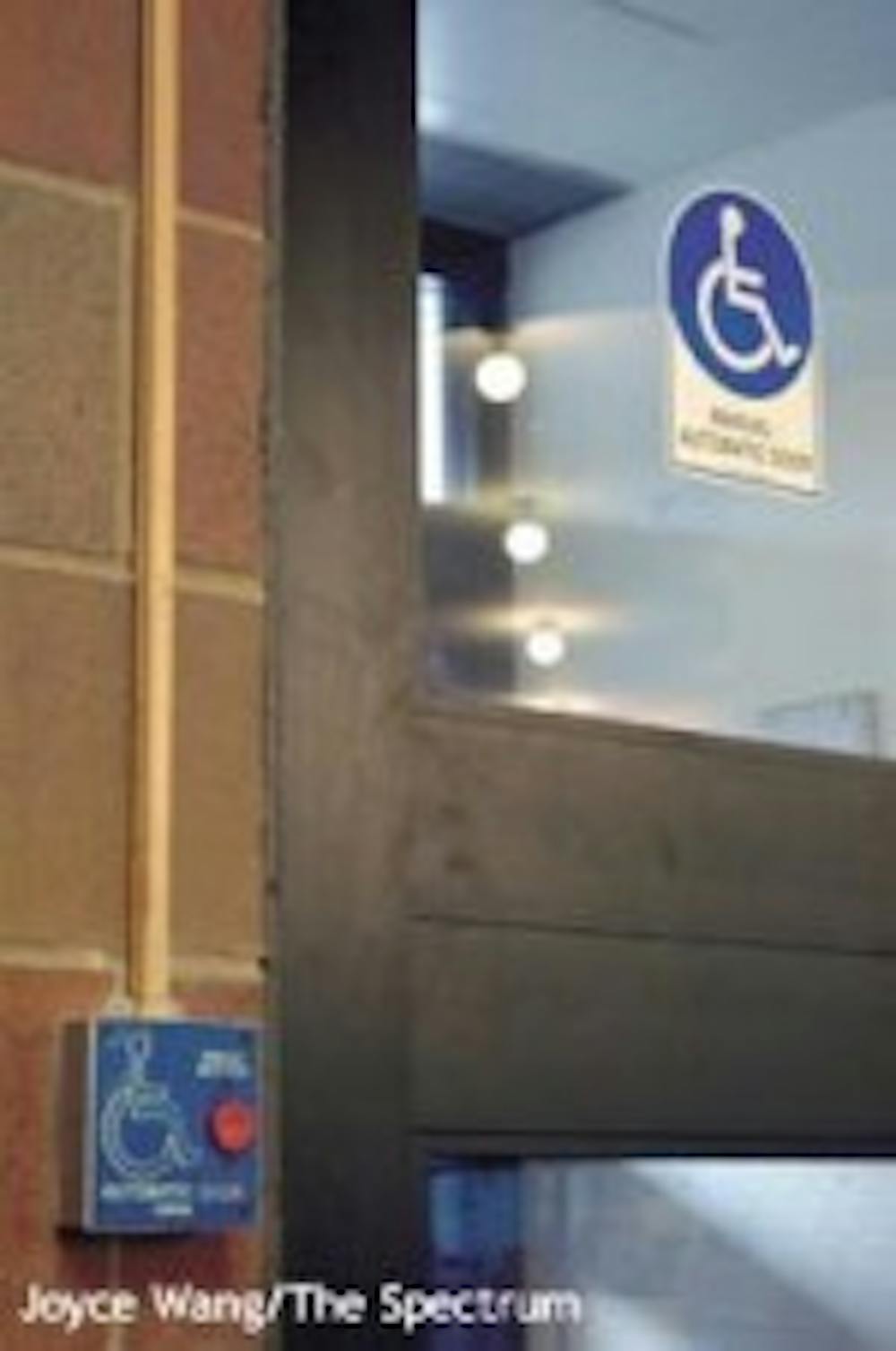
In 2000, three UB students sued the university, claiming it failed to provide disabled students with reasonable accessibility accommodations.
Three years later, under an agreement reached by both parties, UB was required
While new facilities have been employed and some community members believe that progress has been made, others remain concerned with UB's accommodations for the disabled.
According to Monica Moshenko, chairperson of the United University Professions at Buffalo Disability Committee, architectural barriers exist for disabled students, which are compounded by a lack of empathy on part of the entire university community.
A former UB faculty member for 17 years and mother of a disabled child, Moshenko feels that UB does not "foster a culture of full inclusion."
"(Does UB) provide services based on individual needs, that ensures access to all activities and events at SUNY Buffalo?" she asked.
According to Randall Borst, director of disability services, UB has not been able to keep up with mandatory improvements in a timely manner.
"There are things we are just not working on, that were legally required to be done over ten years ago - actually over 20 years ago," he said. "So has the university moved as fast as it's required to move? No, we haven't."
Borst believes that the slow pace is due to a lack of coordination and funds.
"The UB community has an outmoded way of thinking towards disabilities," he said.
Jennifer Machucki, a disabled 2001 UB graduate, said that she was unable to obtain assistance on campus in times of need.
"I contacted people to get help, but it was difficult to find," Machucki said. "Randy Borst was absolutely no help to me...he told me I should leave if I was unhappy."
Borst does not recall the incident but said that he has never refused a reasonable accommodation.
"In certain situations a timely response cannot be made," he said.
According to Dennis Black, vice president of student affairs, the results of the audit indicated numerous suggestions for improvement, and the university has acted accordingly.
$5 million has already been allocated for physical improvements, and in the future, UB will invest $200,000 annually on improvised accommodations for academic support.
Black said that changes included ongoing faculty-staff training, as well as a new snow clearing procedure allowing mobility-impaired students and staff improved access to campus.
Curbs lowered for wheelchair access were originally being covered with snow when campus roads were plowed.
Christine Muller toured the UB's School of Architecture a few years ago with her son, who suffers from Duchenne Muscular Dystrophy and utilizes a wheelchair.
Muller said that they encountered several problems while visiting campus.
"Our experience was not good," she said. "The only wheelchair entrance to the building was not clearly marked... and the power door buttons did not work."
According to Muller, there was no means of access to the basement, and numerous attempts at exiting the building were futile.
When she asked the tour leader about accommodations for wheelchair students, she recalls, "If you can't hack it (walk) you shouldn't be in this program."
When Muller tried contacting UB officials regarding the experience, she remembered the UB administration being "unaffected by our concerns."
Borst said that disabled access on campus has been limited for decades.
"There is always a lot to do, and there are many areas where people with disabilities feel there are things that we should've done, things that could've been done long ago and those are also being worked on."
According to Moshenko, there are still several areas that need improvement, such as emergency evacuation training for dorm residents, student and community support groups and mobility.
Borst believes that much of the delay can be attributed to a shortage of resources and staff availability, but progress is on the way.
"There are considerable access needs that have not been done...we don't have many wheelchair accessible bathrooms - that's one area that will be getting some improvement."
Borst said that the changes necessary to campus are considerably involved.
"I think there are people who suffer considerable inconveniences at best, because of certain physical boundaries that the university is still in the process of removing," he said."In the future, I hope UB can become more updated and universally accessible."



