
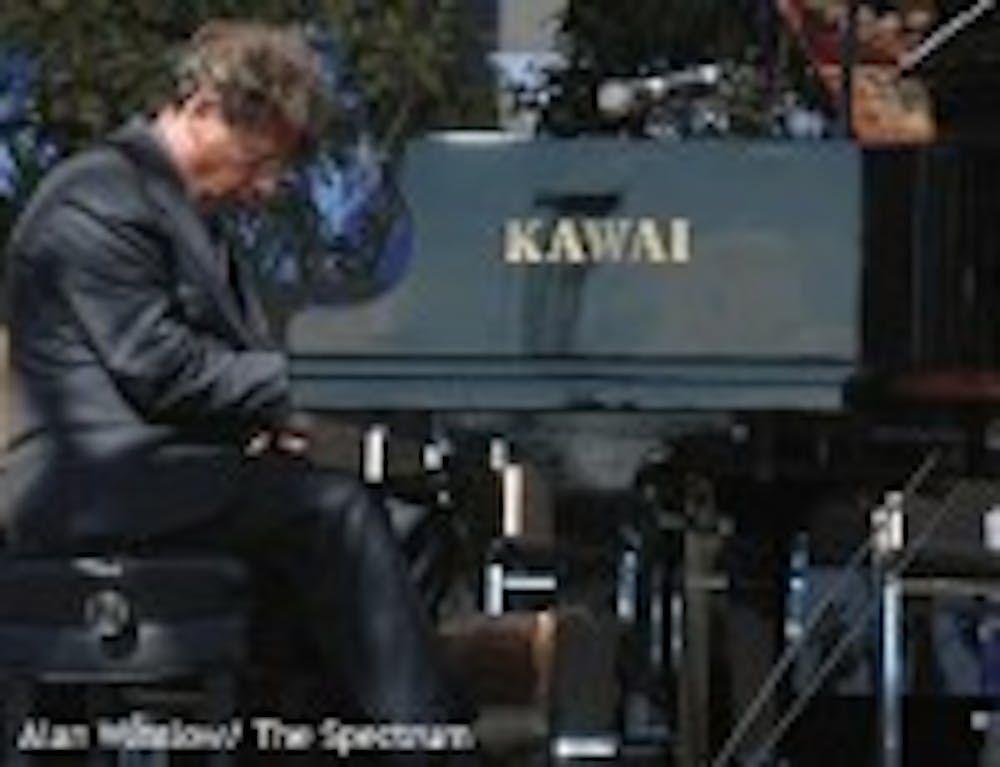
Monday night, revered composer Phillip Glass guided the audience across a bridge between Eastern and Western thought.
As part of the Center for 21st Century Music Inaugural Concert series, Glass impressed the crowd at the Center for the Arts with a collection of works, including selections from the score of the Scorcese film "Kundun."
During a discussion following the performance, the musician explained that film score was intended to promote unity between two worlds.
Special guest, UB's own Slee Sinfonietta, opened the performance with two pieces written by Glass and one by Charles Wuorinen. The music captivated and stirred the audience without being overwhelming.
"Epithalamium," a Wuorinen piece, was extraordinarily executed by trumpeters Jon Nelson and Gareth Flowers. The horns fluctuated between harmony and dissonance with a gradual but ever-rising tension.
Though it was unclear why a work by Wuorinen was included in an evening conducted by Philip Glass, "Epithalamium" was a welcome selection.
"Songs of Milarepa" was Glass' second piece of the evening. He composed this work based on 11th century Tibetan poetry. University faculty member Alex Hurd performed the baritone vocal part, bringing an operatic quality to the spiritual text.
This technique came across as a bit out of place and difficult to digest. The strings were textured and the percussion was dynamic, although the orchestra sometimes overpowered the vocals.
"I thought it was strange to hear it in English," said Katie Young, 20, a senior English major at UB. "I wondered what it would have sounded like in the original language."
The performance concluded with Glass' chamber composition, "Symphony No. 3." This was perhaps the most touching piece of the evening and certainly the most indicative of his musical prowess.
Blending complex time signatures and poly-harmonies, the strings moved in and out of synch. This resulted in a deliberate but seemingly natural execution of Glass' characteristic style.
A pioneer of the minimalist movement of the 1960s, Glass crafts simplistic, yet highly sentimental scores. The drone of the minor intervals plucks at the audience's heartstrings.
The composer is a master of polyrhythm and chord stacking, and most of his pieces are devoid of any easily recognizable meter. Glass generally works with rhythmic units above or below the listener's consciousness. One might become simultaneously moved and disturbed by one of his pieces without quite understanding why.
"The selections tonight were an excellent example of his ability to combine groundbreaking conceptual work while maintaining a connection with an audience," said Ryan Kulesza, a graduate of The University at Buffalo's School of Music. Kulesza'a only complaint was that the program was too short and lacking in climax.
In the post-performance discussion, Glass related humorous anecdotes and devoted much of the discussion to his work on the score of "Kundun," which was to be shown at Slee Hall immediately after the concert.
During a question and answer segment, a young composer asked about popularity and success. Glass recounted the story of his first major concert. His mother was one of six attendees, her only criticism being "Why is your hair so long?"
Glass' conclusion was that "there were people who came, and that was enough."
Though they may have seemed shaky or strange at moments, the bridges formed between composer and audience, East and West, opened hearts and minds, and that was enough.



