
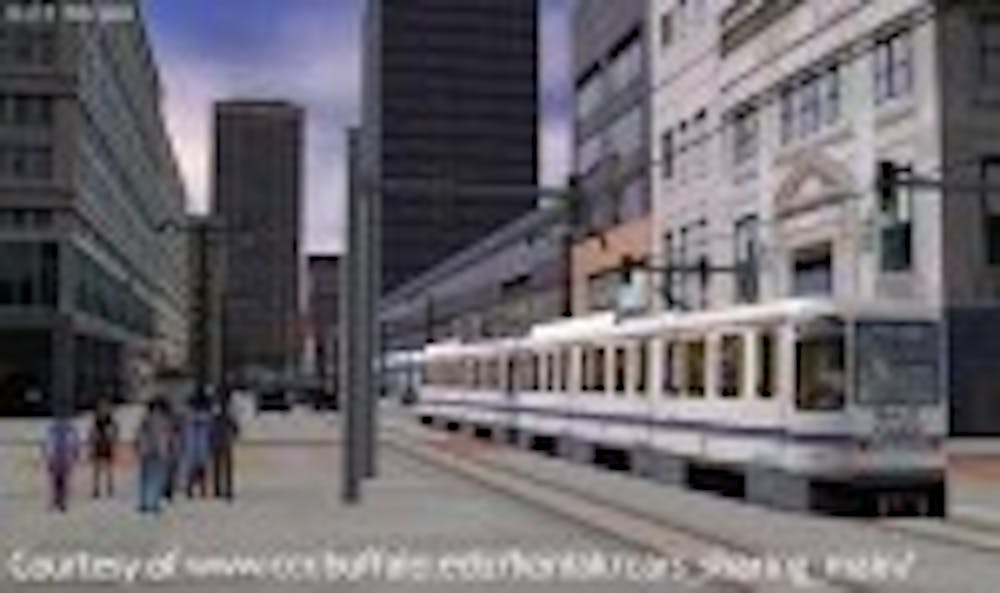
A virtual tour last month gave downtown Main Street a new look: accessible.
The UB Center for Computational Research (CCR) presented "Cars Sharing Main Street" at the Market Arcade Film and Arts Center on August 8. The visualization showed how Main Street would look if opened up for two-way traffic alongside the Niagara Frontier Transit Authority (NFTA) trains that already run on the Buffalo thoroughfare.
Downtown Main Street's history is as rocky as the construction that's obstructed South Campus students for years. Originally converted into a pedestrian mall with the intent of revitalizing downtown, Main Street spent nearly 20 years cut off from two-way traffic, instead servicing only the metro route. The area where the metro rail runs aboveground was intended to be an open-air marketplace.
According to Doug Hartmayar, director of public affairs for the NFTA, construction of the rail line began in 1979. On May 18, 1985 trains began operating as far as the Amherst Street station. On November 10 of the following year, the entire route - ending at what was at the time called the South Campus Station - was opened for service.
CCR is a part of UB's New York State Center of Excellence in Bioinformatics and Life Sciences. One of the missions of CCR is to provide economic development and economic outreach to the community.
"We like to help local companies do things that they could not normally do," said Adam Koniak, a CCR multimedia specialist.
By opening up Main Street again, the NFTA hopes to "stimulate growth, multi-model access options and ridership, and improve overall quality of life," according to the project's proposal for the integrated street on their Web site.
John Bidwell, the Traffic Engineer for Public Works, said the project "would improve the core of Main Street" As it is now, there are some stores that customers would not know exist because no cars can access them.
Some people, like senior Biotechnology major Sandy Canna, believe that the qualities Main Street has now are more important than the accessibility issues being addressed by the NFTA.
"I don't think they should (open Main Street to traffic). I like it better the way it is," Canna said. "If they open it up it would be more industrialized. And there is plenty of parking around."
"I think that it will affect more the area by bringing more businesses down there," Koniak said when commenting on the effect on UB students. "And all the students who are now working or also take the subway downtown now can drive to those places. The Theater District will also open up itself a little bit."
Generally students said that opening up Main Street again would make it easier to navigate downtown.
"I think that would be a good decision especially for people that do not live in Buffalo that go to the schools around here," said Shawn Quill, a sophomore Exercise Science major. "Once you get downtown and turn a couple of times you can get lost down there real easily. I have been down there a couple of times and trying to get back on Main Street is kinda tough. If they made that trolley path open for cars it would make things easier."
Besides the Main Street project, CCR is working on a visualization of the university grounds that would allow prospective students to get a virtual tour of UB before coming to Buffalo. This new venture would work along side UB 2020 project, for any other expansion that the campus may need to add in the future. The CCR's Web site, which currently sports the plans and virtual tours for the revitalization, is located at www.ccr.buffalo.edu.



