
In a country where a woman can have her hands cut off for wearing nail polish, opening a beauty school seems unthinkable.
But that's just what three idealistic American hairdressers decided to do in Kabul, one of the most violent regions of Afghanistan.
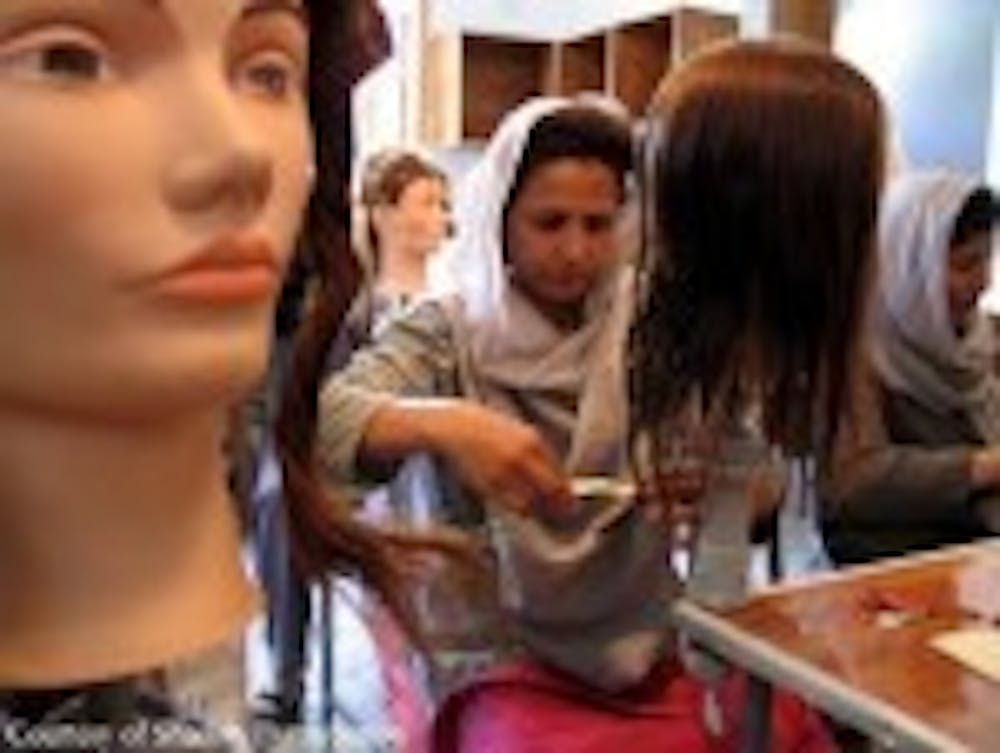
"The Beauty Academy of Kabul," directed by Liz Mermin ("On Hostile Ground") follows the growth of the Academy from an idea to a highly successful and popular place for women to learn about beauty.
The documentary revolves around several current issues in Afghanistan, mostly the Taliban, but also marriage, the marginalization and abuse of women, and the importance of the beauty culture once removed from the Western mainstream.
Mermin chooses to frame the American hairdressers, who are all female, as brazen and heroic, unafraid of coming to a world where women are largely oppressed and men are feared and worshipped.
The first few minutes of the film offer old footage of Kabul in the 1970s, prior to the Russian invasion and subsequent Taliban rule. People dance in clubs, shop in the streets, and women wear fashionable clothing. The scenes are not unlike something that might have been seen in America during the same era.
The perspective that Mermin is able to offer as a result of this is astonishing. Kabul now lies in ruins. The infrastructure is destroyed, and most of the city streets' occupants look homeless and miserable.
Under the rule of the Taliban, women are forced to cover their hair and hide their skin, including ankles and wrists. Makeup is not allowed because women who wear makeup are considered promiscuous.
The heart of the film is in the stories of the students who have been living in Kabul during the violent reign of the Taliban. Despite the horror that the women express through their first-hand accounts, they are surprisingly upbeat. There is never a moment when they complain of their mistreatment. One aspiring beautician recounts seeing three women doused in gasoline and burned in the middle of a street for disobeying their husbands.
The Kabul women's ability to survive in this environment is inspiring, but their unyielding optimism signals a somewhat biased documentary.
Many of these women operate clandestine hair salons out of their homes and are able to make more money than their husbands do each month.
Despite the American women's obnoxious behavior, the Afghan students quickly form deep bonds with them. They wish that they were able to wear miniskirts and short sleeves like American girls.
Mermin is able to form a unique juxtaposition between the delicate work of the beauty school and the rough conditions that exist out in the streets, which are filled with men holding machine guns.
These repeating images solidify the difficulty that the women have in simply living their lives. Not only do men control women, but the control is extremely cruel and violent.
Mermin reveals a unique corner of Afghan culture, one that is often misrepresented and completely misunderstood by Westerners. She is trying to say that no matter where you're from, women enjoy having the right to look feminine, and that no one should be able to take that from them.
"The Beauty Academy of Kabul" is playing at the Dipson North Park Theatre.



