
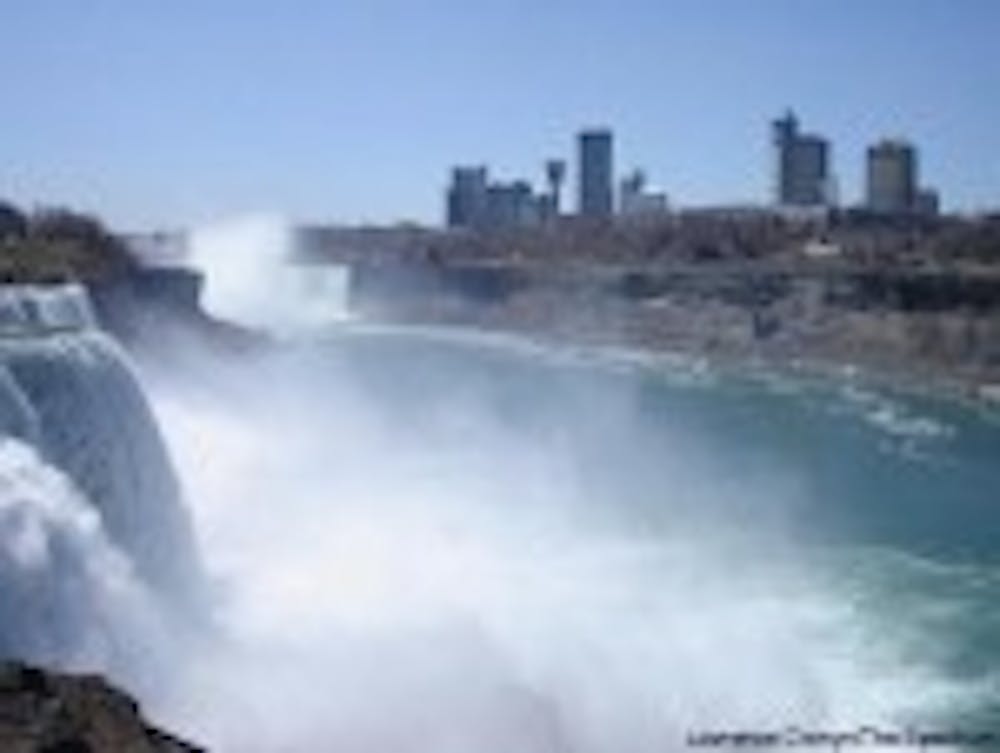
The mist plume emanating from the Niagara Falls is one of the tourist attraction's best-known traits - the nearly constant cloud gave rise to the Maid of the Mist, both the ghost story and ubiquitous boat tour.
But in recent years, that mist plume has increased to the point of obscuring the falls themselves, leaving millions of tourists with a misty impression of one of the world's most famous natural wonders.
The increase in mist used to be attributed to the recent glut of high-rise hotels on the Canadian side of the falls. That theory was debunked by a team of UB geologists who released the results of their recent study that found a new source of the thickening mist.
The original theory suggested the new high-rise buildings were altering airflow patterns around the falls, contributing to a higher, thicker mist plume. But according to a study led by Marcus Bursik, a professor in the department of geology, the outside air temperature and the water temperature are what cause the different heights and amount of mist from the falls, not casino-deflected air.
"The warm mist from the river water mixes with air at the base of the falls. The warm mist heats up the air that's mixed in," Bursik said. "Sometimes, it can heat it up enough that the mixed mist and air is lighter than the surrounding air, in which case the mist rises just like a hot air balloon."
Essentially, the mist is more abundant on days when the water temperature is significantly greater than the air temperature, a phenomenon that is most common in the fall.
"The perception that there have been more misty days in recent years may just be related to the temperature trends," Bursik said.
Bursik led the study with several students who were investigating the plume for their graduate-degree projects.
"We had to take pictures of the mist plume with video and still cameras; we had to record river water and air temperatures and prevailing wind conditions; and finally we had to record weather conditions on the ground near the waterfall, which we did with a portable weather station that could fit into a backpack," Bursik said.
UB's mist-measuring team first presented their findings at the 36th Binghamton Geomorphology Symposium at UB last October. Seed funding from UB supported the research.
The team presented their findings most recently at UB's annual Environment and Society Institute Colloquium on Friday. Students and research teams from all over Western New York also presented their research projects.
Cameron Wald, senior biological sciences major, attended the colloquium and said she found it highly insightful.
"It was really interesting to see all of the different types of research students and faculty were doing," she said. "With all of the talk about global warming and many other environmental issues, there is a definite need for students to be actively researching the environment."



