
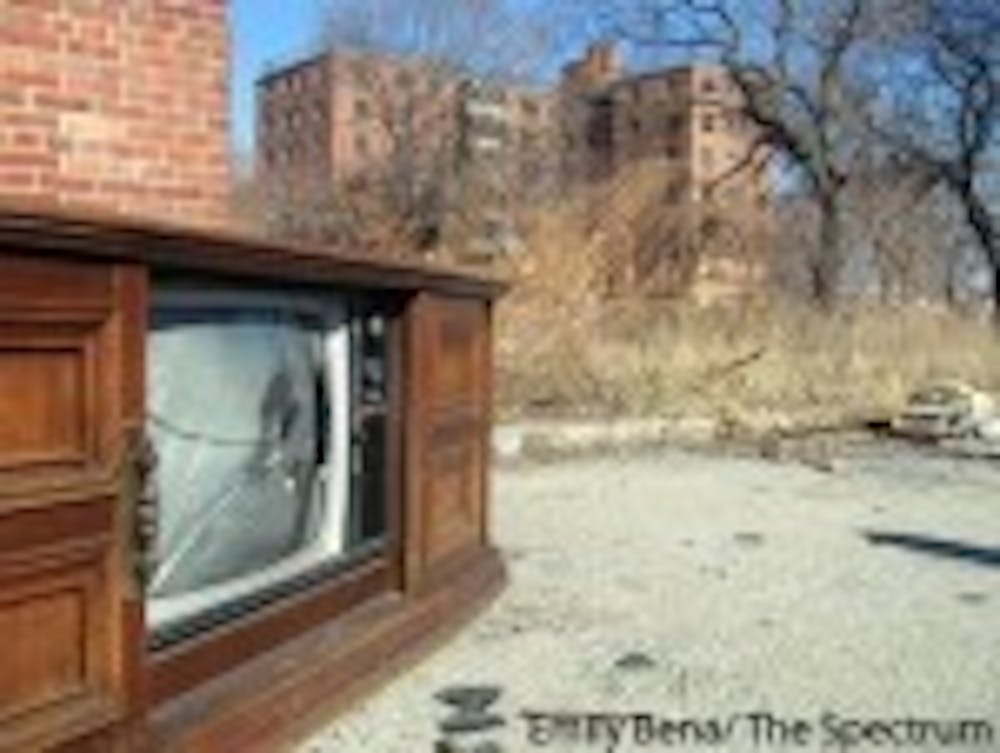
When urban planning Master's students looked at an abandoned Glenny Drive apartment complex they saw more than just six dilapidated seven-story buildings that hadn't been lived in since the early 1980s.
Instead, they saw the opportunity for something that Buffalo's East Side is sorely lacking: commitment to improvement and development.
With the help of Ernest Sternberg, a professor in the department of urban and regional planning, the students have proposed "The Plaza at Kensington Heights," a plan for transforming the 17-acre apartment complex from the 1950s into a large-scale retail development.
"While conducting our market analysis we found that the distance, upward of five to eight miles, is forcing many city residents to shop and work in the surrounding suburbs," said Nicole McGowen, a graduate student involved in the project.
"If they wish to shop locally, their choices are limited to local neighborhood or grocery stores. The residents end up paying over 50 percent more than they would at a store such as Wal-Mart," McGowen said.
Kensington Heights is not only lacking retail developments but it is literally falling apart.
According to an article in Artvoice, the Glenny Drive apartments have been abandoned for more than 20 years, partially due to asbestos contamination.
With smashed windows, wide-open doors, and walls completely covered in graffiti, these apartments are nothing more than a public nuisance and an eyesore. By observing development progress in other cities, the team of students realized the potential of the Kensington Heights area.
"During our research we found that cities across the country are starting to realize their untapped resources to house such large-scale retail developments as Wal-Mart or Home Depot, which have largely been located in the suburbs," McGowen said.
Success of such retail development strategies in Boston and Washington D.C. inspired the students to consider a similar plan for Buffalo.
Sternberg said that the "big-box" stores, chains such as Wal-Mart, Target and Sears, are running out of space for new locations in the suburbs.
"They are beginning to realize that in the urban centers they have ignored there is, in essence, a 'trapped population' desperate for the services they can provide," Sternberg said in a UB news release. "It might be time for us to take advantage of that realization."
In their project report, the students noted that Buffalo had a retail gap of more than $300 million dollars in 1998. This means that the retail purchases of residents were significantly higher than what the city retailers actually sold; all because the residents are forced to take their spending money outside the city limits.
The students think the location of the Glenny Drive apartment complex on Fillmore Avenue, adjacent to the Kensington Expressway, will make it easily accessible and gives it great potential for re-use.
If the plan for the Heights goes through without any major glitches, there are 83 additional acres adjacent to Glenny Drive that could be acquired in the future for expansions.
In addition to improving the appearance of the area and building the potential for retail, the project can also bring a few jobs to the East Side area.
"Any sort of retail development can spur economic growth and create jobs," McGowen said. "There is no guarantee that the job creation will be anything other than mostly low-paying and low-skilled jobs."
However, a job is a job, and at this point Buffalo will take any bit of economic growth that it can get.
The first stage of the Kensington Heights plan, researching the possibilities of development, has already been completed.
"The next steps consist of four phases," McGowen said.
The first thing the students will do is concentrate on marketing, zoning and permitting requirements for the area. When that is complete, they will focus on negotiations with the retailer or developer, and then focus on environmental and physical modifications. The fourth and final phase is the design and construction of the new development.
McGowen said that care would be taken by the developer to ensure that The Plaza at Kensington Heights will cater to the needs and wants of the East Side residents. Once a retailer or developer is on board, McGowen and the other students hope the plan will be fully implemented within a few years.
"It is our hope that the City of Buffalo will soon hire a marketing consultant to attract a retailer or developer to this site," she said.



