
It's a movie about one of the most irreparable mistakes of mankind, and it resembles a fairytale.
"Manderlay," an eight-chaptered contrivance of America's trial with slavery, is playing at the Market Arcade through March 28. Danish director Lars von Trier ("Dogville") develops a deeply ironic film that questions whether African-Americans deserve their freedom.
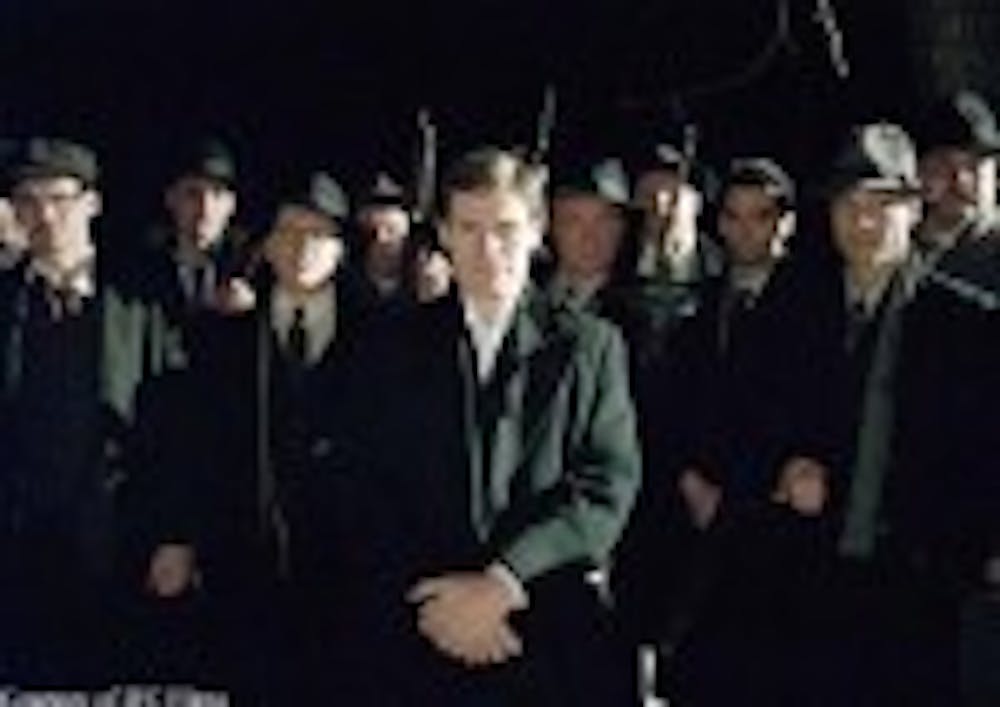
"Manderlay" is set in the 1930s American South, but don't expect many visual clues because the scenery that Trier uses is practically nonexistent. He arranges his actors on what appears to be a large white sheet of paper. The backdrop is always black and scenery is replaced with sound effects, as though the movie were being performed onstage in front of a live audience.
John Hurt, the narrator of "The Tigger Movie," narrates this story in a similar Mother Goose fashion. Each character represents a stereotype. Bryce Dallas Howard ("The Village") plays the self-righteous heroine Grace, who becomes preoccupied with showing her desensitized daddy (Willem Dafoe of "The Boondock Saints") that she can make things better for the people of Manderlay.
Danny Glover ("Saw," "The Shaggy Dog") plays Wilhelm, the wise black man who constantly reprimands Grace in the gentlest way possible. His role is particularly striking because he is the only black character to assert, "America just ain't ready for us to be free." Viewers should be warned that this film is politically charged and is not made for the weak at heart.
The entire cast is underdeveloped, and not one of members becomes intriguing throughout the entire progression of the movie. Trier may have intentionally made his characters difficult to relate to in order to emphasize how convenient it is to distance oneself from the past. The entire film seems haunted by emptiness. Even the lines of the characters are heard as an echo.
Trier may not have an expansive knowledge of the English language or maybe he deliberately wrote the dialogue to be as bland as the scenery, but whatever the case, "Manderlay" requires patience. Admittedly, this movie is somewhat difficult to watch, but by its completion, after all the irony untangles, it is easier to recognize its value.
Visual arts are continually evolving, but the more stylized and symbolic films are still nudging their way into the entertainment industry. Trier deliberately brings discomfort into the theater, which could discourage many viewers from attempting to appreciate his film. Even though his investigation of politics may not be as sensationalized as an off-the-cuff blockbuster, his questions are worth tolerating.
Eventually it will become apparent that Trier is making snide remarks about America's bumbling crusade for democracy. Aside from aggressive political commentary, Trier is also attempting to tell a story. By balancing "Manderlay" with commentary and a storyline, he invites the viewer to form their own reaction.
It is possible for the audience to feel distanced by the story's painstaking obscurity. The movie seems to become sidetracked with Grace's repressed sexuality, and even includes a scene of her masturbating that completely disrupts Trier's political agenda. At least "Team America: World Police" iced their criticism with comedy.
Trier has developed one of the most peculiar ways to reoccupy American history, and he undoubtedly will cause a moral ruckus inside of every viewer. "Manderlay" may be worth seeing, if just to have a strong reaction.



