
Standing on the edge of a cliff on Thailand's Koh Kho Khao Island for the first time, Kelly Harris and Lisa Stabel could not believe how revitalized the landscape appeared from what they had seen in newspapers and on television nearly a year ago when a tsunami swept through the South Pacific, destroying everything in its path.
While studying abroad in Singapore this past semester, the pair of UB seniors saw a newspaper article that sought volunteers to help in the post-tsunami relief effort. With a two-week break before their final exams, the two scholars decided they wanted to help.
"It was a last minute thing that we never planned for," Stabel said. "We thought it would be a great opportunity."
Harris, a biomedical science and chemistry major, and Stabel, a pre-med student born and raised in Buffalo, left Singapore and flew to Khao Lak, Thailand, where they eagerly signed up to volunteer.
"We really wanted to do something for the tsunami relief, we just didn't know how we could help. That's when we saw the news article," Harris said.
After signing a liability waiver, the two girls left the Tsunami Volunteer Center not knowing what to expect. Harris and Stabel figured they would be placed in a classroom and asked to teach English to the locals.
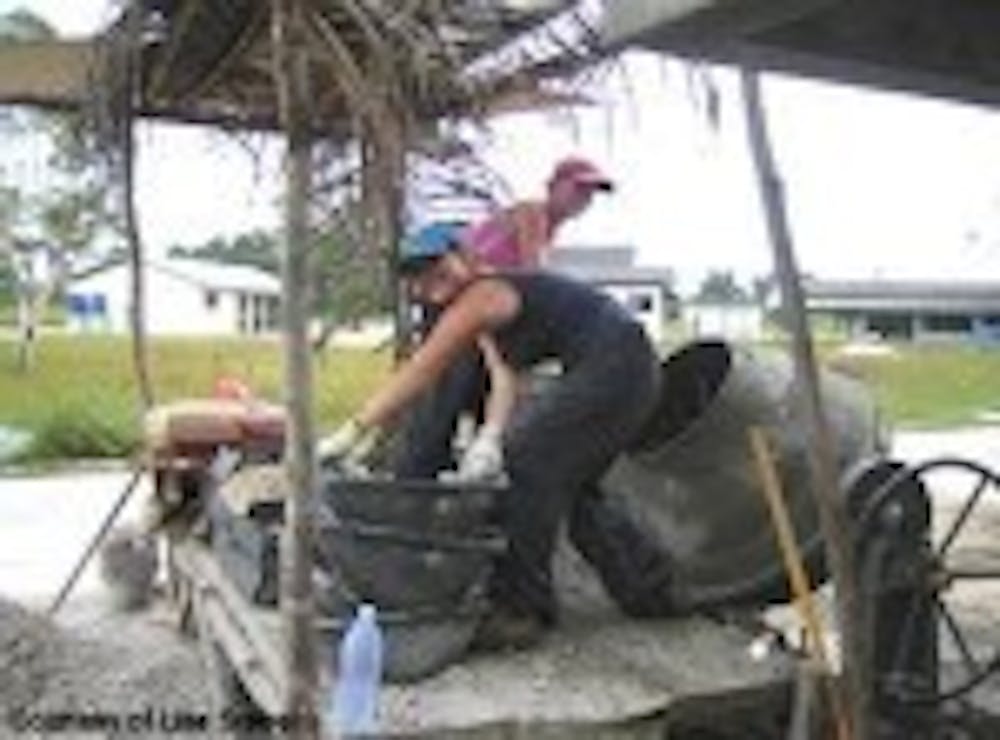
Instead, Harris and Stabel worked construction and were surrounded by professional men and women from across the globe who left their families and jobs to volunteer, some having been there for almost a year.
The two students traveled from their bungalow in Khao Lak to the island of Koh Kho Khao located off the western coast of Takuapa. Each morning, they hiked nearly a mile until they reached a car that would take them on a 20-minute ride to a ferry. After docking on the island, the two would hop in the back of a pickup truck filled with other workers, with whom they rode to the work site to begin their day.
"It was hard work and it was hot," Harris said. "After the first day I didn't think I'd make it all the way through."
After two straight weeks of 10-hour days, however, the girls said they felt like more than just volunteers.
Their long days consisted of constructing houses from scratch and building concrete stilts on which the new houses would sit. The girls' only means of protection from site hazards were their sunglasses, which were in constant use in order to avoid the hot sun.
Over the two weeks, Harris and Stabel heard tsunami horror stories, including that of a Thai man who stood on top of his truck and held on to a palm tree in order to save his life.
"Each person had a story or knew someone who died," Harris said.
The two were amazed by the amount of progress that was done in the short time they spent in Thailand. Both have volunteered for numerous organizations but felt this experience was by far the most meaningful and fulfilling.
UB and the SUNY system have a consortium for study abroad, which currently has over 400 programs. UB combining with SUNY allows students to find a program nearly anywhere in the world.
"There's a program out there to suit both academic needs and non-academic interests for virtually everyone who has an inclination to go," said Dr. Sandra Flash, the director of UB's Study Abroad Program. "In the study abroad program you're not just a tourist, you're learning more about the culture and environment while earning credits to fulfill your degree."
Harris and Stabel credit the program for their opportunity to lend their support to the rebuilding efforts.
"The study abroad program gave us extra time to volunteer," Stabel added. "If it weren't for the abroad program we would have never had this chance."
Harris, a native of Weedsport, N.Y., said she plans to join the Peace Corps after she graduates this spring; she attributes the experience of studying in Singapore and volunteering in Thailand to helping her prepare for the two and half year commitment.
"The best part was the people. They were really friendly and treated us like we were part of the community," Harris said.
"It really gave us a chance to meet people. It makes you understand and appreciate how hard they work," Stabel said. "These countries don't have the equipment or resources that America does."



