
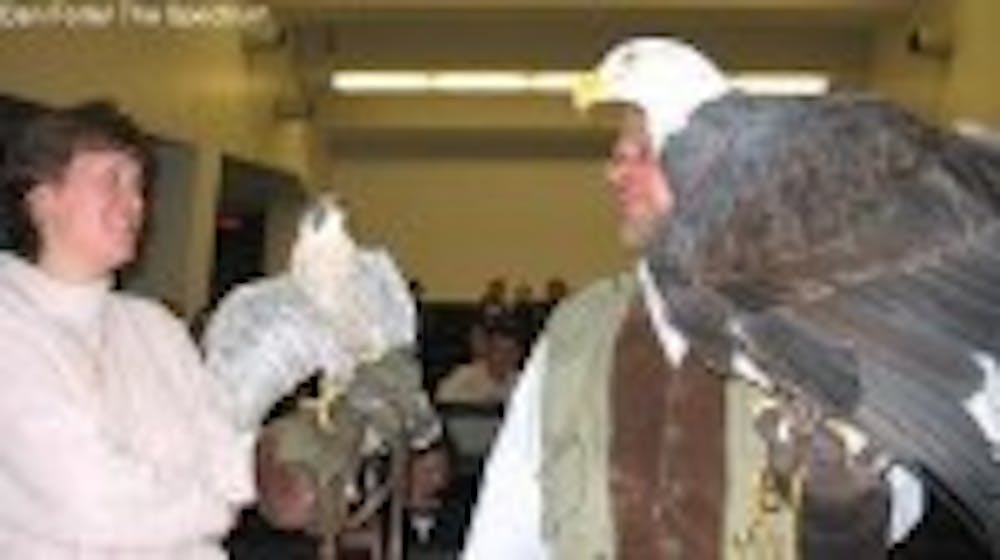
The bald eagle might be an American symbol, but few people have a chance to see this patriotic icon up close.
One environmental studies class had just that opportunity on Monday when Paul Schnell, from the Institute for Environmental Education, brought in four birds of prey to talk about the birds' role in the environment.
It was the kind of demonstration that can make math majors wish that just for one day wish they studied ecology, as Schnell brought in a bald eagle, a red tail hawk, a peregrine falcon, and a barred owl. Even before the raptors made their entrance, students were pumped.
"I'm expecting to see some cool birds," said Jenn Williams, sophomore environmental studies major.
Each "cool bird" was chosen specifically to demonstrate different traits that help each species adapt to hunting and capturing prey as well as their role in the balance of nature.
"The numbers of red tail are common so people can relate to the raptors they often see, while bald eagles and peregrine falcons are rare," said Schnell, a UB graduate. "They make people aware to preserve biodiversity and habitats."
While Schnell discussed birds, he also allowed them to feed, which shocked a few of the audience members.
"It was funny to see the feathers fly around, but I wasn't grossed out," said Nick Majcher, a sophomore mechanical engineering major.
Raptors, as well as other types of birds, play a large role in the ecosystem, according to Schnell. Their niche in the food chain maintains balance, and without these birds, there would be a large disruption in the ecosystem's equilibrium.
Additionally, the health of the bird populations reflects the health of the environment. For example, if there are harmful chemicals, such as pesticides, present in the environment, bird populations will be the first to suffer, in the same fashion California condors became extinct and bald eagles became endangered. Essentially, poor environments will attribute to the extinction of bird species.
In order to avoid this kind of disaster, Schnell warned the audience that people must keep the environment clean and stop the destruction of habitats.
"I wanted to inform people about environmental appreciation," Schnell said. "The human population grows by three million and we are losing habitats at the rate of three million acres a year."
Because of this increased birth rate, the wilderness is changing rapidly as more land is being used for human shelter.
As a result, people occupying this land need to be more aware of how their actions affect the environment as well as the species inhabiting those environments, according to Jim Simon, a graduate student studying environmental studies.
"I would like them to learn and appreciate the role of raptors in the ecosystem," said Simon, one of the event's promoters.
Schnell has performed this demonstration for 20 years in the Western New York area, and he said there are a number of ways in which people can help to alleviate environmental pollutants, such as carpooling, taking shorter baths to save water and conserve energy.
"Everyday, try to do something for the earth," Schnell said. "Take a young person out and introduce them to the earth."



