
Though some students here at UB might want better classes and more of them, few actually protest the issue, let alone riot. In Mongolia and India, where two cultures are facing a rising influence of liberal ideology in higher education, that's exactly what students are doing.
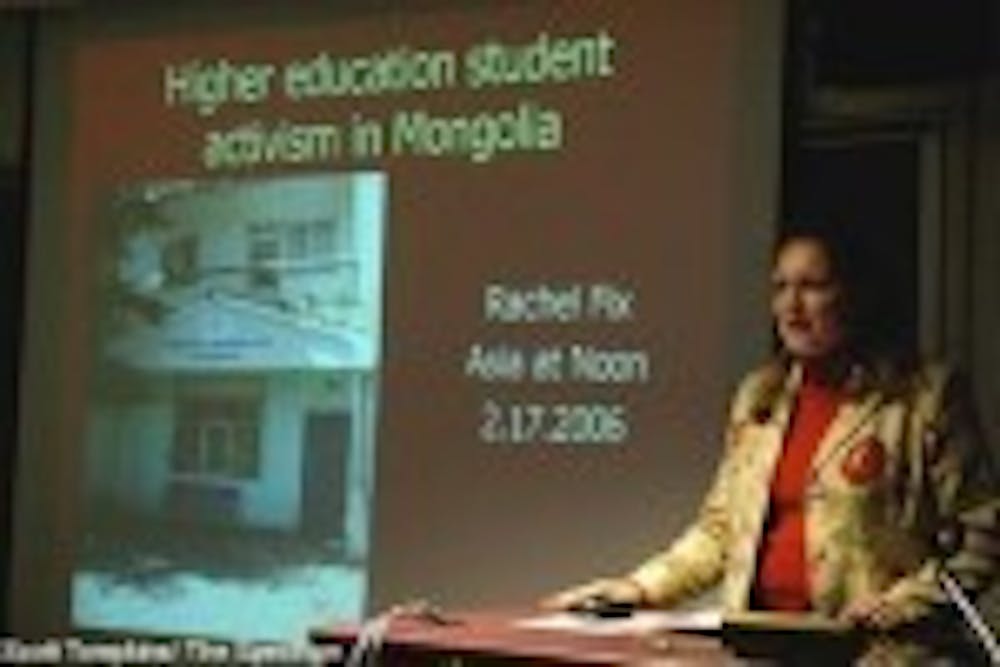
On Friday, a group of students and faculty gathered in Park Hall to discuss student activism in these Asian countries at the latest installment of UB's Asia at Noon series.
Rima Aranha, who holds a Master's in social work from Tata Institute of Social Sciences in India and is pursuing her Ph.D. in global studies at UB, focused her portion of the lecture on India.
Rachel Fix, who holds a Master's in international education policy from Harvard University and is currently pursuing her Ph.D. at UB's Center for Comparative and Global Studies in Education, focused on the situation in Mongolia after student protests turned violent last year. In addition to her research, Fix taught in Mongolia for three years and worked as an education consultant in the United States and abroad.
The presentation stressed that the Mongolian government is currently facing new challenges in its transition to a free market economy, creating a breeding ground for student involvement.
"It's creating an environment that is ripe for even more student activism," Fix said.
There are also issues with higher education: the quality of education is in question, costs are high and there's an overall disconnection between education and job opportunities.
"Higher education has never been in greater demand in Mongolia, but is also costly," Fix said.
According to Fix, interviews with Mongolian students conducted in a pilot study showed that many students are dissatisfied with the quality of education, because teachers don't even show up.
"We wait 20 minutes for the professors with doctorate degrees and 10 minutes for professors with Master's degrees," said one student. "If they don't show up, we leave."
The lunch seminar also focused on the political dynamics at universities in India.
Aranha focused on the student wing of the Ahhil Bharatiya Vidyarthi Parishad, an Indian political party and its transmission of a right wing ideology, which is trying to form and construct a Hindu nation.
There is a political mobilization with recruitment drives being held on campuses in India. The ABVP presents itself as a neutral, apolitical organization concerned with personality development and character building, but there's evidence of indoctrination of students into political ideology.
Aranha's examination of the student ABVP showed a central decision-making body where students and parents rarely question leaders.
The number of students involved in ABVP is unclear. ABVP claimed a membership of 22,281 students, but data collection only showed 25 to 30 active members. Aranha said the discrepancy lies in the fact that students often pay a fee to join, but never show up.
Student protests are occurring in India between Hindu and Muslim clashes. A protest was also held in October 2001 to speak out against Sept. 11.
"Students who got arrested are proud and say it is an instrument in freedom and democracy," Rima said.
Audience members gave both doctoral presenters a positive review.
"I'm familiar with their work," said Suzan Neary, doctoral student in Comparative and International Education. "I did enjoy the presentation and their work really complimented them."
"You always hear about the need of activism," said Sherene Cheah, graduate student in Comparative Higher Education. "You hear a lot, but nothing so in-depth. It's an eye opener of more things to come."



