
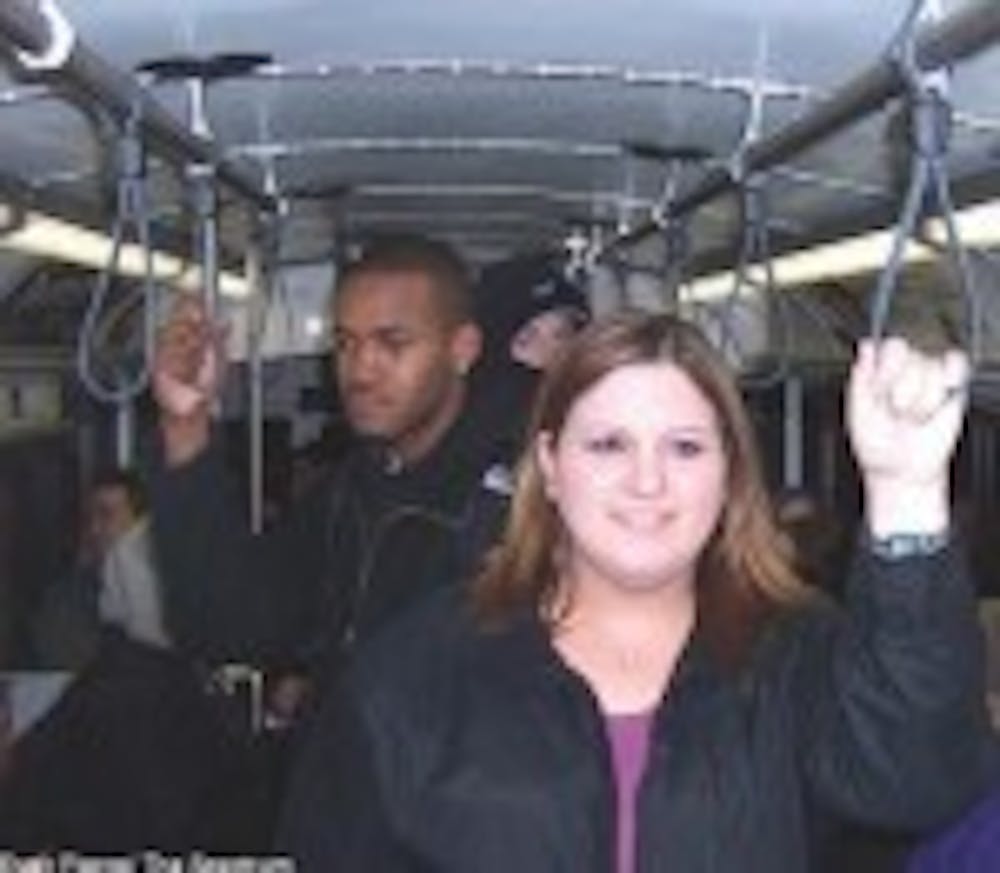
Students forced to stand on UB buses will no longer have to brace for impact whenever the shuttle comes to a halt. As part of a campus-wide effort to increase student safety, hanging straps have been installed on the buses, making routine stops a bit less jarring for commuters.
Although this precaution may seem small, the Personal Safety Committee (PSC) is also taking steps to enhance students' safety on a much larger scale. In addition to the bus straps, the PSC has installed new crosswalks in troubled areas, is continuing to crack down on illegal drinking, and has paid particular attention to rape prevention.
"I think the committee has been successful in improving blue-light phones and has bettered the lighting on campus, this year especially, to make students safer at night," said John Grela, director of Public Safety and chair of the PSC.
Cracking down on illegal drinking is a continuing concern for the committee, and officials said they feel that the recent closing of P.J. Bottoms is a personal victory.
"It's all about slowly building a case," Grela said. "I have been reporting the activities of P.J. Bottoms to the liquor authorities for the last 15 years, and these gradual processes are a big part of what Public Safety is all about."
Grela also said University Police and the PSC plan to focus on alcohol providers and party-throwers, rather than punishing individual drinkers.
The PSC meets every month during the academic year to discuss a long list of safety issues. They are also responsible for making UB's annual security report, a document required by federal law to be available to students and staff.
The security report is meant to inform those who are interested in many aspects of public safety at UB, including statistics on the numbers of on-campus crimes, policies regarding security, procedures in reporting crime, and descriptions of programs used to educate the campus community about alcohol, drugs, and abuse, according to Grela.
At Wednesday's Faculty Senate Executive Committee meeting, faculty voiced concerns over the security report and whether or not it is effectively distributed to students.
The report is sent to chairs of departments and, in most cases, that is the end of the line. Some members of the Faculty Senate suggested that to remedy this problem, the report should be accessible through the MyUB Web site.
In response, safety officials said they realize the document doesn't typically reach students, but the school takes alternative steps to educate undergraduates about personal safety.
PSC members host programs during freshman orientation, are increasingly involved in UB101 classes, and University Police officers teach self-defense workshops.
While some faculty members said the annual security report is not easily accessible, others questioned its accuracy -- some even claimed it's just a tool to make UB appear safe to prospective students.
"I feel that some of these numbers, including rape and alcohol crimes, are extraordinarily small," said Debra Street, an assistant professor in the sociology department. "It feels that the numbers could be doctored for the sake of prospective students and their parents."
Grela reassured that the numbers were accurate to the fullest extent of his abilities, though he said the numbers are only incidents that have been reported. He is unable to control the unreported crimes that occur at UB.
Though there is still a dispute over how to best utilize the information in the security report, Marilyn Kramer, the Faculty Senate representative for the PSC, said that what has been accomplished should not be overshadowed by a disagreement.
"We have a rather routine agenda at PSC meetings in which certain members report certain subject matters," she said. "Although the bureaucratic portions are sometimes prevalent, we are more importantly focused on the students' needs and, of course, their safety."



