
Thirty people gathered at the Buffalo Convention Center in the icy, pouring rain on Monday to protest the sale of hundreds of abandoned homes to the highest bidders, many of whom will never set foot on the property they just bought.
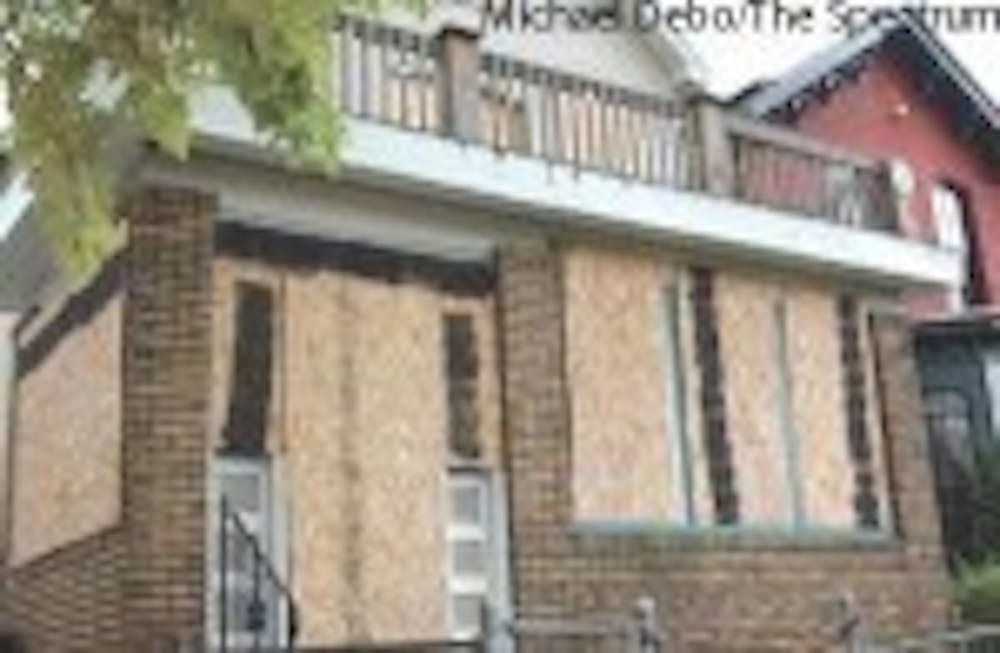
These absentee property owners oftentimes only buy the property with the intent to sell it again at a higher price, usually ignoring much-needed repairs, leaving dilapidated houses and rundown buildings to blight neighborhoods like many in Buffalo's West side.
Aaron Bartley, head of People United for Sustainable Housing, said many of these landlords flock to wholesale auctions, buying up houses with no intention of improving them at all. His group hopes its efforts will help stem the tide of these absentee landlords and, in turn, help improve city neighborhoods.
"The types that we're really concerned with are those who buy property and sell it very quickly," Bartley said. "That's called 'flipping.' "
A lot of flipping is done on eBay and other Internet sites where Bartley said one could find 40 to 50 properties on the West side alone for sale at any given time.
"Someone may buy a house for what they think is an great deal on eBay, even after the person who bought it at auction doubles what they paid, and then get here and find that the house doesn't have a roof or is unlivable," Bartley said.
What's worse is that those homes usually end up being abandoned.
The other kind of absentee landlord negatively influencing the community is the one who charges outrageous rent and doesn't put any of the money back into the building.
"The percentage of homeowners that aren't in the homes or in the city is going up," Bartley said.
Bartley, who is also an adjunct instructor of urban and regional planning at UB, said his group's protest had a good opportunity to raise those issues at Monday's property auction.
"The event was widely covered," he said. "Our presence was definitely felt."
Other problem areas that Bartley cited were lax rule enforcement by the federal Housing and Urban Development agency, as well as banks in the area.
HUD is supposed to give preference to people who live in the area and will live in the homes when it comes to buying these foreclosed properties. But HUD, through its lack of enforcement, is allowing people to pretend to be owner-occupants and bid on the homes, only to flip them later, according to Bartley.
And banks, through the Community Reinvestment Act, are supposed to reinvest in low-income neighborhoods, and that's just not happening, Bartley said.
One of PUSH's goals is to create a homesteading program where low-income families would be given a price break on homes if they agreed to live in them for a period of time. This would increase the owner-occupancy rate of the area, which is directly related to the health of a neighborhood.
Another helpful tool is that of the "housing co-op" where each apartment building is owned collectively by the tenants so that issues such as repairs are more likely to be addressed.
Another PUSH idea is the "community land trust" where a non-profit organization owns the land on which the home is built and the home is owned privately. If someone buys a decrepit home for $4,000 then fixes it up, they could possibly raise the value to upwards of $40,000, said Bartley.
"The purpose of the community land trust is to control appreciation rates," he said. "The purpose of that is so that the homes don't become unaffordable to low-income families."
PUSH actually bought one of the properties at Monday's auction with the hopes of fixing it up and starting one of those "housing co-ops." The property they have acquired will be brought up to code and made livable before it is sold.
There will be several volunteer opportunities for students to help with the Habitat-for-Humanity-style rehabilitation of these West-side neighborhoods, according to Bartley.
"(UB students should) keep looking for opportunities to be involved in the neighborhood," Bartley said.



