
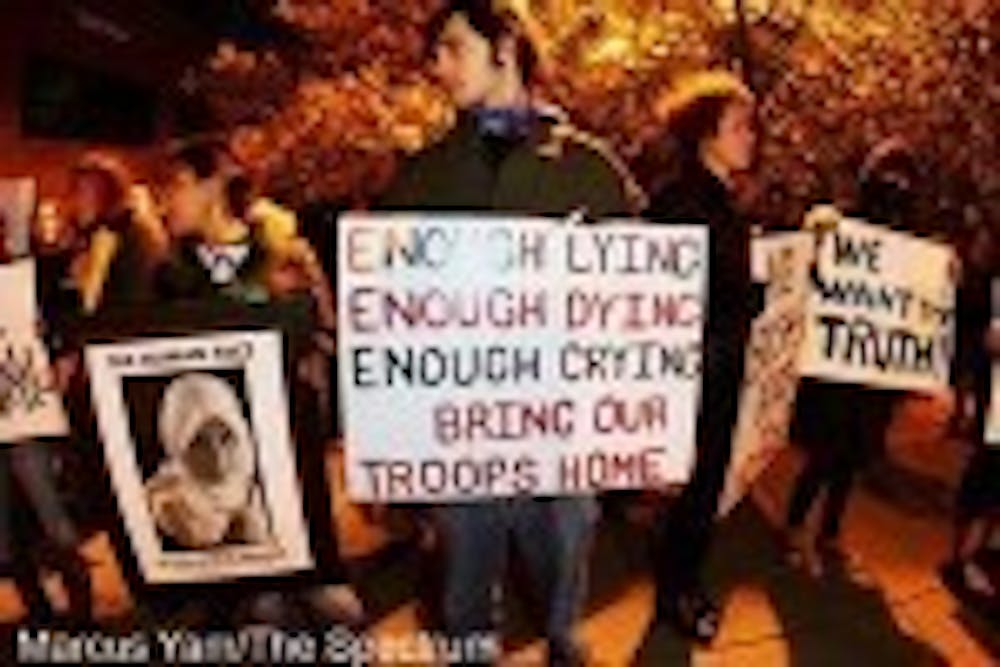
Colin Powell called his errors in presenting WMD to the United Nations a "painful blot" in his career. Protestors outside his speech on Wednesday seemed to believe his role in the Iraq war is more than a blot - it's a full-blown scar.
"I find it offensive that UB is allowing a war criminal to speak here," said Ben Priest, a second-year graduate student in English.
While many people praise Colin Powell for his accomplishments as the first African-American five-star general, a former joint chief of staff and the former U.S. secretary of state, over 50 members of the UB and Buffalo communities raised their voices in protest outside Alumni Arena to show their disgust for Powell's involvement in the Iraq war and the event's alleged censorship of hard-line questions.
Priest said he hoped Powell would be able to admit he was wrong.
"I think it will be interesting to see if he can respond articulately to the tough questions (about the war)," Priest said.
The protest was lead by the UB Progressive Alliance, a newly-formed group whose goals include bringing undergrads, graduate students, faculty and staff on campus together to extend democracy here and around the world, according to James Holstun, an English professor and member of the Alliance.
The protest went strong as the picketers withstood dropping temperatures and the occasional jeer from someone entering the arena. For them, there was a sense in the air that what they were doing was right, that they were winning.
"The majority of Americans are against the war according to the polls," said Eben Schwartz, a second-year psychology graduate student. "It's not just a minority or some fringe group."
Most of the protesters said they were promoting the cause of peace. Singing, chanting and handing out fliers, the event without any violence or words harsher than the Raging Grannies' song saying to "stick that war in your pants, sir."
Protestors were critical of not only Powell's role in the Iraq War, but also that UB appointed a panel to screen questions. There were no questions asked about Iraq during Powell's question and answer session.
There was a strong student turnout for the protest and many of the attendees said they planned on attending Powell's speech itself. Major issues raised by people included an "illegal war" being waged, Colin Powell's presentations to the UN to justify the war, the money being spent on the war and the money being spent to bring Powell to UB.
"The major problem is that UB is paying a large amount of money to bring someone who started an illegal war," said Paul Ott, a fourth-year philosophy graduate student. "Colin Powell seems to have a positive image about him but he has a long history of going to war. He was involved in Vietnam and he led the invasion of Panama."
His accomplishments in office were enough, however, for some students to overlook any possible wrongdoing.
"He was a joint chief of staff. He was the first African-American secretary of state," said Aaron Greenberg, a freshman political science major. "He has a lot to teach students and it's money well spent. They have the right to protest, I just think it's stupid."
Still, the protestors and some passers-by said they remained unmoved by Powell's record. Josh Weinstein, a fourth-year English graduate student who was with Priest, said he isn't as critical of Powell but would like to see peace in the near future.
"I don't think he's a war criminal," Weinstein said. "I'm here to advocate peace."
For other protesters, the fact that Powell admitted that going to war was the wrong thing to do was not a central issue. Rather, they focused more on the losses incurred as a result of the war.
"I know he admitted to his lies but what can you say to the 100,000 Iraqi dead and the 2,000 American dead, and all of their families?" said Marie Kullman, who was protesting with the Buffalo War Resisters.
The Buffalo War Resisters has been protesting the war outside of the Army Recruitment Office downtown since Aug. 6, 2004 -- which is also annually the anniversary of Hiroshima -- and joined the UBPA Wednesday night.
Another group present at the protest was Women in Black. They are part of an international peace movement that began in Israel in 1988 to protest the occupation of Palestinian land. The Buffalo Chapter began its picket on Oct. 13, 2001, the week after the first bombs were dropped on Afghanistan, said Pat Shelly, a member of Women in Black that also works for the Gender Institute at UB.
Shelly said that "now they're protesting that money is being spent on war and not health care, education and housing."
And protesting through song were the Raging Grannies, an international peace organization whose purpose is to "in the tradition of wise women elders...promote global peace, justice and social and economic equality by raising public awareness through the medium of song and humor," according to their Web site.



