
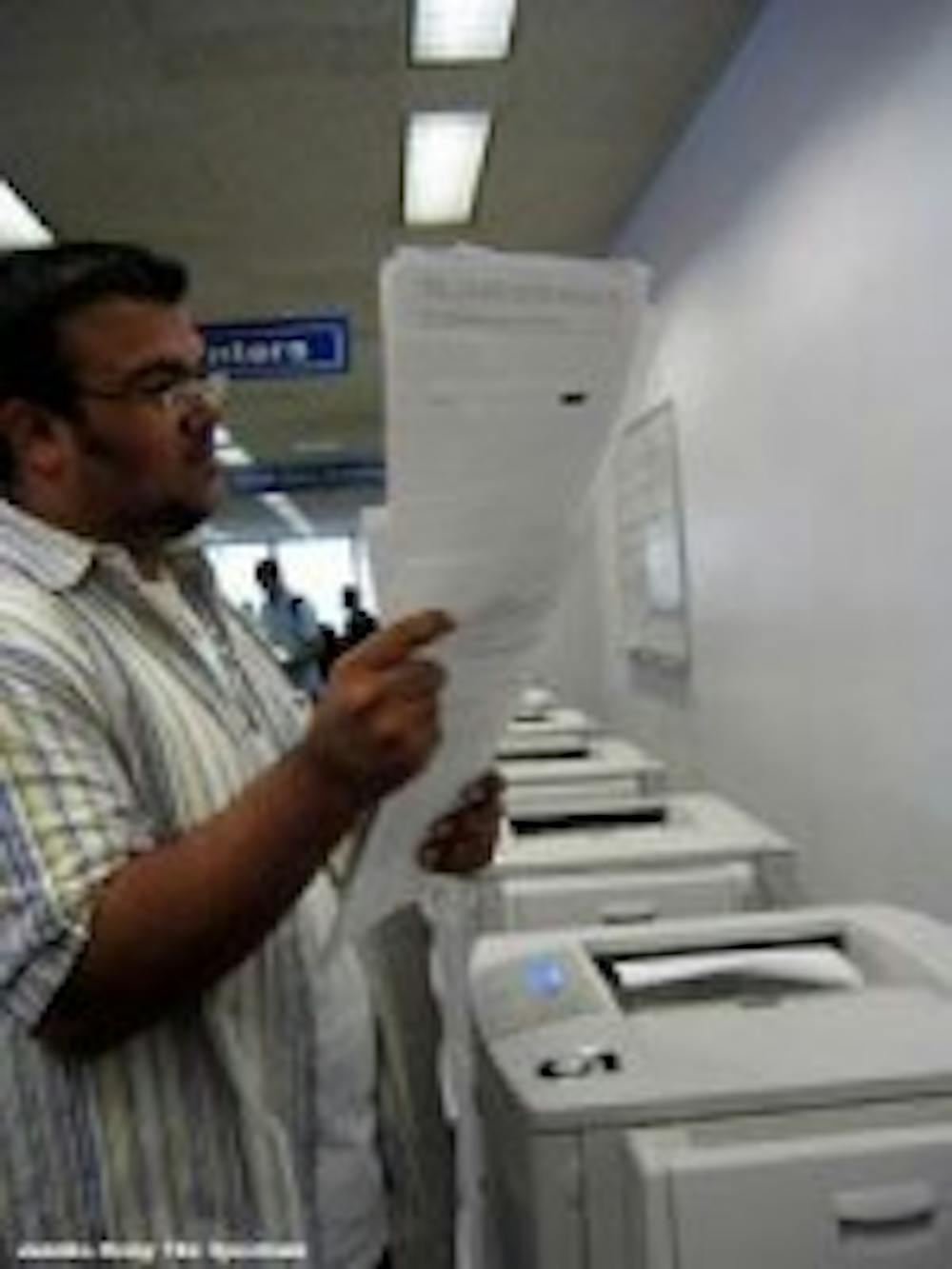
As if most lines are UB weren't long enough already, the wait isn't over for the arrival of iPrint@UB, a new print allocation program that will limit student printouts.
The system, which will allow each student, faculty, and staff member to print 650 pages each semester, and an additional 200 pages during the summer session, has been delayed in starting yet again.
According to UB officials, the vendor that sold iPrint to UB lost their key developer this past summer when iPrint was supposed to begin its pilot. That means the system could not be tailored to fit the needs of the university.
Without that key developer, things are not moving as rapidly as before but the process is back on its feet. Rick Lesniak, director of academic services for CIT, there were several major reasons UB couldn't move forward with iPrint over the summer or even in the fall semester.
One problem, he said, was that the system wouldn't consistently display the number of pages a student had remaining in their account. Based on that, they didn't want to move forward with a possibly faulty program.
"We're going to have unhappy students, we don't want that" said Lesniak.
The system promises shorter waits for printouts since shorter jobs, usually around five pages, will be printed right away and long ones will be queued for a certain amount of time, Lesniak said.
Kalil Hodges, a senior exercise science major, said that the vast majority of what he prints are PowerPoint presentations he needs for class. He said that teachers should start printing more of what they want students to have for class so it doesn't take up all of the pages he needs for printing assignments.
"My teachers don't even print their syllabi anymore" he said.
Lesniak said that teachers only account for about 2 percent of the overall printing on campus. In past years, if a professor needed a large print job, it often came out of that teacher's departmental budget. At least a partial shift back to that concept may be necessary, Lesniak said.
Raju Soman, a senior chemical engineering major, was strongly opposed to iPrint at first, but said he warmed up to it as he learned more.
"It will be okay if teachers start to print more instead of putting it on the student's shoulders," he said.
Lesniak said the group that has expressed the most dislike for the system is teacher's assistants, better known as TA's. He said they not only have to print what they need for the classes that they are taking but many of them also share the responsibility of having to print handouts for the classes that they are assisting or teaching.
Lesniak said investigations to see if possible accommodations can be made in the future are underway.
Many graduate students have argued that they need a higher printing allocation, but Lesniak said it could not be overlooked that they pay the same technology fee as undergraduate students. The system, he said, should be fair.
Joe Gill, a junior mechanical engineering major said he doesn't print a lot, "But I can see the problem (with the current system)."
Gill said an approval system similar to that of some high schools, where the librarian or moderator needs to approve what one prints, might be effective.
Although UB spends a tremendous amount each year on paper and ink, Lesniak said iPrint@UB isn't being introduced so UB can cut costs.
"The point is not to save money but to improve service and ensure consistency as well as lower print times," Lesniak said.
The latest the pilot program will begin this semester is early November, so it won't interfere with peak print times as the semester ends, according to Lesniak. He said if the program is further delayed, it would begin in January 2006.
"I can't imagine that it would take any longer," he said. "But we don't want to make promises we can't keep"



