
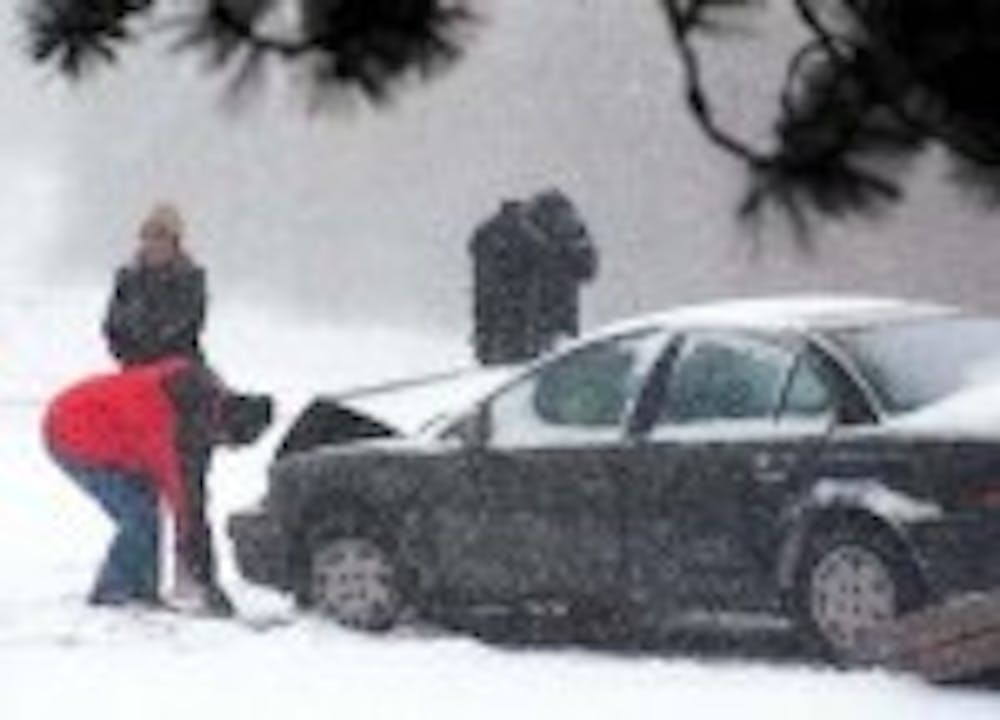
Snow-covered cars spin their wheels and careen like billiard balls down unplowed roads. On campus, where the yellow lines are obscured, they are strewn casually around the lots.
The snow starts falling. Hard. The gas gauge is on "E." How long has it been there? Can I skip class and go back to sleep? Can I move to California? Tomorrow?
It's January in Buffalo, and for commuter students, getting to class is no less than an Olympic feat. The time-tested commuters have one major piece of advice: be prepared.
Mandy Anderson, a graduate student majoring in biology education, has an hour and fifteen-minute drive from Honeoye Falls during the winter season.
Anderson said she is fairly prepared in case an emergency happens on her long drive.
"I make sure I always have my cell phone with me," she said. "I don't have extra clothes, but I have blankets and food. I make sure I get my oil changed regularly and that I'm confident my car won't break down."
The two keys to safe winter transportation are preparing your vehicle and knowing what to do in an emergency, according to the Federal Emergency Management Agency's winter driving advice Web site.
The site recommends that prior to going out in the snow, every car should be checked by a mechanic for properly functioning exhaust, heaters and batteries. Fuel tanks should never go below half full, the site says.
However, even with sufficiently maintained and working vehicles, it is possible to get stuck or stranded in poorly plowed areas. The site advises drivers to make sure they are prepared in case of an emergency situation.
Martin Bielicki, a freshman undecided major, who has a daily 40 to 45 minute commute from Gasport, said his car is stocked and fully prepared for any winter driving catastrophe.
"We have jumper cables, an SOS sign, a First Aid kit, an anti-rape whistle, stuff to get the door open, a crow bar and a flashlight," he said.
Bielicki also stocks a thick rope, tire sealer, batteries and an emergency bag of water.
Though he says he has thought about the subject, Bielicki said he doesn't have a detailed plan of what to do in case of an emergency.
"You have to take it in a situation by situation basis when making your decisions about travel," he said.
In the past, Bielicki has resorted to taking the bus, had his brother drive him to campus, and stayed with friends who dorm when bad weather struck.
However, even these precautions did not help when he almost skidded into a guardrail turning on Audubon Parkway the other day.
While skidding is sometimes unavoidable, Drivers.com offers advice on the best way to handle the situation. In a skid, the driver should remove his or her foot from the pedals and focus on steering until control is regained. A sudden input of brake or acceleration can only make things worse.
If ever trapped in a car during a blizzard, stay in the car unless help is visible a short distance away, FEMA advises. Display an SOS sign, or hang a brightly colored cloth from the car's radio antenna.
Jennifer Bonkoske, a sophomore industrial engineering major, said she keeps emergency items in her car.
"I have a whole tote of stuff in the back," she said. Some of the items include extra washer fluid, a pillow, and sleeping bag.
Bonkoske said if ever snowed in, she would call someone to come and get her.
Having a cell phone on hand is one way to be sure of getting out of a dire situation as quickly as possible. While waiting for help to arrive, FEMA recommends doing minor exercises to avoid frostbite or hypothermia, and using newspapers, maps, or even car mats for added insulation.
Kim Rosenthal, a Buffalo resident who commutes to Genesee Community College, admitted to not having any emergency items in her car. But Rosenthal said she makes sure to give herself ample time in snowy weather on her trip to GCC, which is 40 minutes east of Buffalo on the Thruway.
"If I know the weather is bad I will usually give myself enough time so I'm not rushed or worried," she said.
Rosenthal said she plans to camp out in the library if ever stranded.
"I would probably find a nice soft chair in the library and stay there," she said.
When snow and ice make driving impossible, UB students can take advantage of the commuter lounge, which is open until midnight on weekdays and 2 a.m. on weekends.
"If there is a problem after regular business hours, students can either call university police, or contact the Student Union manager at the information booth," said Emily Allen, the graduate assistant for UB's Office of Commuter Services.
Allen said students who decide to stay overnight on campus should be careful about where they leave their cars.
She advises them to pay attention to designated overnight parking lots to avoid a ticket, as snowplows come through early in the morning.
Although drivers must be responsible for their own safety during the winter season, many said they are aware that accidents can often be the result of mishaps caused by other drivers.
Anderson, the biology student from Honeoye Falls, said her real worry about winter driving is avoiding other cars.
"In the snow it's more frustrating because I don't think other people are as careful," she said. "They're in a hurry and they're going too fast, and I'm afraid if they needed to stop they would run into me."
Despite the weather, life goes on and responsibilities must be fulfilled. Students acknowledge the need to take proper caution to ensure that they get where they need to be and do what they have to do, even in a snowstorm.
"You have to get to class regardless of your situation," said Bielicki, the freshman from Gasport. "Sometimes it involves leaving earlier in the morning, being late to class, or in rare cases staying somewhere overnight."



