
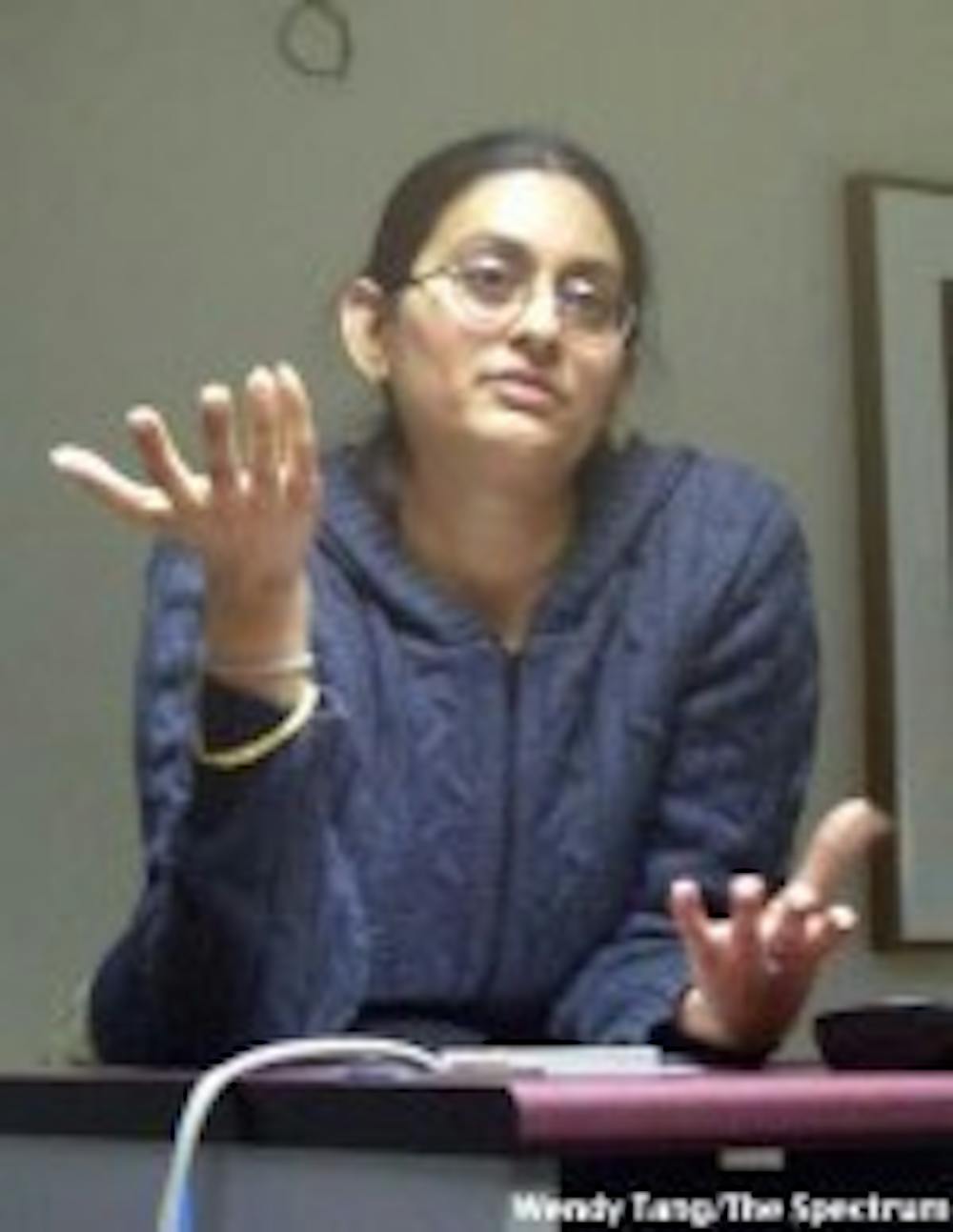
To Neelima Raju, her lecture on Indian dance at Park Hall on Friday wasn't just about showing students a few colorful steps or entertaining them with the spiritual rhythms of India.
"I hope that students will see the importance of maintaining traditions and aspects of your culture such as this," Raju said. "Classical dance is being studied by fewer and fewer Indians and is at risk of being lost if these studies aren't continued."
A doctoral student in cellular biology at the Roswell Park Cancer Institute, Raju spoke Friday as a part of UB's "Asia at Noon" program, a series of brown-bag lunch lectures sponsored by the Asian Studies department. Raju's lecture, entitled "Dance Traditions of India: Kuchipundi, Heritage of the State of Andhra Pradesh," was the fifth of six Asia at Noon lectures planned for this semester.
Raju has practiced classical Indian dance for 17 years, during which she has given about 100 solo and group recitals across the county of India. She opened the lecture by focusing and discussing the classical dance and theater traditions of Southern India.
"In Southern India, the classical and dance are very closely linked and exist as almost one tradition," Raju said. "Classical dance is taught under the master-apprentice system, and it is very closely linked with religion, philosophy, and the general way of life."
Raju also covered the general concepts of Indian dance, which are based on the "natya shastra," the bible of Indian dance and theater.
According to Raju, the intricate patterns of beats and the movements of major and minor body parts are unique to Indian dance. These, coupled with the descriptive gestures and mime that are also characteristic to Indian dance, make for distinctive "poetry in motion."
"With Indian dance, there is an integration of religion, philosophy, poetry, sculpture, dance and music," Raju said. "Indian dance is much more than just dance."
Raju also touched on the role of gender in Indian dance and the changes that have been made to those roles over the past 30 years.
"Traditionally, only men participated in classical dance, playing the roles of women," she said. "But men are also traditionally the bread-winners in Indian families, and it is hard to sustain a family on a dancer's pay. So women have stepped in, first playing their respective roles and then eventually taking over the men's roles."
Thomas Burkman, director of the Asian Studies department, said each Asia at Noon lecture serves a certain niche, and this one particularly related to the program's recent goals.
"This particular lecture fit well into our present development of the Asian Studies department," Burkman said. "We have a new program on Indian history, so this lecture was especially helpful."
Kristen Bogaard, a sophomore architecture major, said she found the subject of Raju's lecture to be intriguing.
"I absolutely love Indian dance and think it's just fascinating, from the actual dancing down to the clothes they wear when they dance," Bogaard said. "The whole Indian culture is just amazing. I just love learning about it."
Raju said she hopes students left her talk with a sense of the importance of maintaining traditions like Indian dance.
"Our traditions are what make up our respective cultures," she said. "Without these traditions, we are nothing."
The Asia at Noon series continues with Fang Qiang's "The Complaint System in China" on Nov. 19 in 280 Park Hall.



