
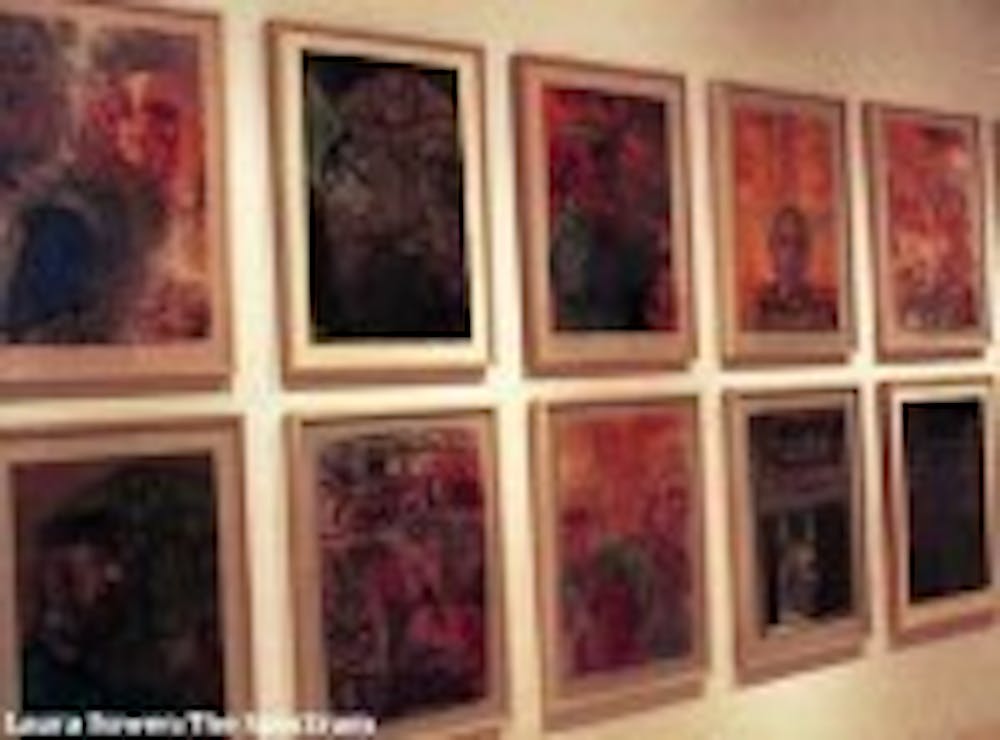
The head of an aged professor sits against an Armageddon-soaked backdrop with antediluvian texts littered throughout the canvas. A room full of self-absorbed, anti-socialites are unknowingly rendered from their backside. An eggshell jacket is mysteriously suspended in the air as if sitting on the shoulders of a ghost.
These are part of a recurrent theme in artist Harvey Breverman's "Humanist Impulses," a book released in conjunction the opening of the exhibit of the same name. The display is shown at the UB Art Gallery in the Center for the Arts and the Anderson Art Gallery on Martha Jackson Place near South Campus through Dec. 31.
Breverman's show at UB marks his 85th solo exposition. More than 200 of Breverman's paintings decorate UB's gallery walls. Breverman, a former UB professor since 1961, recently won the Distinguished Teaching of Art Award from the College of Art Association.
Breverman's years at UB evidently had a peculiar influence on many of his paintings. One can envision many of the aged and wrinkled faces represented in Breverman's portraits teaching Shakespeare in Clemens or discussing postmodern impressionism in the CFA. That's because many of those faces made up the UB intellectual community of yesteryear.
Faces like Sigmund Abeles, John Ashbery, John Barth, Samuel Beckett, Diane Christian, Robert Creeley, Carl Dennis, Leslie Fiedler, Michel Foucault, Allen Ginsberg, Alain Robbe-Grillet, Susan Howe, Bruce Jackson, William Kennedy, R. B. Kitaj, W.S. Merwin, Alice Walker, and Tom Wolfe.
Each face tells a different story and ambiguously expresses an interpretable gamut of emotions. In the book, essayist and critic Nancy Green, in respect of Breverman's humanist depictions, lauds the varying spectrum of emotion within each character.
"His subjects live, breathe, suffer, triumph. They are survivors who daily confront the intricate mystery of everyday life, and they are grounded in the centuries of the Old Masters."
Often professed to be a realist, Breverman details some of his paintings with meticulous precision. In "Benediction Diptych II" Breverman fastidiously depicts a raggedly decrepit overcoat that could only be imagined cloaked around a wandering vagabond or an inner-city bum.
"As a draftsman, Breverman excels. It is this talent that may cause some viewers to hum a realist painter," Green says in the book. "He carefully exposes each fold, each stitch in the seam, each facial wrinkle."
Coats and shawls make up an unusual and hefty section across the gallery walls. Breverman, in an interview with Sandra Firmin, described his abnormal fixation with his linen drawings.
"My excitement with the complexity of folds and how they suggest what is going on underneath is probably why the nude has not surfaced on my work," he said.
Besides his depiction of woolens and of UB's ancient alumni, the Holocaust is another theme that Breverman artistically explores.
Breverman says that, "as a longtime student of the Holocaust history and, though not a survivor, one who lost relatives in Eastern Europe, I grew up in that dark time in the United States with all of its requisite baggage."
In "Terezin IV" a barbed wire is amplified against a fiery red background. Below, geysers of fire are torched, each billowing smoke into the dreary skyline. The gloomy mood and warlike scenery are reminiscent of Nazi concentration camps.
But Breverman's paintings contain more substance than a mere picturesque portrayal of an expression or a historic location. They demand interpretation, and because of each painting's flexible and abstract individuality, personal interpretation is a must when analyzing Breverman's work.
In the book, Breverman said it best.
"As the great imponderable, meaning and interpretation are variable and reside in the senses. Visual phenomena, even when clothed in recognizable and describable forms, may defy rational explanation. But they demand prolonged looking and an attempt at verbal discourse."



