
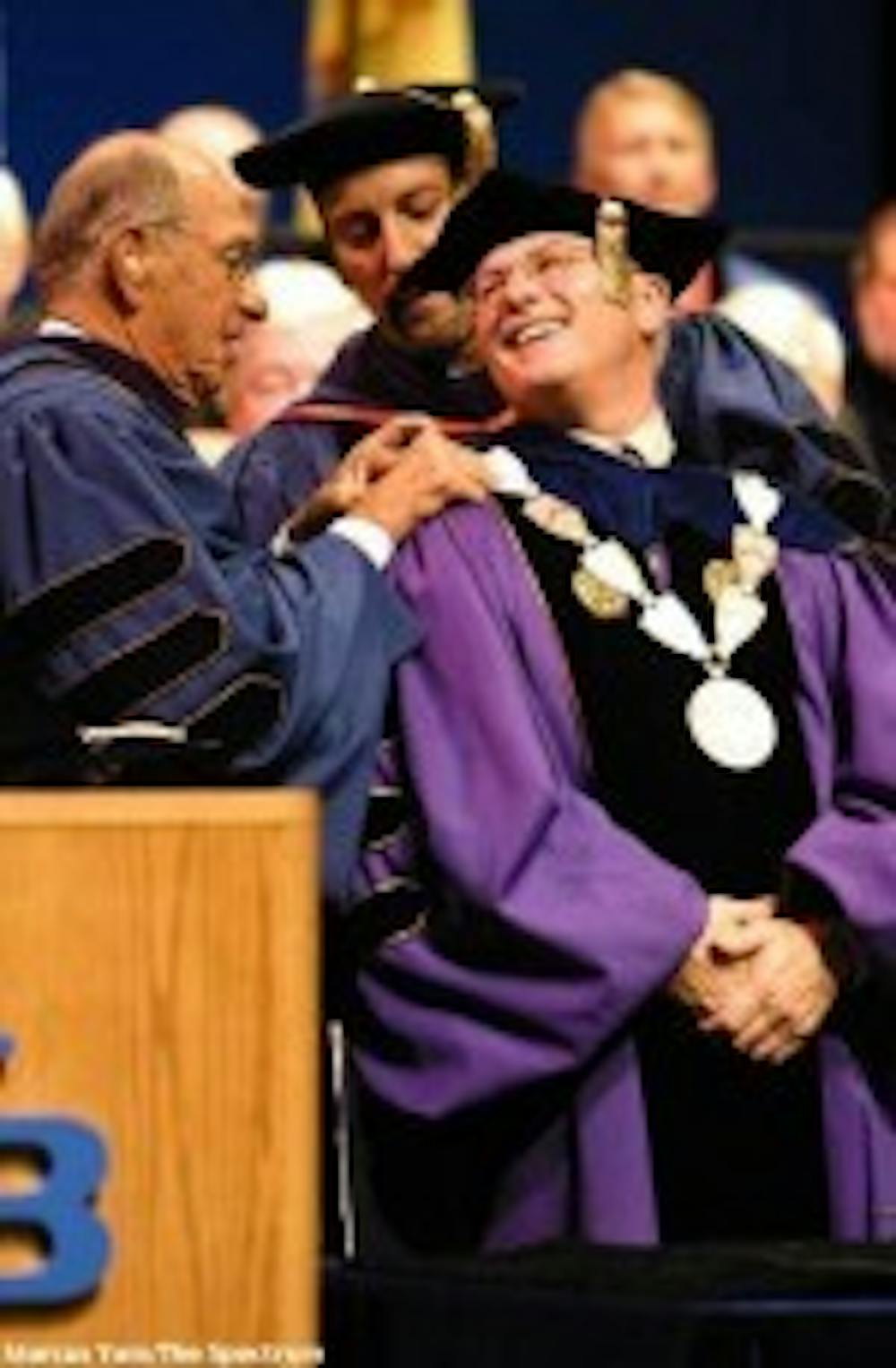
John B. Simpson was inaugurated as the 14th president of UB Friday in an event rich with academic ceremony and talk of UB's future.
In his acceptance speech, Simpson spoke of his long-term vision for the university and emphasized the role of public higher education in America.
"I pledge to you today that UB's very first priority will be the considered pursuit and practice of academic excellence," Simpson said during his speech. "UB will pursue and practice academic excellence in ways that ensure our institutional commitment to integrity, to collegiality, to equity, to diversity and to educational access."
Most of the UB academic and administrative community attended the investiture ceremony, which last occurred at UB 12 years ago when William Greiner became the 13th president.
Representatives from over 100 universities around the world, UB alumni from the past six decades, government officials and a limited number of students also attended the ceremony.
Four speakers from Simpson's past spoke during the investiture, among them his father, Barclay. Simpson was also welcomed by speeches from members of the UB community.
"It was a great gathering of people and a great gathering of ideas," said Dennis Black, vice president for Student Affairs.
"Great Public Trust"
The focus of Simpson's speech was on the role of public higher education in America. He said that as a public university, UB was intended to fulfill a "very great public trust" and must make efforts to provide accessible education to prospective students.
"Both across the nation and here in New York State, we must improve the ways in which we ensure public access to public universities," Simpson said. "We must do so not only because it is part of our public mission, and because it is simply the right thing to do, but as well because higher education is foundational to our society and vital to our democracy."
In his speech, Simpson cited statistics that show 29 percent of families with income under $25,000 per year have a student in college, as compared to 67 percent of families with an income of over $75,000.
"Public universities like UB ... can help lead the way in finding solutions to the very real challenge of providing equitable access to higher education in this country," Simpson said.
Simpson also spoke of the commitment to Western New York he believes UB holds.
"With its intellectual capital, and potential to attract new investment, the research university therefore functions as a crucial force in fueling economic development efforts," Simpson said, adding that UB's economic impact on the region was last measured at over $1 billion.
As public higher education was a theme in Simpson's speech, it is also an issue in the upcoming presidential election. But if Simpson has an idea which plan would be better for institutions like UB, he's not saying.
"There are good and bad things about both plans," Simpson said in an interview before the investiture, adding he was very familiar with both of the candidates' plans for public higher education.
Long-term Plans
Simpson also outlined his strategy for determining UB's future, a process that centers on a project called UB2020. The program will solicit input from UB's academic community and will develop a long-term master plan for the university.
"This strategic planning process will guide us in developing a realistic understanding of what we should do as an institution, and equally important, what we should not do," Simpson said.
He added that "academic excellence" would be the ultimate goal for UB2020.
"UB is first and foremost an academic institution, and academic issues are what we are all about," Simpson said.
Research will be an important aspect of UB's academic successes in the future, Simpson said. He has already taken steps as president to increase the university's research potential by investing further in the Bioinformatics Center in downtown Buffalo.
"The research university will continue to provide the means ... by which we explore the human experience and advance the ongoing development of every aspect of human society," said Simpson.
Insight, Academics, and Humor
Before Simpson's speech, a long line of varied speakers took a few minutes each to give their greetings, speak their minds, and talk about their own experiences with the man of the hour.
SUNY Chancellor Robert King called Simpson "just the right person to lead UB in this time" and added that Simpson is "a person of enormous demonstrated talent, a scholar, a leader, and a very nice guy."
Four key speakers from Simpson's personal past spoke the most in-depth about higher education and Simpson himself.
Susan Jeffords, professor and vice provost at the University of Washington, worked with Simpson when he was a dean and "came to respect and honor him very deeply."
Jeffords stressed the importance of the humanities and the arts, "which give us the opportunity to see the world through someone else's eyes."
"While all of the devices of technology and science may link us together, they do not connect us," she said.
Jeffords said at his core Simpson is a scientist, but it took a scientist of Simpson's vision and understanding to raise the level of Washington's humanities program to one of the finest in the nation.
"That will make him such an extraordinary president," Jeffords said.
Joyce Justus worked with Simpson when he became a vice provost at UC-Santa Cruz. Justus said she was most interested in "the quality of the man," about which she discovered three things: Simpson was honest, dedicated and a believer.
"His dedication to his practice and principle is a thread which runs through everything he does," said Justus, a professor emerita at UC-San Diego.
After touching on the issue of the academic achievement gap, Justus added that Simpson is "focused, funny, hard working, and he never shrinks away from a problem. You guys don't know what you got. You're in for a wild ride."
Claude Steele, a professor from Stanford University, painted a picture of Simpson as someone who loves to push the limits, build, and make projects work.
"John is a person who is not quite complete without a challenge," Steele said. "Challenge brings him into focus."
Steele also spoke about how the job of bringing together groups divided by race, economics and gender within a community has fallen to the universities.
"Smart leaders pick their challenges, but great leaders rise to theirs," Steele said.
On the subject of rising to challenges, Simpson's father Barclay, a successful businessman in California, said he would like to see university presidents like his son fulfill their obligation of helping the less fortunate.
"(Universities) have an obligation to help and teach the less fortunate or their kids and grandkids will pay a heavy price," he said.
Simpson's father also cracked a few jokes concerning what he couldn't say as a guest speaker.
"I cannot comment on President Bush's intellect, plus or minus. Nor can I discuss John's sex life or other interesting subjects," he said.
Along with their congratulations, many of the speakers touched on academic points.
Robert Bennett, chancellor of the state Board of Regents, stressed the role of a large research university to "close the gap for those most needy students." Johann-Dietrich W?\0xA6rner, president of the Darmstadt University of Technology, said he hopes Simpson keeps strong the international ties former President Greiner forged.
"UB is at a critical stage," said state Senator Dale Volker. "Its foundation is solid. Its potential is endless."
UB distinguished professor Susan Howe quoted former UB President Samuel Capen to talk about the dual role of a college president. Student representative David Brooks also quoted Capen, saying that UB is "certainly a place for grand plans" like Simpson's.
A Positive Reaction
Following the recessional, faculty and community members had nothing but good words for both Simpson and the ceremony at a reception in the CFA atrium.
Provost Satish Tripathi said he thought Simpson's speech was "very thoughtful" and that it showed "the status of higher education."
"Both John and his father talked about access, and that's very important," Tripathi said. "It's an exciting time."
Robert McIsaac, a UB graduate in 1954, said Simpson is setting good goals for UB, especially when it comes to increasing interaction with the community."
"I think he's really going to get the university going," McIsaac said.
UB Council Chair Jeremy Jacobs echoed McIsaac, saying UB will grow as Simpson rises to meet his challenges. Jacobs also praised Simpson for his passion for education and his understanding of the links and connections a top-flight university needs.
In a recent story in The Buffalo News, Jacobs expressed concern that with all the planning and administrative hiring he was biting off more than he could chew. On Friday, Jacobs said that story was "magnified way out of proportion."
Jacobs said he merely wanted to stress that one has to "manage your ambitions" and keep in mind the funding for grand plans. "I know during the last go around, all these goals were set and Albany wasn't in sync," he said.
Jacobs said he thinks UB will press SUNY for all the money it can get for Simpson's plans and then pursue alternative sources for funding.
Former UB President Willaim Greiner said his own investiture was too long ago to remember clearly, but thought Simpson's views on higher education are a sign of good things to come for UB.
"I think it's right on. He has excellent judgment," Greiner said. "I think John's vision on this is right on."
Greiner said he has met with Simpson, but is not actively consulting with him.
"The new president charts his own course," Greiner said.
A Missing Majority
According to officials, over 200 students picked up tickets for the investiture, although only a few handfuls seemed to attend.
Senior Dan Bryden and sophomore Amanda Rivet said they decided to go at the suggestion of their academic advisor. Bryden said he thought the chance to be at the president's investiture was a unique opportunity that many students were unaware of.
"I think a lot more would students have come if they had known about it," he said.
A biomedical sciences major, Bryden said he liked what Simpson had to say.
"I like that he's really interested in research and trying to give equal opportunity to students," he said.
Rivet agreed with Bryden and said she liked Simpson's message about helping the less fortunate and reaching out to the community. Simpson says UB's future is still in the works, but "it seems like he's already made a great plan," said Rivet, a pharmacy major.
Jayson Kowiak, a junior, said he decided to attend mostly because his girlfriend was in the choir, but was intrigued by what Simpson said about bridging the academic gap.
"It seemed like a lot of the other faculty had a lot of really good words for him, and I guess if they'd be looking all the way in California he has to be qualified," Kowiak said.
Like Bryden, Kowiak said he thought there would be a bigger student turnout.
"When I came in here I was surprised there were as many seats as there were," he said.
Dennis Black, vice president for Student Affairs, said students who didn't attend the investiture missed out.
"You got a sense of what UB is about, and you get a sense of privilege in going to UB. You see the color, the pageantry, the excitement," he said. "If you see all that, going to class at 8 a.m. could be easier."



