
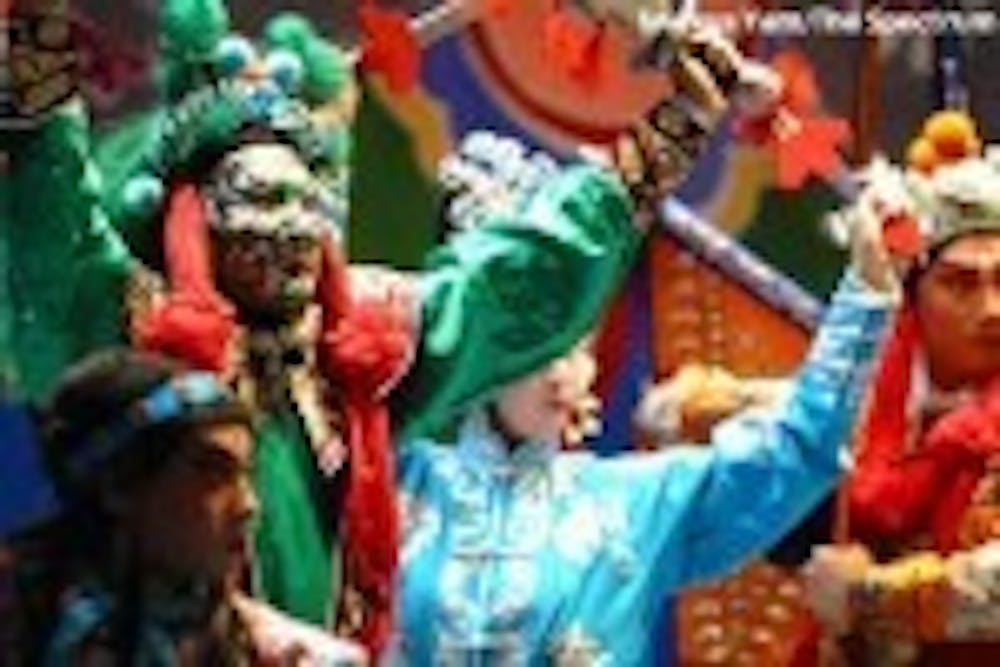
The curtains parted and a huge blue backdrop covered the entire back wall of the stage. Two warriors symbolizing fire and water are on either side. What appears to be a dragon is in the center. Below the lavish tapestry is a plain white rug, and the performers in their elaborate costumes stride onto the stage to the crashing of gongs.
"The Adventures of the Monkey King: A Beijing Opera" stayed true to traditional Chinese opera in its performance at the Center for the Arts on Friday night.
The performance focused on three stories based on the fables of the famous Monkey King, Sunwukong, a character in Chinese mythology. Wu Cheng'en compiled the stories into "Journey to the West" in the 16th century. Although the performance was almost entirely in Chinese, the story was not difficult to follow. Dramatic interpretative gestures and onstage action aided.
The first act began with Company Manager Ed Dvorak giving a few simple Chinese lessons to the audience, so that they would recognize phrases that were repeated frequently.
The Monkey King strode onto stage in his yellow monkey costume, informing the sea creatures that he needed armaments for his followers. Ghaffar Pourazar began his colorful role as the Monkey King by demanding respect from Turtle and Swordfish.
"Mei hou wang! (Handsome Monkey King!)," he said as his shouting twisted their ears.
Every actor was covered in facial makeup, but Pourazar's face was painted white with red streaks, exaggerating his facial expressions.
Ning Cheng, who played the Dragon Princess and later the Iron Fan Princess, was arguably the best performer in the cast. Her small stature and dynamic, expressive style endeared her to the audience, who loved her all the more after she displayed extraordinary acrobatic skill. She offered the Monkey King many fine weapons, which he twirled around to estimate their worth. He ultimately rejected them all.
One of the more unique aspects of the performance was the way the actors drew the viewers in personally. At one point, Pourazar caught the sharp part of a sword he was juggling, and pretended to be in agony for a few moments before laughing at the anxious crowd.
For many who have become used to Quentin Tarantino's "Kill Bill" notions of Oriental fighting, often involving sharp katanas and severed limbs, the mock martial arts battles from "The Adventures of the Monkey King" were eye-opening. The fighting was more a feat of acrobatics, as actors went flying all over the stage but only made minimal contact, clanking swords together.
Freshman pharmacy major Bin Gao commented on this aspect of the play.
"I like the swordplay and their acrobatics are very good. But it's probably not as good as if you were to go see it in China. I've seen it there a couple of times.
The second act commenced with the Monkey King accompanying Buddhist monk Xuansang on a journey to India in which the Flaming Mountain blocked their path. Cheng reappeared in a white gown with blue embroidery, long feather feelers on her head, and enormous purple streamers on her arms, which she used in a beautiful song-and-dance.
"It's different. I've never seen anything like this," said sophomore Kelly Botsoglou, an anthropology major.
The Monkey King decided to try to borrow the Iron Fan Princess' magical fan to fan away the fire. But the Princess held an old grudge against him, and the viewers giggled when she grabbed her antennae and waved them at him menacingly. The refreshing, almost childlike humor in this play was generally well received.
"Jie wo (Lend it to me)," he says, referring to the fan.
"Bu jie (I won't lend it)," she replies.
Pourazar and Cheng work brilliantly together, he wielding his staff and she swinging two swords. Whenever the actors paused the action to pose dramatically and look into the crowd, the audience burst into hearty applause. The loud, clanging music also reached a height during intense acrobatic moments, stopping abruptly at important moments or at scene finales.
Finally, the proud Iron Fan Princess retrieved her glittering fan and with one sweeping motion, sent the Monkey King flying into the winds with many pronounced somersaults and back-flips. The act finishes with the cheerful princess as the victor, but in the full version of the play, the Monkey King returns later with more antics.
Act three is an episode from the Monkey King's earlier life. The act deals with events in the king's life including the Garden of Immortal Peaches and a birthday banquet at which all the immortals would be present, including Buddha and Confucius.
Upon discovering that the angel had no invitation for him, he shrieked comically in indignation.
"I am going to this banquet come heaven or hell," he said.
Plain-prose language was consistently used throughout the production, in accordance with the standard in Chinese Opera performances.
The Monkey King slunk furtively over to the chair and proceeded to eat and drink as much as he could while making as large a mess as he could, and shoved the rest of the food into a sack to bring to his monkey followers. The last thing he stuffed in the sack was the teapot. The audience burst into hysterics as he read the bottom of the teapot.
"Made in China," he said.
When the Jade Emperor heard how the Monkey King had conducted himself, he sent his army to apprehend the king. The army consisted of six actors in ornate costumes. He first fought a military officer played by Yishan Wang, who wore four pennants on his back, then used his cudgel to fend off Green Dragon and White Tiger, played by Chen Huang and Chen Zeng.
This battle was by far the most entertaining, with the Monkey King constantly cracking jokes and insulting his attackers. He brushed her off a female attacker by pretending he was putting on makeup and doing his hair, then imitating a woman's walk. When a small man in black robes managed to scare off one of the monkey followers, the Monkey King kicked away the man's staff, forcing the man to fall on his face in slapstick fashion.
Pourazar finally got his chance to shine in the acrobatics at the end of the performance. Green Dragon and White Tiger lobbed their thick swords at him. He juggled the swords on the end of his cudgel before throwing them back.
After defeating the army, the Monkey King proudly whirled his cudgel through the air so fast that it couldn't be seen and bid farewell.
"Bye bye," he said and sprinted offstage.
The cast members received a well-deserved standing ovation; their arduous training certainly paid off.
UB President John Simpson said he thought that the performance was excellent.
"It's unexpected. It doesn't look like any opera I've ever seen," he said. "It's tremendously exciting."
Sophomore English major Joshua Colson said, "I think it was really interesting ... I appreciate all the years they put into studying this."



