
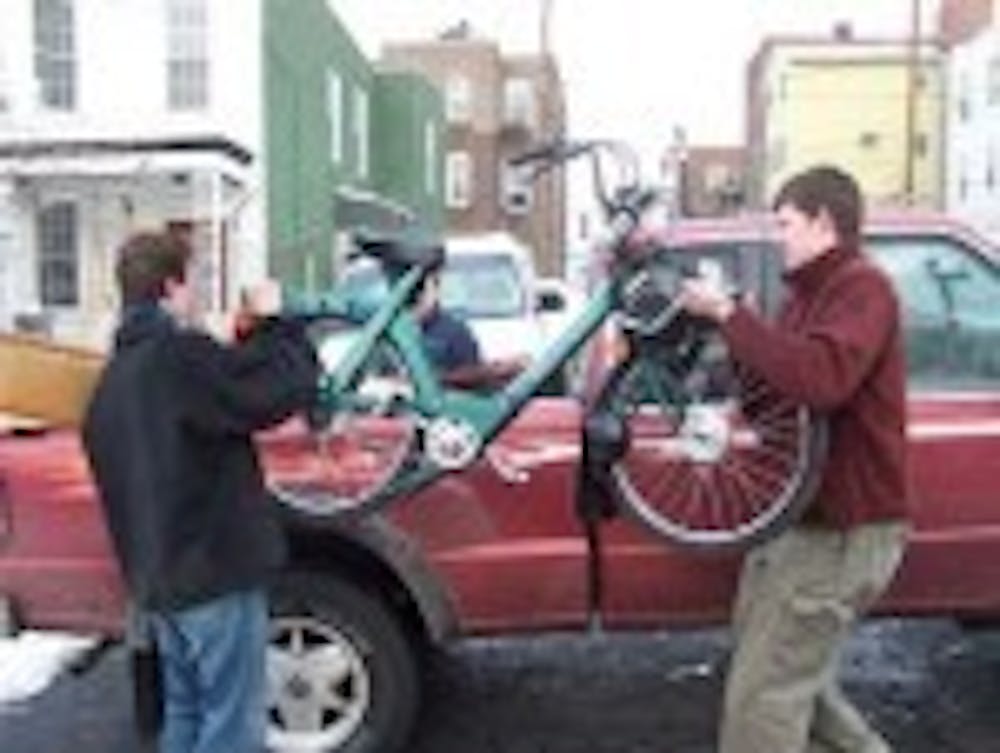
A bicycle with a motor sitting precariously over its front wheel, the Solex isn't exactly the kind of bike you can buy on Niagara Falls Boulevard. Or, for that matter, anywhere in Buffalo. Or anywhere in the United States.
But what the Solex lacks in recognition, it makes up for in quirkiness and complexity. That is why a handful of UB students have started a club entirely devoted to the rare French racing bike.
"It really is a poor design," said Lindsay Volaski, UB Solex's president. "But people do amazing things with it. It's a real engineering challenge to take something that's not supposed to do what it does and make it do more."
Mostly made up of engineering students, the UB Solex team started last February when Joseph Mook, an engineering professor who is dean of Mechanical and Aerospace Engineering, told his students about Solex competitions he had seen in France, Volaski said. Soon after, a club was formed, and the members built their own Solex and raced it at a festival in Troyes, France in May.
"We really took the initiative to do it," Volaski said. "It took us about two months to do it. We got the bike just before spring break and built it in time for the races in May."
An awkward bike that looks like even the lowest speed will send its rider tumbling off, the Solex was invented in France after World War II and gained popularity for its fuel efficiency and practicality as everyday transportation. While it thrived in Europe as a cult racing phenomena, it never gained popularity in the United States, so stateside competition is almost non-existent for UB's Solex club.
When UB Solex competed with the bike in France last May, they were the only American team represented at the festival.
"The Solex are different than a normal bike, with the engine over the front wheel. Riding it is a whole different experience," said James Stanley, the club coordinator. "We wanted to learn as much as we could. We weren't too concerned with how we were going to place."
According to Volaski, the Solex racing community at the competition welcomed the team and taught them more than they even knew about their own hastily built machine.
"People were so nice and friendly to us over there," Volaski said. "We had one guy who let us camp in his yard stay up with us all night and help us with repairs and preparing our bike for the next day's races."
This year the club -- which will apply for permanent club status later this month -- aims to not only increase membership, but also to build and race their flagship "super-prototype" class Solex at another of the class-four Solex races this summer, according to group members.
"The super prototype class is pretty much unlimited in what you can do to the Solex, with a few limitations to keep all the bikes Solex at the core," said Paul Cormier, a junior mechanical and aerospace engineering major and UB Solex treasurer. "But the improved original limits you more. You can only tune the engine and adjust other small things, which can be really fun too."
New member Jeff Daniels, a junior mechanical engineering major, said he can't wait to contribute to the club.
"It's a bunch of engineering dorks, gear-heads, and engine junkies," Daniels said. "I work on (motor) bikes a lot, so I think I can help a lot. I think there are a lot of good ideas, good engineering going on here with these bikes."
Along with SA funding, UB Solex -- much like other engineering clubs that compete -- must rely on sponsorships to pay for costs of materials, manufacturing, and travel. Such costs, according to members, can push the cost of a super-prototype class Solex to nearly $6,000 per bike.
That doesn't mean, however, that club members are balking at taking the next step.
"We did really well with our limited budget last year, raising over $2,400 in two months," Volaski said. "We had sponsorships from some of the academic departments, and this year maybe from area businesses like Moog or Cooper."
In their first competition, the UB Solex team didn't place well, wrecking their bike bad enough to not bring it home from the trip. According to Volaski, the team will build this year's model from scratch to compete in a new 24-hour endurance challenge in Chaumont, France, scheduled for June.



