
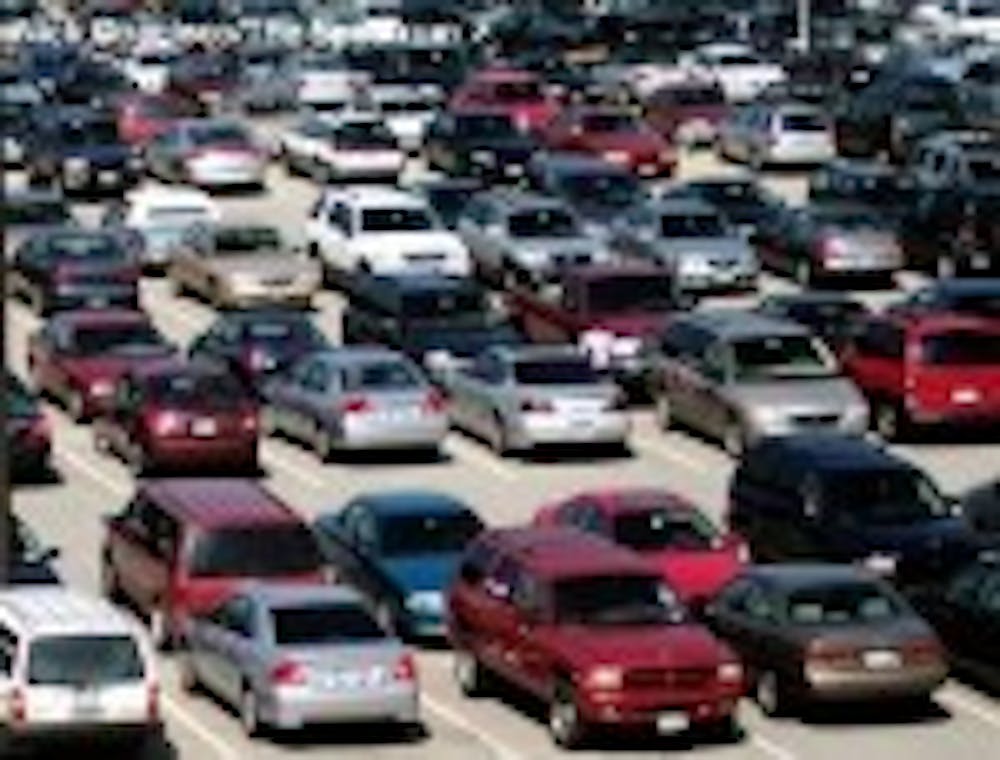
The situation is dire. It is 9:56 a.m., there is no place to park and a car plastered in Korn stickers has just zoomed into the last open spot in front of you.
It is the same story for parking at UB year after year. Cars desperately circle the lots. Lines of vehicles form and stalk students back to their cars one by one. Often two cars, blinkers blazing, face off to see who can claim a vacated spot more quickly.
This semester, the Department of Campus Parking and Transportation have created a parking advisory radio station in an attempt to alleviate the problem.
The radio advisory can be heard on 1620-AM. It broadcasts a series of recorded messages that loop every few minutes, reaching those within a five-mile radius of UB.
Christopher Austin, adjudication and transportation coordinator, said the purpose of the station is to notify students of any changes in parking or transportation services.
It covers emergencies, such as accidents or road closures, and directs traffic during special events. It urges listeners toward alternative parking in the Alumni and Center for Tomorrow lots, where shuttle services are available.
Austin said the response has been great.
"Our department as a whole has received positive feedback that people are tuning in," he said.
However, many commuter students admitted that they have not listened to the station yet, although they are aware it exists. Some, like senior history major Bridgett Gallagher, question its effectiveness.
"I don't know how helpful that is," Gallagher said.
Gallagher feels parking problems are worse this semester, despite efforts to improve them.
"You can tell it's a bigger problem because people are parking where they shouldn't," she said.
Student opinions vary greatly depending on where they usually park and at what time they arrive on campus.
"I've been late three or four times this semester because of parking," said Anthony Carubba, a junior Economics major who arrives on campus every morning at 9:30.
Rosario Malaver, a senior Spanish major, agreed that parking is most difficult around 10 a.m. She said she often spends 30 minutes looking for a space near the Student Union.
"Sometimes I have to pay for parking when I can't find anything," she said.
Andrew Morabito, a senior English major, parks near the Center for the Arts and said he doesn't have any problems finding a spot, probably because he arrives early at 8:30 a.m.
"Coming around noon you can't find parking anywhere though," he said.
Chris Austin said the radio program is part of an effort to educate students about the shuttle buses from parking lots located farther away from the academic spine. So far, the campaign seems to be working.
"Ridership has more than tripled over the past three years," he said of the shuttles.
During the first two weeks of classes, aids were available in the parking lots and on shuttle buses to help new students find their way around both campuses. They distributed campus maps, shuttle and bus schedules, route maps for transportation routes, and free coffee coupons donated by the Faculty Student Association.
"Our aim was decreased uncertainty and stress for new students," he said.
Aides in the parking lots approached cars circling the lots, reminding them about parking in the Alumni and Center for Tomorrow lots where shuttles are available every 10 to 15 minutes. Austin said once students are aware of the shuttle services and try them out, they are more receptive to using them.
Some students are open to the idea of using the shuttles, though they acknowledge the fact that it might entail a little more effort on their parts.
"That's not bad, I had to do that once," said Kristy Faulhaber, a sophomore international economics major. "It was just a little more time consuming than just parking and walking. Maybe five, ten minutes total."
Faulhaber attended UB two years ago when shuttles were not available, making parking in Alumni and CFT much more difficult, "especially in winter when you had to walk from the stadium lots," she said.
Rosario Malaver is of the ilk who believe the shuttles are inconvenient.
"The shuttle doesn't arrive every five minutes, and sometimes you have to ride around the whole campus to get where you want to go," she said.
Graduate business Matt Litchfield, who drives to the spine from the campus apartments, said he might be open to using the shuttle during the winter when fewer spaces are available due to snow.
Like many students, he arrives early to ensure getting a parking space.
"I get here early specifically so I don't have to spend a lot of time driving around for a parking space," Litchfield said. "Three days a week I arrive about three hours early to get a parking space."
Future plans for improving parking are limited.
"We're considering a discussion of whether there should be reallocation of student parking," Austin said.
This would entail having certain lots, or rows, designated for certain groups of students, such as freshman, upperclassman, and those who dorm.
Austin has advice for those wanting to pull their hair out while circling the parking lots.
"Our recommendation is to visit the outlying lots by the time ten o'clock rolls around," he said.
Students have their own ideas for parking improvement.
"I think they should build a parking garage. It would solve a lot of problems, and during the winter, cover the cars," Malaver said.
Litchfield agreed.
"I've seen smaller schools that have parking garages than UB," he said.
Lisa Ye, a junior Biology major takes the shuttle from South Campus. Come winter, though, she will drive to North Campus to avoid walking in the cold. She would like to see UB place attendants in the lots to direct cars.
Bridgett Gallagher has an idea that might not go over quite as well.
"Honestly, less staff parking," she said. "I don't think they need that many parking spaces."
Susan Wolff, a fifth year health and human services major, said rules should be implemented preventing those who dorm on campus from driving the short distance to the spine.
Between North and South campuses, Austin estimates there are over 15,000 parking spaces available, with somewhere around 500 spaces open at any given time, as well as continuous parking turnover.
Although there seems to be adequate parking spaces available, as Susan Wolff points out and despite efforts for improvement, "Parking is still impossible."



