
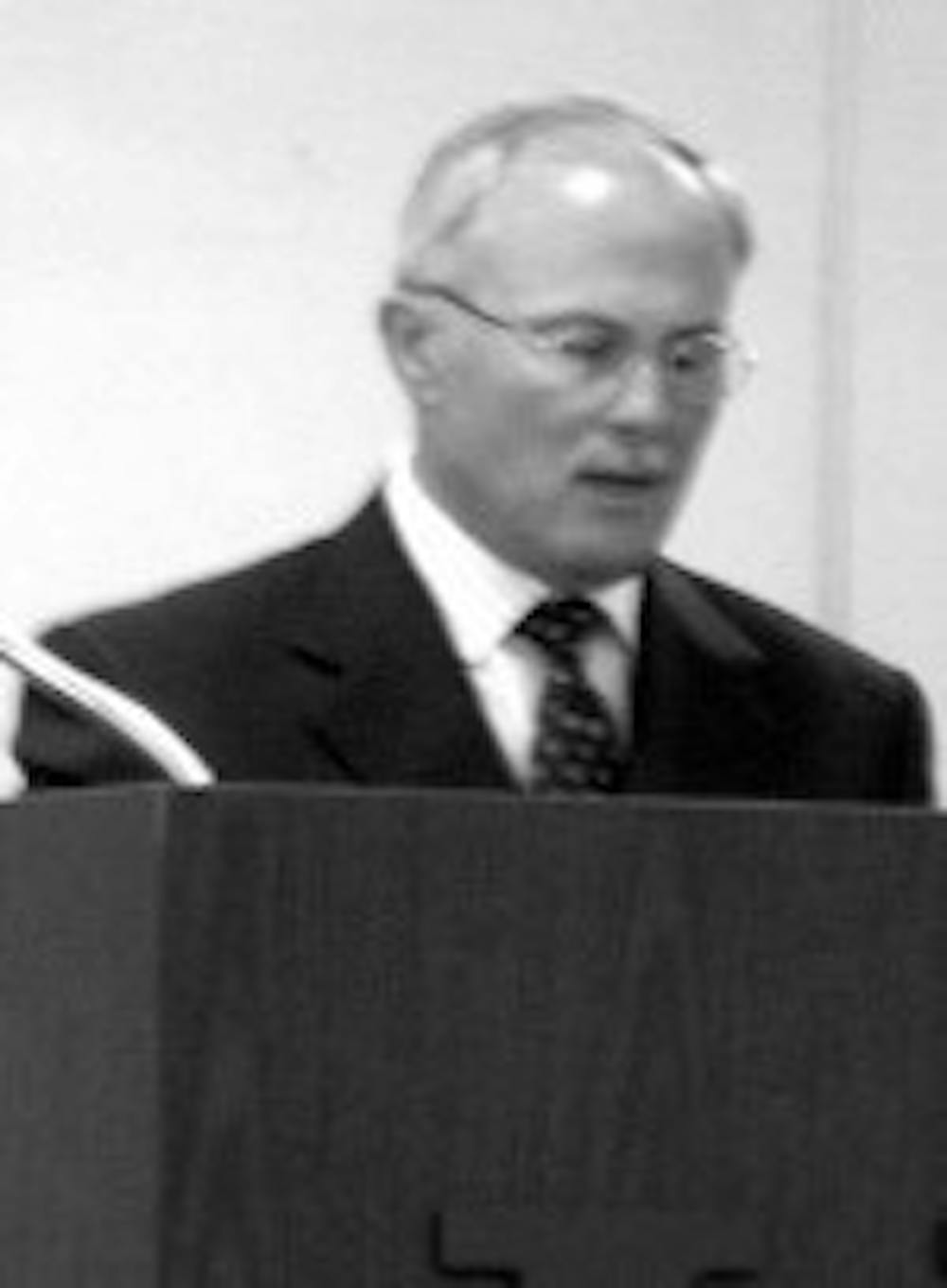
By the end of the academic year UB will have both a comprehensive plan for the future and a unified faculty conduct policy, President John Simpson told UB professors and staff Tuesday afternoon in his annual report to the voting faculty.
"The opportunity right now is to set a course of excellence that will guide us through the decades," Simpson said.
According to Simpson, a comprehensive plan is currently under development and should be completed by the end of the semester with the help of administrators, faculty and students. From there, Simpson said the administration will be able create programs to support the overall plan and make a direct impact.
"We can then develop academic support plans to support what it is we want to do. Simply put, we do not have that now," Simpson said.
Faculty members who attended the speech seemed receptive to Simpson's focus on the future.
"This was my first time meeting and hearing President Simpson," said Karen Spencer, a librarian in the law library. "It was just refreshing. I appreciate the dialogue."
Simpson said without a comprehensive plan, UB cannot achieve its full potential.
"If we don't have our own agenda, someone else will," Simpson said. "We must excel in anticipating, meeting, and solving the problems that we face in the twenty-first century."
During the summer, Simpson created several task forces designed to focus on certain parts of the plan. One task force is focusing on the community-university relationship, while another deals with the Center of Excellence for Bioinformatics and Life Sciences, Simpson said.
Simpson said he is also working on a student advisory board and urged students to participate in developing the comprehensive plan by giving their input on a new Web site that will be operational at the end of this week.
The focus of the meeting, however, was on the concerns of the faculty.
Simpson said UB needs to "evolve into a proactive and strategic administrative culture" if it wants to move higher in the U.S. News and World Report rankings. Simpson said many people put too much emphasis on such rankings, but that stock must be put in them nonetheless.
"These rankings are one of the realities we must confront," he said.
Simpson stressed several times the importance of creating and following through on a coordinated and integrated plan.
"It is the faculty of this university that ultimately must drive, shape and define this process," he said.
Simpson highlighted the achievements of last year's faculty, but said he was "disheartened" by reports of lapses in "civility, integrity, and professional conduct" by certain faculty members.
But the real surprise, he said, was that UB does not have a singular policy for complaints against faculty or a unified code of conduct. Rather, UB uses a combination of staff handbooks, state regulations and other guidelines that are difficult to access.
"There is no one comprehensive, clear statement that brings all the pieces together," Simpson said.
The value of a comprehensive statement would be both in easier access and a reflection of the character of UB, Simpson said.
Following the meeting, the President held a question and answer session.
Phil Stevens, an associate professor of anthropology, questioned the "experiment" of UB in Division-I athletics and its place in the comprehensive plan.
In response, Simpson said it was too early to judge UB's place in Division I athletics.
"I want to examine athletics in the same frank light that we examine everything else at this university," he said.
John Boot, a professor in management science, said he was concerned about UB's relationships with the other SUNY schools.
"UB has always played the hoity-toity role towards Binghamton and Albany, and I have always seen that as a mistake," Boot said.
"If we want to be a team player, we can benefit from that. But if we're not going to be a team player, we at least don't have to be degenerate," he added.
According to Simpson, with public universities across the county receiving fewer funds from their states, UB and other public schools will need to evaluate their levels of independence, but that is not a discussion for right now.
Instead, with the plan in place, UB will be able to go to New York State and say, "This is what we're doing. This is how we're going to get there. This is how you can help us," Simpson said.



