
If Russell Klettke doesn't seem like the typical nutrition guru, that's because he isn't.
The co-author of the newly published "A Guy's Gotta Eat, The Regular Guy's Guide to Eating Smart" is a freelance writer who attempts to answer what he perceives as a national call for nutritional guidance encoded with language that men - particularly men who live alone - will find useful.
"We feel that there's a bias in a lot of other nutritional media," said Klettke, the "we" referring to himself and his co-author dietician Deanna Conte. "Bias toward female interests and female ways of talking and this just goes right by some men."
Klettke's biggest beef is with the fact that nutrition information on most food labels is based on a 2,000 calorie-a-day diet, when the average man eats 2,500 to 3000 calories a day.
He also has a problem with the language used in the nutritional media.
"Veggies - why do people say 'veggies' all the time?" he said. "You don't find a lot of guys saying 'Oh let's go get some veggies.'"
Klettke chuckled at the possibly sexist implication that his statement might make as he described who would benefit most from information in his book.
"Not just college males, but men - men who in some ways have to feed themselves."
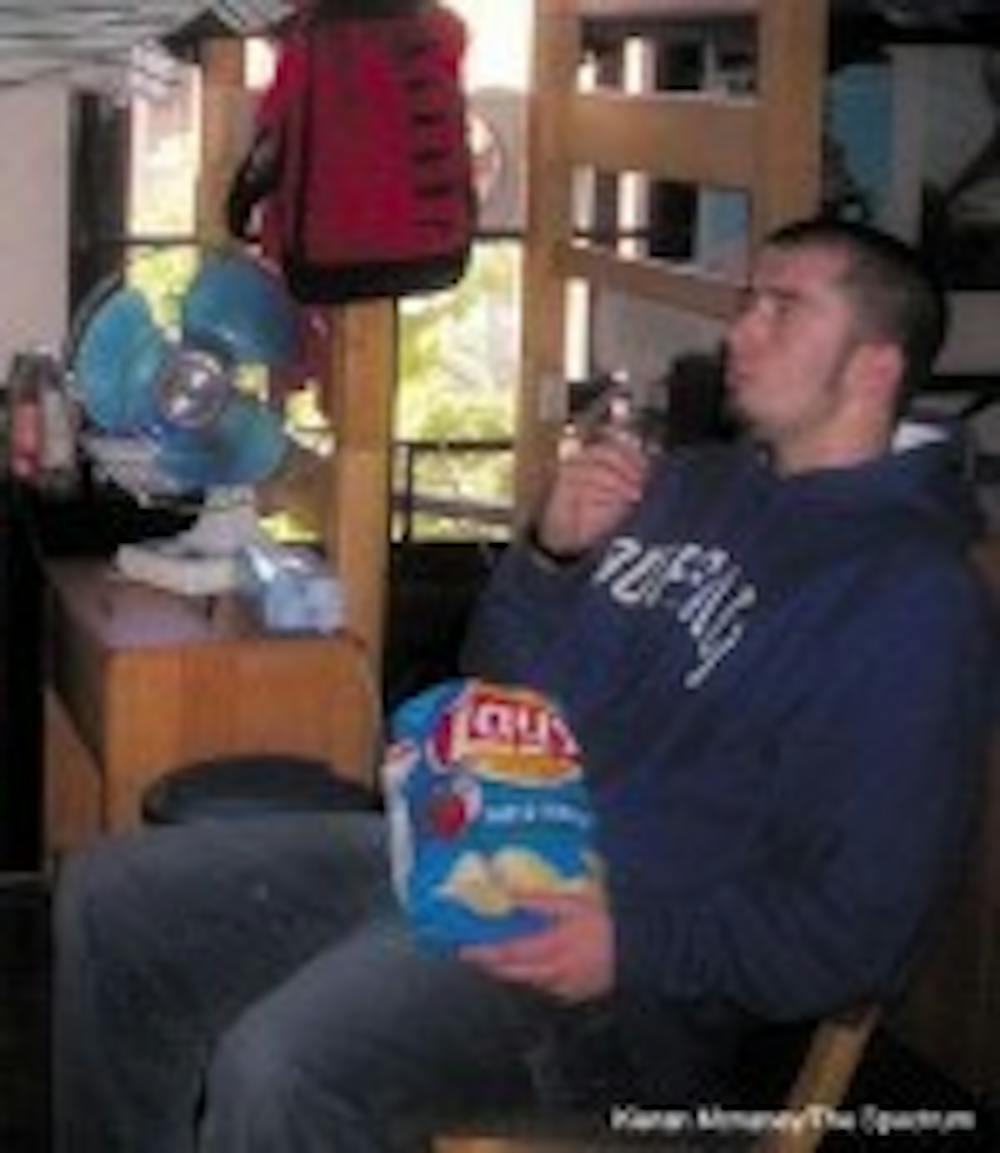
Most universities are teeming with young men who have left the comfort of mom's cooking behind and are forced to make their own food choices.
And they don't always gravitate toward the best choices.
"When I have to pay for my own food I just eat whatever is cheapest," said Michael Williams, a senior civil engineering major. "Usually the cheapest and fastest things I've found aren't the healthiest."
As is evident by the coining of the phrase "Freshman 15," the bad decisions made at mealtime can have a substantial effect on the waistline.
J. J. Cross, a senior political science major, said he remembers his battle with the beginner's bulge.
"When I moved on campus I put on 15 pounds. I went from 175 to 190 in a semester and a half," he said. "I wasn't eating three square meals. I wasn't eating breakfast, I would eat (my first meal) at like 2 (p.m.) and then I would eat late at night."
Aside from eating at less than optimal times during the day, Cross also admitted to eating the wrong kinds of food, blaming much of his weight gain on the "greasy food" that was readily available to him.
In his book, Klettke sympathizes with those males who are not always armed with the time or inclination to consider many of the factors that go along with food consumption.
The average college male might not be as fussy about his figure as his female counterparts, and according to Klettke, they don't have to be.
"They don't have to go on a diet to eat smart, it's more about knowledge and structure," he said. "The people who eat smart and don't seem to obsess on it, for the most part, it's because they know what they're doing."
According to Klettke, an example of the way certain food affects body weight is the difference between an apple and an apple muffin.
The apple muffin, he said, is processed to the point that it is absorbed into the bloodstream almost immediately after consumption. Because of the rapid absorption, the consumer might experience a sugar rush that drops off after a short period of time causing the person to have an urge to snack soon after.
Klettke said the peelings and nutrients found in the unprocessed apple help to slow down digestion causing a much slower release of sugar into the bloodstream, therefore it might be some time before the consumer has another urge to snack.
"Better yet, have some nuts before that and it will really slow everything down," Klettke said. "If you snack smarter you wont snack as often and do the binge snacking thing."
While knowing how the effects of small snacks can be a good place to start as far as healthy diets go, Klettke believes there is a lot to be said for the heavier mealtime choices.
Klettke, who is from the Niagara Falls area, said he knows all about Buffalo's most famous mini-meal.
"Wings, wings, wings," he said. "Chicken wings, gotta love them, but eat them in moderation."
According to Klettke the proper way to enjoy a mealtime treat like Buffalo wings, is to avoid having a whole platter of them. Eating only some wings along with a whole salad can make for a more guilt-free meal.
"It's not the best meal in the world but you gotta live," he said.
Klettke said a whole chapter of his book is dedicated to making better meal choices when dining out.
Many people only have the resources to whip up their own concoctions and in the case of the college male, the quicker the better.
"At home I eat a regular, balanced meal with meat, rice or potatoes and vegetables. But that takes a lot more time," said Williams. "Here, if I can make it in 20 minutes that's usually what I'll eat."
Klettke said he has made provisions in his book for the cooking man, by outlining basic cooking skills.
"We structured the book for people who are not going to have a lot of time to become super good cooks."
While "A Guys Gotta Eat ..." claims uniqueness in the fact that it is written for the man who prepares his own food, and promises to omit the word "veggies," the fundamental message is one that is beneficial for everyone who feeds themselves.
"Regular foods, not supplementation or depravation diets, but regular food in balance, variety and moderation is the key to good nutrition," Klettke said.



