
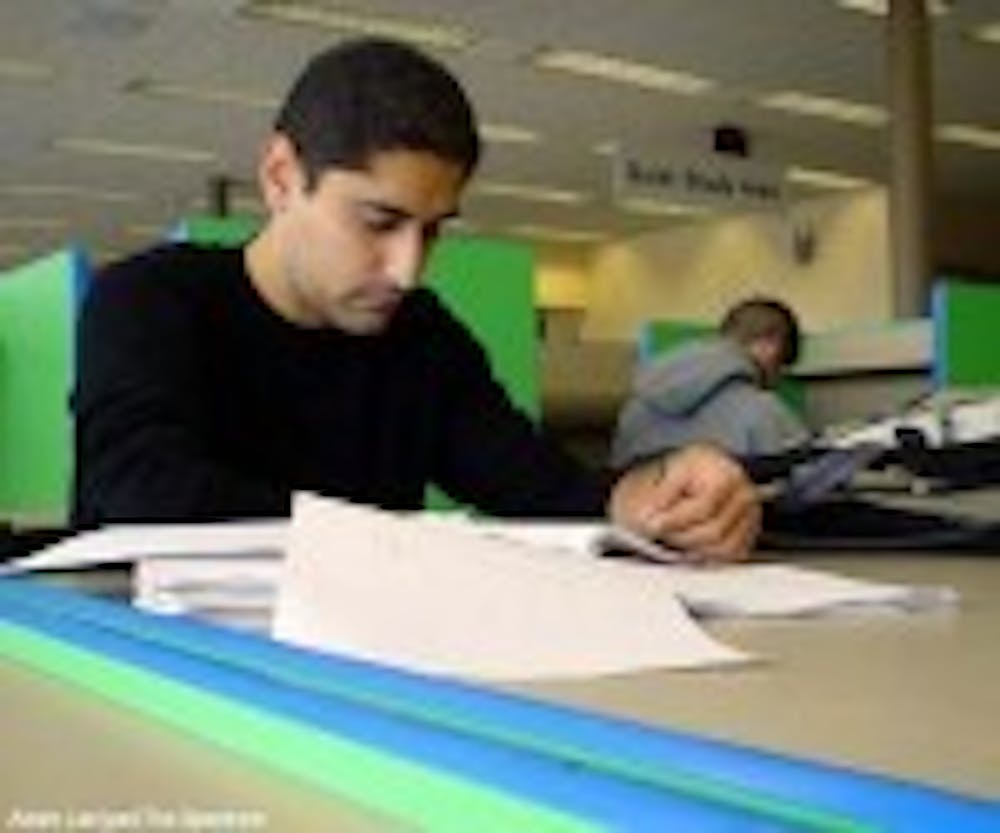
A dream denied became a dream come true for Taid Rahimi.
Like many students, Rahimi, a biology major, went home during the summer. Yet security restrictions imposed after Sept. 11 prevented him from returning to Buffalo, which caused him to miss his MCATs and the entire fall 2003 semester.
However, Rahimi now says that instead of being a setback, his extended stay at home in West Africa added a new trail to his career path.
Born in Iran, Rahimi's family left the country at the age of 1 and moved to Togo. In January 2002, he transferred to UB from Landegg University in Zurich, Switzerland. He decided he wanted to attend medical school and soon signed up for the MCATs.
Since he had not been home since his move to the United States, Rahimi decided to go back to Togo to visit his family.
"It's a poor country," he said. "There's a population of about 4 million, and it's mainly French-speaking. It's a little thing. (My city) is not a capital city, and certainly nothing like Buffalo."
Although Rahimi doesn't recall any problems on his way home, he was aware that he could face heightened security due to post-Sept. 11 precautions.
"I called the United States Embassy to make sure I could get a re-entry visa, which was guaranteed to me within the month of July," he said. "My mom even talked with the personnel chief to make sure there would be no problem, and she was told there would be no problem at all."
However, when Rahimi went to the U.S. Embassy in Togo, his passport was taken. He was told it would be back in his possession within a week.
But a month passed, and there was still no sign of the passport.
"I called to figure out where it was, and the embassy said everything was fine and to just relax," Rahimi said. "It was the same embassy I have always dealt with since I had first come to the United States when I was 15 as a tourist, so they were familiar with my case. Even though the people changed, they were still all familiar with my file."
During the next few weeks, the Rahimi family was walking on eggshells.
"I was calm, but my mom wasn't," he said. "The embassy said there was an extended delay on my file. It was sent to Washington, and it would take some time to come back."
His Aug. 16 appointment to take the MCATs was fast approaching, but there was still no explanation from the embassy - so Rahimi studied online.
One week before the test, Rahimi said he lost his calm attitude.
"I called every day and there was no answer," he said. "It was a week before the MCATs, and I'm going bizarre."
After missing the test, Rahimi faced his next problem - getting back to the United States in time for the fall semester.
"There was nothing I could do," he said. "My mom was more stressed than I was, and she knew these people personally. By this time it was beyond the U.S. Embassy. It was in the hands of Washington."
But Washington did not clear up his immigration problems in time. In response, UB officials froze Tahini's records.
"Ellen Dussourd (Director of International Student and Scholar Services at UB) was supportive, and UB was too," he said.
While in West Africa, Rahimi presented workshops on visa procedures to students in 11th and 12th grade.
By November, Rahimi had begun applying to universities in London and England, worried that he might never make it back to UB.
"By this time I was calling everyday to find out information on my re-entry," he said. "There was still no progress."
On Jan. 22 - eight months later - Rahimi finally got the call he had been waiting for.
"The US Embassy called, and said to come pick (the visa) up," he said. "The same week got it, I left to come back here."
No one ever offered Rahimi an explanation for the delay. He will now graduate a year late in the spring of 2005.
"I lost a year. I was supposed to graduate this semester. Instead, I will graduate in the spring of 2005," he said. "All of my friends are waiting for medical school, and I'm still here."
He shared the many reasons for his confusion over the situation, including his good grades, his lack of a criminal record and his faith life, which he explained is incongruous with the idea of terrorism.
"Being a member of the Bahai faith since I was 15 years old, and the principles which I adhere to, such as the oneness of all mankind and religions, would not allow me in any way to become a threat to any governments or organization," he said. "Thus being considered a danger for the United States' national security was most perplexing."
Jan. 23, 2004 was not just the day U.S. immigration officials applied a long-awaited stamp on his visa - it also marked the beginning of his new lifestyle. As far as medical school goes, Rahimi has changed his course of action.
"I don't want to go anymore," he said. "I had a chance to meet leaders in engineering in West Africa while I was home. There were educational leaders who even built their own school, and that's what I want to do. Medicine is not for me."
There were upsides to being stranded at home with his family, which has developed schools for students grades K-12.
"I got to really know my family and work with their business," he said.
After graduation, Rahimi said he wants to teach in a Buffalo-area school and then attend graduate school.
Rahimi said he has no plans to go back to Africa soon, but when he does he would like to expand the schools his family has built.
"I have no hatred towards the system," he said. "It's almost understandable to take measures like this. The U.S. Embassy is very kind, professional and nice. Their only mistake was the guarantee that I would get back to the States - if I had known this would happen, I would have never gone back home."
All smiles, happy to be back, Rahimi holds the true Buffalo attitude.
"I'm fresh from Africa," he said. "I'm even happy to see the snow."



