
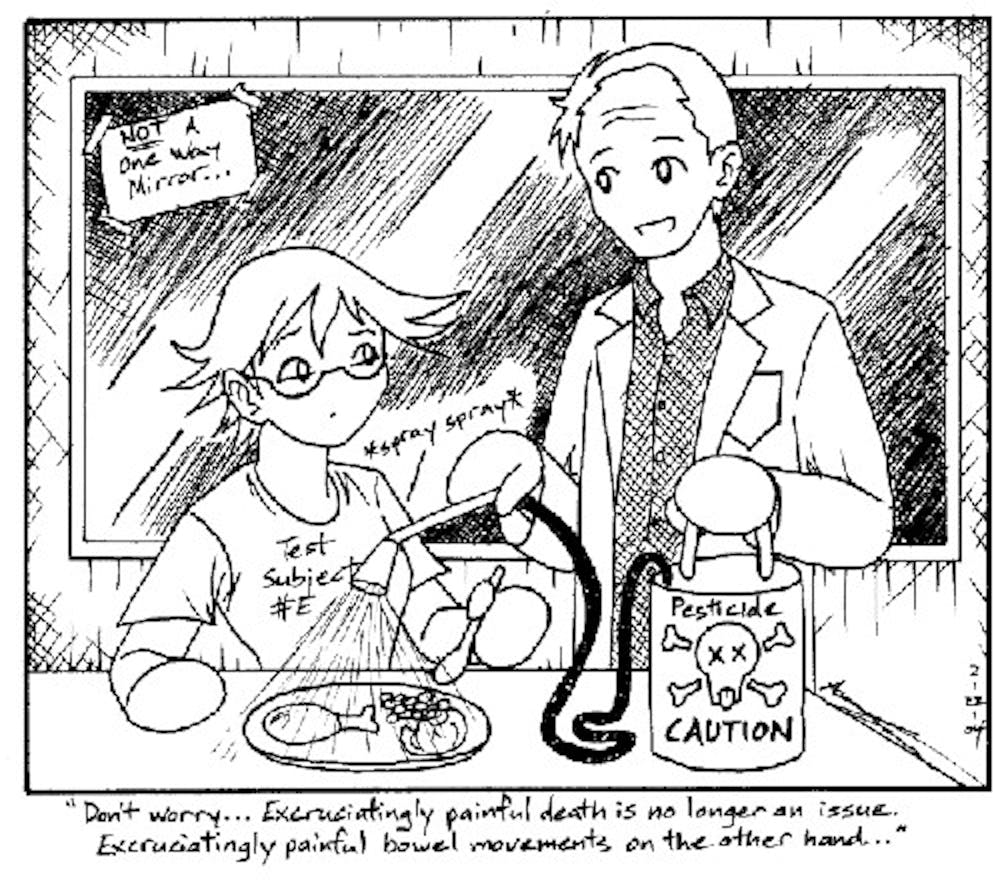
Science and morality are often at odds. There is no way to quantitatively measure what is ethical and what is not. Science claimed a major victory last week, as scientists at the National Academy of Sciences recommended allowing tests for various pollutants on human subjects, as long as strict guidelines are set. If those hurdles can be met with scrutiny, the experiments are necessary and can be beneficial.
As society moves forward, new situations dealing with food are arising. Organic food is too expensive and cannot feasibly sate an entire population, as it has a short shelf life and needs extensive care. Organic food will, and should, still exist in small circles, but for the growing population, safe ways of producing and keeping food must be developed.
Testing of various pesticides and pollutants on human patients has been going on for over a dozen years, but the question is whether or not that information is acceptable to the Environmental Protection Agency. The EPA is supposed to protect the environment and uphold rigorous health standards, but they should accept data if the right conditions are met.
The National Academy of Sciences panel lays out those conditions, but its recommendations do not go far enough. First, human testing must be the last option. A chemical must already be proven safe in other tests, including those on animals, and the research must be able to focus on a specific question. The problem is that no matter how safe something is assumed to be, it may have unknown side effects on humans. Also, many of the problems have to do with the long-term effects of pollutants in air or water, meaning these tests must be drawn out.
Next, there is the huge question of finding test subjects. If people are paid a decent amount to allow testing on their bodies, low-income people may be lured into poisoning their bodies with the promise of compensation. Obviously, the government cannot make such programs mandatory, but a system of random selection could ensure the system is not abused and people who do not want to be a part of it should not be forced into compliance.
If there is some compensation, it must be enough to make people want to participate, but not too much to make people reliant. Also, there must be proper insurance and torts so if something does go wrong, the companies who made the pesticide are held responsible.
Another hurdle that must be passed is limiting side effects. The products are called pollutants and pesticides for a reason, so there must be some change somewhere. Scientists must be able to monitor those risks, and make them negligible.
In addition to humans, there are risks to the environment in several forms. While looking out for the safety and health of human beings is admirable, we cannot forget the needs of the world that we inhabit.
Using humans as a last resort for testing can be done in a productive way. A progressive society must be able to contain risks and work for a future where food is healthy and the needs of the environment are balanced with those of humans. It is a great responsibility to have the life of another person in your hands, but with proper restrictions, various testing can provide society with great benefits.



