
Students who feel their ears ringing a couple of days after a concert know a thing or two about noise-induced hearing loss.
After the rigors of combat end, military personnel can also suffer from the condition -- sometimes permanently.
As a result, researchers at UB's Center for Hearing and Deafness are working with the U.S. military on a drug that will prevent noise-induced hearing loss.
The researchers say they expect to begin clinical trials of the drug by the end of the month.
Dr. Donald H. Henderson, a professor of communicative disorders and sciences, said he has studied the condition since 1968.
"We realized that noise exposure caused an explosion of free radicals (in the ear)," he said.
According to the National Institute on Deafness and Other Communication Disorders, inner ear hair cells convert sound wave energy into the electrical impulses, which carry audio stimuli to the brain. Henderson and Dr. Bo-Hua Hu's research concluded the damage was caused by free radicals, also known as free oxygen molecules.
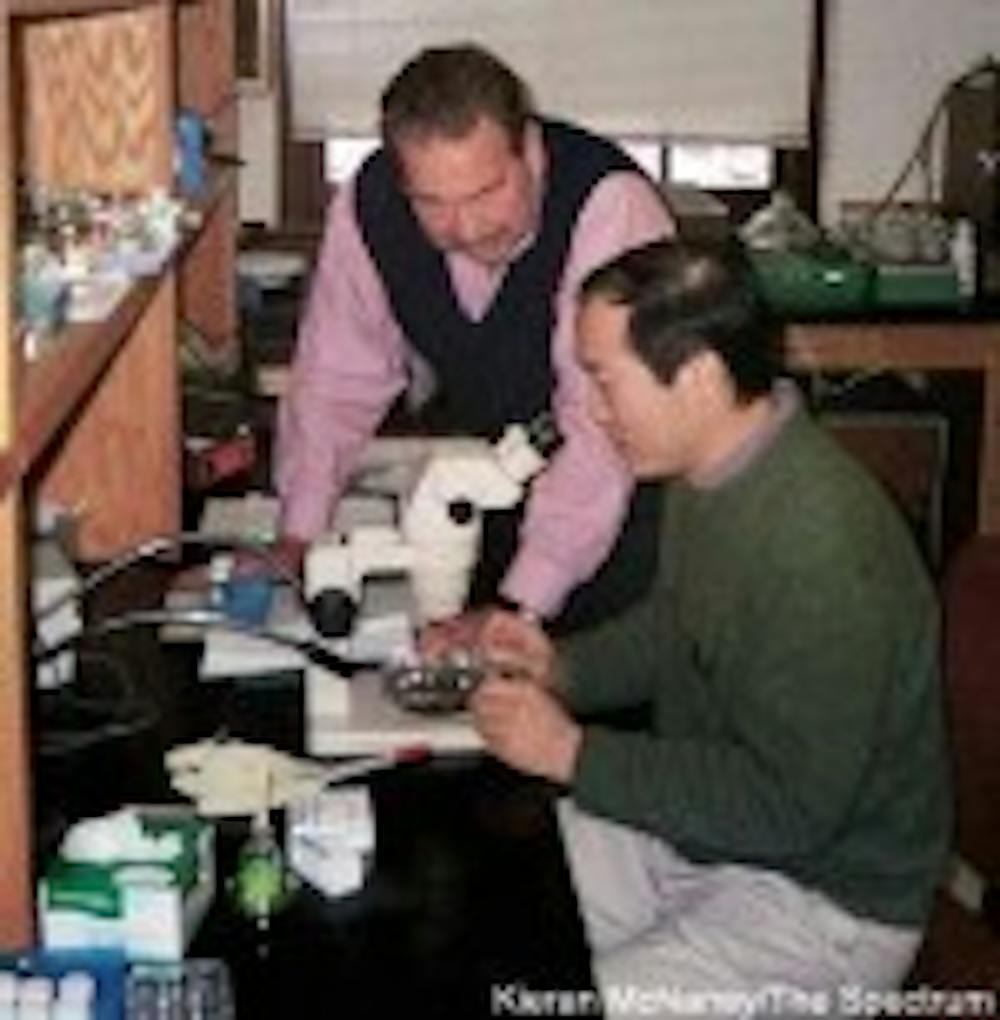
Along with Hu -- a research assistant professor in the Center for Hearing and Deafness -- Henderson studied the effects of the antioxidant drug acetylcystine toward curing noise-induced hearing loss in lab animals.
They found that animals that were subject to low levels of noise over several days built up a natural supply of antioxidants in the ear.
Antioxidants destroy the harmful free radicals, so the researchers deduced that using a chemically produced antioxidant would further protect hearing.
"We knew this drug was a relatively effective antioxidant," Henderson said.
The Food and Drug Administration originally approved acetylcystine to loosen mucus and to treat overdoses of acetaminophen.
The military component came in when Henderson received a $750,000 research grant from the U.S. Army.
"The military has a lot of people exposed to high level noise," Henderson said.
According to Henderson, the drug is not intended to replace existing hearing protection. However, he said it would be useful for soldiers who participate in war games and do not have access to such protections.
Henderson said the drug also could be used to reduce hearing loss that has already occurred by promoting the healing of damaged cells.
If the clinical trials are successful, researchers expect to submit an application to the Food and Drug Administration for the drug's approval.
Susan Cruzan, a Food and Drug Administration representative, said the FDA would assess the researchers' application before they add the new use to the drug's labeling.
Henderson said the research comes with an added bonus: UB and the Army will hold the drug's patent on this new use jointly.
As a result, the university will profit from sales of the drug.
"Money (from the patent) comes back to UB," Henderson said. "Sixty percent goes to research and 40 percent goes to the researchers."



