
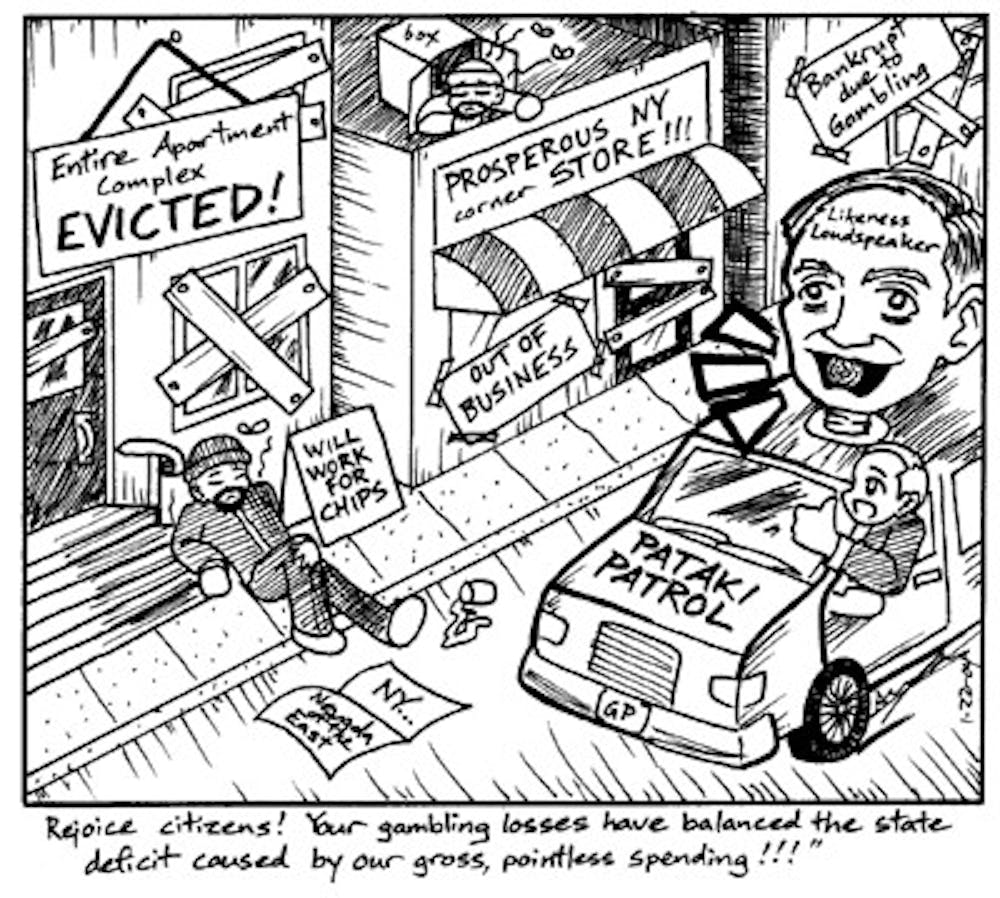
The budget roulette wheel is spinning again, and Governor Pataki has his chips on gambling, hoping to generate $2 billion by selling franchise rights to eight companies so they can open up gambling halls throughout the state. The solution is poorly thought out on many levels and will only make the state's economic problems worse in the long term.
State control of gambling has always been on the docket for Pataki, as he desired change from his first days in office almost a decade ago. Currently, New York State has a revenue-sharing program with Native American casinos, most notably the Turning Stone Casion in Verona, N.Y., near Utica. The legal gambling is already heavily taxed as well, with over two-thirds of their profit going to the state. The new deal will take upwards of 80 percent, but is still misguided.
Statistically the smaller gaming enterprises being proposed attract mainly local residents - and usually lower-more individuals - rather than rich tourists. The discretionary income of local residents is spent quickly and addictively. The money goes into the casino is then sent out of the communities. While Pataki admirably wants to turn that money into education funding, it makes a mockery out of the systems that are supposed to fund education, and it is a subtle way to shift the burden away from progressive taxation into a system funded mostly by the poor.
By linking education to gambling, it puts the future of our youth onto the vices of millions of others. The crumbling school system must be dealt with, but this gambling program is not an effective long-term solution. All New Yorkers should be responsible for education, not just those who gamble.
The other problem is of simple moral values. Gambling is an addiction that can lead to poverty, and could cost the state even more in welfare costs. Pataki has taken the moral issue out of people's hands, using only the bottom line to justify what is right and wrong. Casinos also traditionally generate more crime in the community and are very unattractive.
Communities have resisted being home to a casino, and Pataki wants to take that power away from them, removing their right to disagree. Since revenue will go to private operators or the state, there is no incentive for a community to open its doors, especially when it will suck money away.
Since Pataki has signed on to the gambling agenda, he must manage this inevitable problem. He would rather have money go to the state than to independent sovereign nations or to other states. If he is convinced people are going to gamble, it makes sense to set it up in a way where it can be taxed and the money can move swiftly back into the community.
In the near future, Buffalo is looking at up to two more casinos in addition to the Seneca Niagara Casino in Niagara Falls. If Pataki and other conservatives want to keep taxes down and expect schools to magically support themselves, funding will have to come to programs like casinos. The Seneca Nation is not going to make that investment, so Pataki can legitimately feel that his solution will benefit everyone. Unfortunately, he is so far down the wrong track he must do all he can.
Soon, new video slot-type machine terminals would inundate our society, appearing where we least expect them. Perhaps New York is not far from complete legalization, but that disaster must be averted. Rather than make the best of a bad situation, there was a legitimate chance to fix some problems, but just like an addict, we pull the lever hoping for the jackpot solution.



