
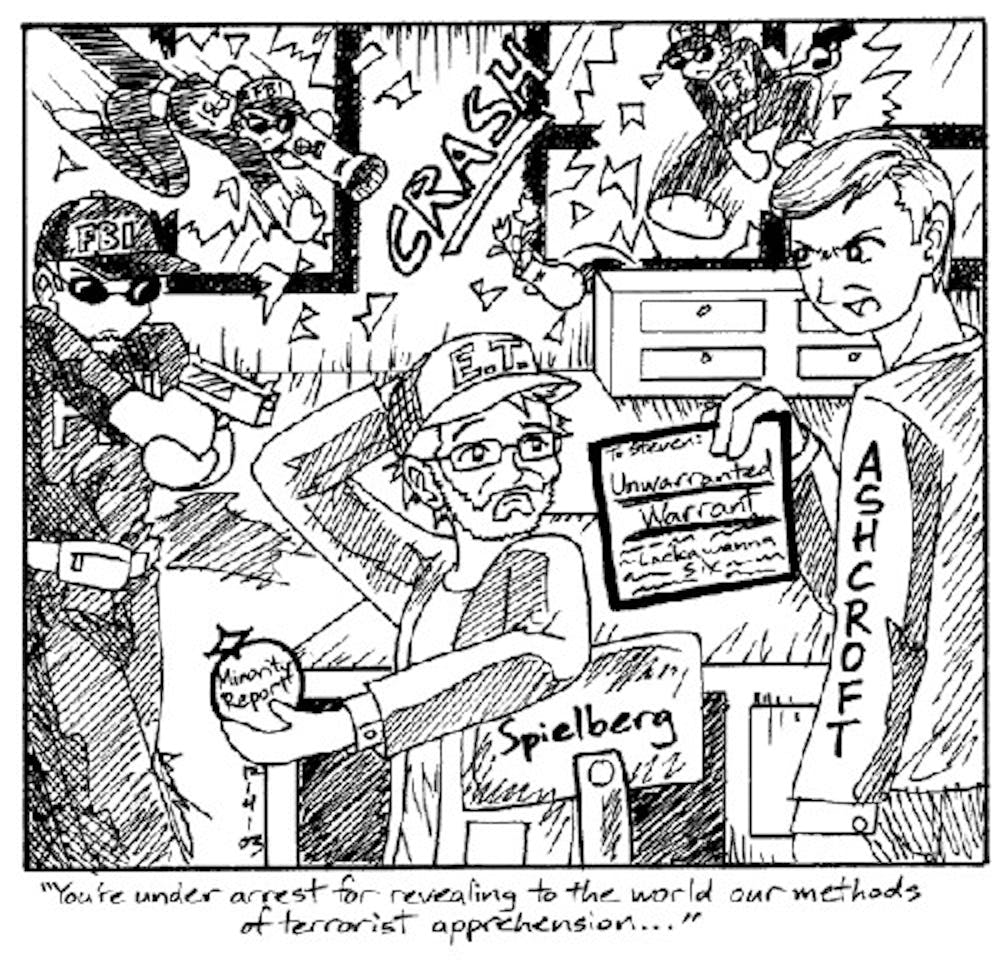
In a hollow victory for the Department of Justice, Lackawanna residents Mukhtar al-Bakri and Yasein Taher were sentenced to 10 and eight years in prison, respectively. Putting them in prison will not do anything to fight terrorism, and the implications of the convictions are frightening. The convictions rely on guilt by association, not actual evidence, and seem more fit for "Minority Report" than the U.S. justice system.
The six men from Lackawanna traveled to Afghanistan in June 2001. They were not captured until September 2002, almost a year after the Sept. 11 terrorist attacks. During that span, the FBI was not only aware of their presence, but the men had been in contact and willing to reveal information about their activities. Mukhtar al-Bakri was arrested in Bahrain the day after his wedding, because the government claimed he was there to conduct terrorist acts.
The men allegedly heard Osama bin Laden speak at the camp, and a 1996 U.S. statute declares that any "material support" - even attendance at a camp - is automatic grounds for being deemed a terrorist. There is no actual evidence that al-Bakri or any of the six men were planning terrorist acts or were a threat to their community. Their guilt is simply by association.
"It's the first time in American history where people are going to prison for going to a training camp. It's wrong ... It's unconstitutional," said David Cole, a Georgetown University law professor
The sentences came after a California 9th Circuit court struck down portions of the "material support" part of the law on Wednesday. While the 9th Circuit court does not directly govern the Lackawanna case, Cole has said if the case reaches the Supreme Court, Attorney General John Ashcroft's domestic anti-terrorism policy could be in trouble.
Furthermore, arresting people before they think of a crime, much less before they actually commit it, is completely contrary to the American legal system. Obviously, if there is clear intent to attack either another person or the United States, there would be a good cause, but since the U.S. government had no evidence to prove its case, the arrests rest only on a poorly written and reactionary law that is being used on too broad a scale.
The 10 and eight years of punishment are excessively harsh given the crime. The decisions are also a shallow diversion, especially without the capture and persecution of bin Laden, who was actually preaching and carrying out the crimes. Putting away al-Bakri, Taher and the other Lackawanna terrorists is not a substitute for bringing the real criminals to justice.
The guilty pleas were made under threat of permanent imprisonment, possibly without a trial or access to a lawyer. Getting a guilty plea is a victory in name only, as the men could have been used as resources for the information about the workings of training camps. There was a reason they left the camps and returned home ahead of schedule, and threatening their well being in order to prop up a cardboard victory achieves nothing.
Almost every aspect of the case against these six men is disastrous. It is political opportunism, expressed in how it began and how it was carried out. While Ashcroft can claim a victory, this case sets an ominous precedent. Prosecuting people without evidence, forcing them to plead a certain way and then sentencing them for an extended period is a mockery of the judicial system. It will not make anyone safer from terrorism.



