
Elegant, timeless, profound.
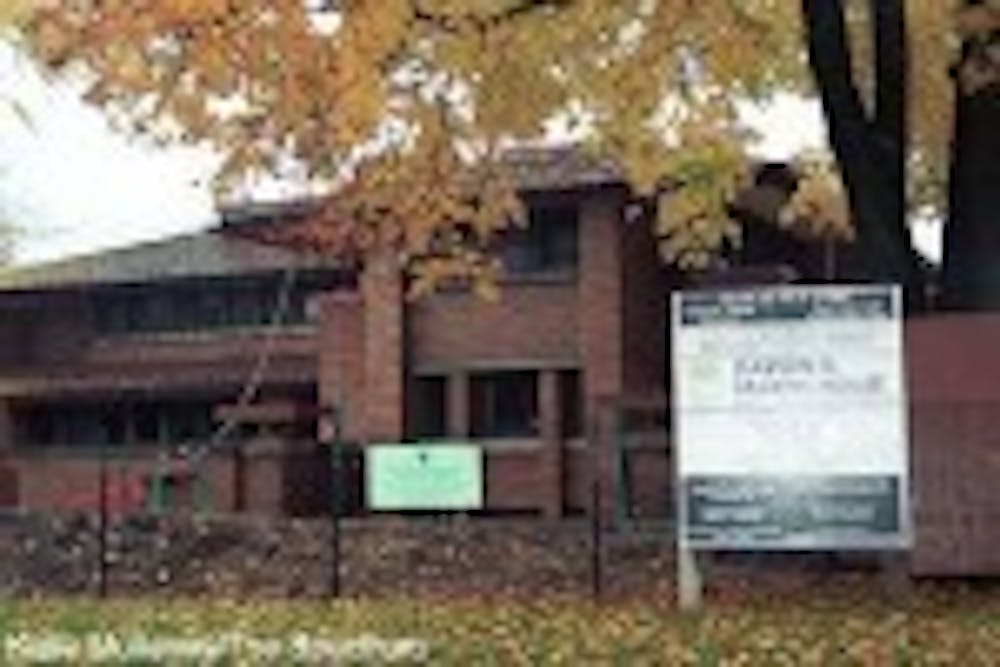
These are just a few of the words that are applicable to Frank Lloyd Wright and his breathtaking proto-modernist architectural style. Undoubtedly one of the premier 20th century American architects, Wright's legacy has special significance here in Buffalo. His local gem, the Darwin D. Martin House, located at 125 Jewett Parkway, still stands as one of the proudest and most defining pieces of Buffalo's architecture.
The Albright-Knox Art Gallery, in concurrence with UB's School of Architecture and Planning and the Martin House Restoration Corporation, present "Mori on Wright." The exhibit features the finalist designs for the Martin House's visitors' center, which will be built adjacent to the house. The winning design, created by New York City architect Toshiko Mori, is also on display.
Each design is represented by a scaled-down replica constructed by graduate students in the Architecture and Planning department at UB. In a display of artistic talent and creative flare, each of the architects' visions were laid out with scaled drawings, computer animations and numerous personal interpretations of Wright's work.
Mori's "garden pavilion" is an intricate combination of new and radical mediums and new forms of lighting. An inverted hip roof was designed to increase the amount of daylight inside the visitors' center. Glass is used to diffuse penetrating light and snow as an insulating and reflecting component. An overwhelming and mesmerizing design to say the least, Mori captivated the audience with an approach that enabled her to design a building that is "a separate entity, but also an element of completion."
At the symposium and lecture held at the Albright-Knox to show the arts community what went into the project, Mori said repeated had been said several times throughout the evening.
"Architecture is a dialogue with history. We have to preserve the history, but also use new materials and technologies to truly upgrade it," Mori said.
With striking resemblance to Wright in her architectural style, Mori opens the dialogue between the old and new, a thought widely spoken of with importance throughout both the exhibit and symposium.
"The new gives special understanding to the old," said Claire Snyder, associate curator at the Albright-Knox and co-curator for "Mori on Wright."
Kent Kleinman, the chair of the department of architecture at UB and guest speaker of the night, highlighted the significance of the exhibit and of Frank Lloyd Wright on Buffalo, as well as art in general.
"In the summer of 2002, we transformed from preservation of a historic landmark to restoration of confidence in our own epic," he said.
Wright's house is truly an epic both here and in the outside world of architecture. In fact, Wright was even quoted as calling the house his "opus," or "perfect composition."
With immense architectural challenges and, as Mori put it, Wright's "unforgiving nature," the house and the resulting visitors' center are the project of a lifetime.
Revitalizing the original structures of the house while building a magnificent state-of-the-art visitors' center, the Mori on Wright exhibit has taken a somewhat unknown attraction and put it back in the spotlight.
Through the assistance of several aspiring architectural students from UB and the support of the Alright-Knox and other local artistic groups, Frank Lloyd Wright's legacy in Buffalo has been revisited and revitalized, along with his most cherished work.
The Mori on Wright exhibit is currently on display at the Albright-Knox through March of 2004, and tours of Wright's Darwin D. Martin House are being offered every weekend from December through April.



