
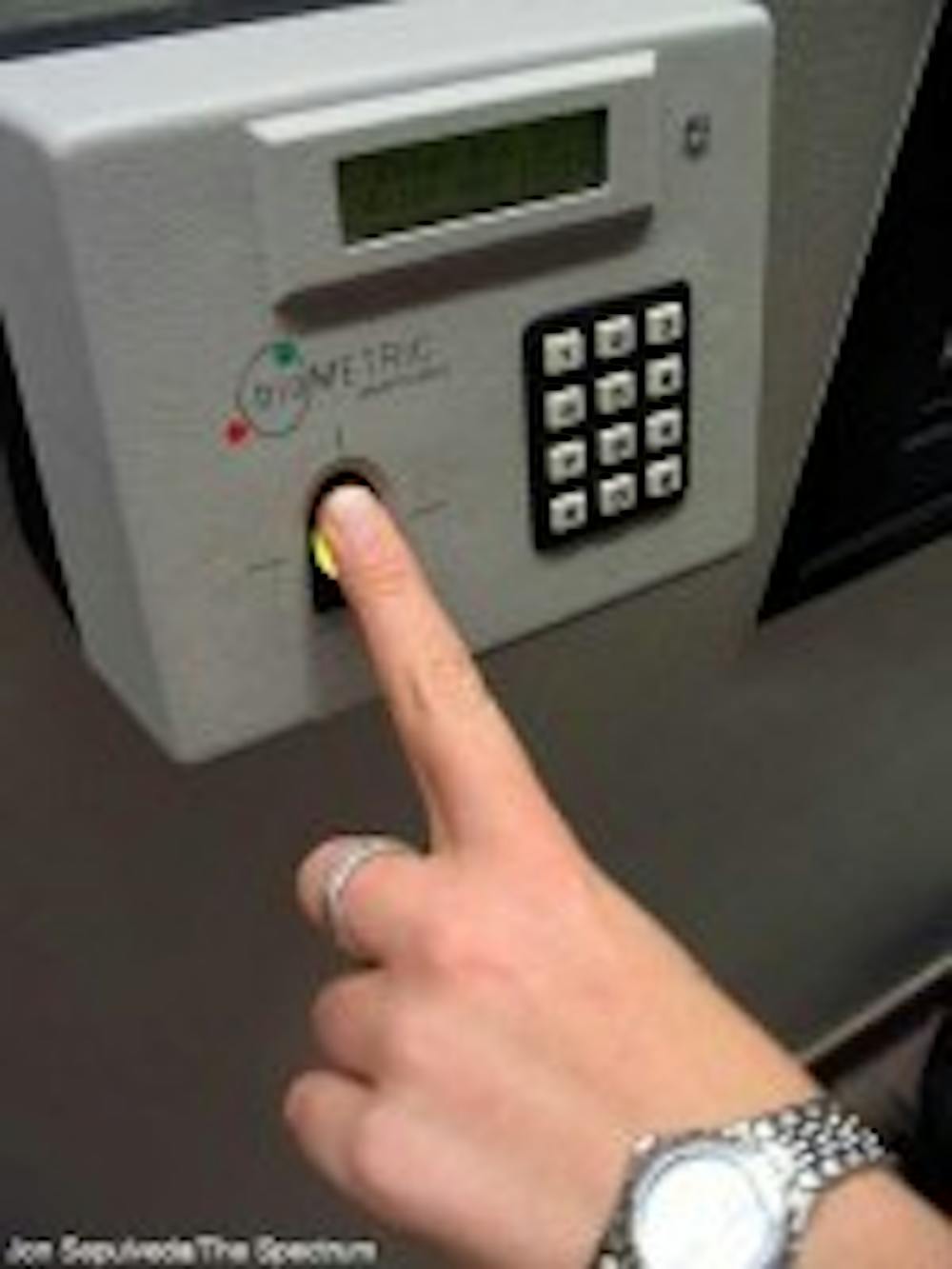
In the future, a shopping trip might not require a credit card, checks or money - just fingertips.
According to an online publication of a USA Today article, the idea of using fingerprint scanning as a means of commercial identification is moving beyond science fiction and into reality. While it is not going to happen anytime soon, companies dealing with financial communication are seriously testing certain technologies that will eventually make this a reality.
Aside from the development of the credit card in 1950, some believe using your fingertip to pay for items and services may prove to be the most significant advancement in commercial technology in over half a century.
Biometrics, the technology that would be used for finger paying, involves placing a finger on a scanner instead of using a credit card to begin a transaction.
Some students consider the prospect of biometrics in everyday life a very useful advancement.
"If someone steals your purse you don't have to cancel all of your credit cards," said Carrie Zimbardi, a sophomore undeclared major. "Using your fingerprint would definitely make purchasing transactions quicker and more efficient."
Although using a fingerprint could make transactions more efficient and would be easier to use than credit cards, there are some concerns about its security.
"There could be privacy concerns on whether the fingerprint images or data end up in the wrong hands," said Venu Govindaraju, a professor of computer science and director of the Center for Unified Biometrics and Sensors at UB. "Today, if your credit is stolen, you could get another but what if the image of my fingerprint is stolen?"
Some believe that fingerprint identification may prove impractical in some areas.
"If you wanted to order a pizza over the phone with your credit card you can read the numbers off," said Zimbardi. "You couldn't use your fingerprint in this case."
A credit card's magnetic strip has endless combinations and can be replaced easily, while a fingerprint is permanent, making it more difficult to address identity theft if it occurred.
"The human fingerprint is difficult to replicate, but I imagine someone will be able to at some point in the future," said Alessandra Boscarino, a senior Italian major. "Your fingerprint is the last place we can go with identification technology, and once that is stripped from us we don't have much left that is private."
Even with the possibility of hi-tech fraud, some believe the benefits of finger paying might prove worthwhile.
"If credit cards can be replaced, the UB ID card can be replaced with a fingerprint as well," said Govindaraju. "Students would be able to pay for lunches and tuition with a finger."
While some marvel at the possibilities and other are preoccupied with what could go wrong, some say they do not see the need for a change.
"How many people really have to deal with identity theft, not that many," said Bob Batdorf, a junior economics major. "If you get mugged or you lose your wallet, you call MasterCard and cancel; it isn't that big a deal."
Although using a fingerprint to enter a room or purchase food at the grocery store has only been seen in Sci-Fi movies so far, the technology for biometrics appears to be in the near future.
"It is around the corner, perhaps one year," said Govindaraju. "(Biometrics) should help create a more secure environment with access to facilities available only to the authorized."



