
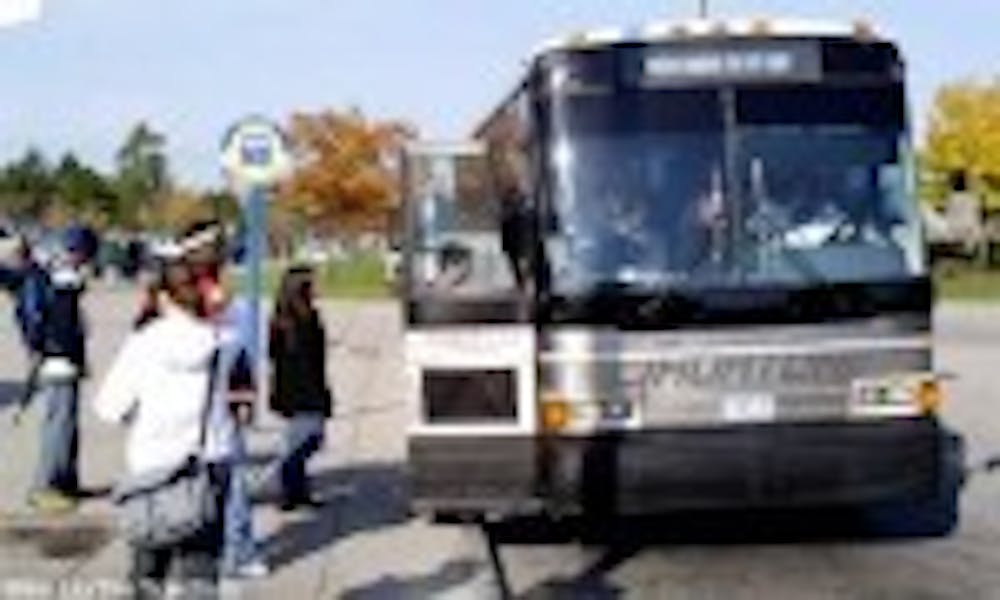
For the over 1,000 residents of South Campus, riding patiently on inter-campus busses is the only practical way to bridge the three miles that separate North and South Campus.
Because the busses are so vital -- and because UB charges students $107.50 per semester to run the fleet as part of the transportation fee -- students say it is very important that they run smoothly and punctually.
Last week, The Spectrum set out to investigate the system and found that student gripes about the system are minimal.
Generally, The Spectrum found the busses run on time. However, students have some complaints about service at night, particularly on the weekends.
"They're always on time during the day," said Mitch Mazurowski, a sophomore exercise science major who lives in Clement Hall. "But it is difficult to find a bus on weekend mornings."
Eric Moglin, a junior in the School of Management and a former South Campus resident, agreed.
"Yeah, they're definitely on time, but it's tough on the weekends," said Moglin. "Early one Sunday morning I had to get over to North Campus, but the bus never came. I asked a cop to give me a ride over, but he said he couldn't."
Chris Austin, the adjudication and transportation coordinator for the Office of Campus and Parking Transportation, said that is exactly the way the system is designed: to reduce bus frequency as demand decreases.
"They run about every 30 to 60 minutes over the weekends and in the summer," said Austin.
Some students also say that in addition to infrequent weekend services, the daytime busses are also late.
"They're usually seven to 10 minutes late," said April Okrepka, a nursing major who frequently makes the trip between campuses. "In the winter it's definitely worse. I guess it is because of the weather, but that is no excuse."
With over 2.5 million riders a year, UB administrators know they cannot please everyone. However, officials say service is improving.
UB is replacing its fabled fleet of Blue Bird busses with white Coach USA busses, which are larger and often have restrooms. According to Austin, student complaints about the aging Blue Bird busses led UB to phase them out.
In addition to the upgrades, transportation officials have bolstered the fleet with more busses.
"We've added four additional busses this year to meet expected demand," said Austin, who added that 14 busses make the inter-campus journey every school day during peak hours, 7 a.m. to 5 p.m.
Busses are very efficient except early in the morning, said Neil Bellemore, a veteran bus driver of 15 years who makes at least 11 trips between campuses every day.
"First thing in the morning you have a tremendous influx of students from South to North," Bellemore said. "You try to accommodate them all, but sometimes it's hard."
The daytime shift is a lot more pleasant than the nighttime shift, Bellemore added, because the students are mostly well behaved.
"I used to drive the night shift on weekends," he said. "That was pretty bad, hauling the drunks around."
Students say that some of the drivers can get pretty mean on the night shift, according the Mazurowski, the Clement resident.
"One night on the drunk bus I got sick and driver stopped the bus, came back and yelled at me," said Mazurowski. "I just kept my head down so I didn't have to look at him."
According to Austin, Bellemore and most students interviewed by The Spectrum, the busses used at UB are clean and generally reliable.
"Soon there won't be any busses here that were (made) before 1990," Bellemore said. "That isn't bad. If you keep up the maintenance on diesel engines, they'll go a million miles."
Even though the busses are generally in good condition, they have been known to break down, according to many students.
However, Austin said that breakdowns are rare.
"It has not happened very often this year, but since you have the vehicles operating for long stretches of the day, it can happen," said Austin.
Austin added that if students are dissatisfied with the transportation service in any way, they are encouraged to contact the Office of Campus Parking and Transportation.
"If a student has a request for a change, let us know," said Austin. "If it's not clean, if the seats are ripped, if the temperature needs changing, anything that a student needs correcting, contact us as soon as possible. We want to hear that so we can address the problem."
By now, most South Campus students said they have their transportation routine set. They know how to avoid the overly crowded busses and how to make contingency plans when busses do not run frequently.
"If you know what you are doing, it's not a problem," said Moglin, the junior management major.



