
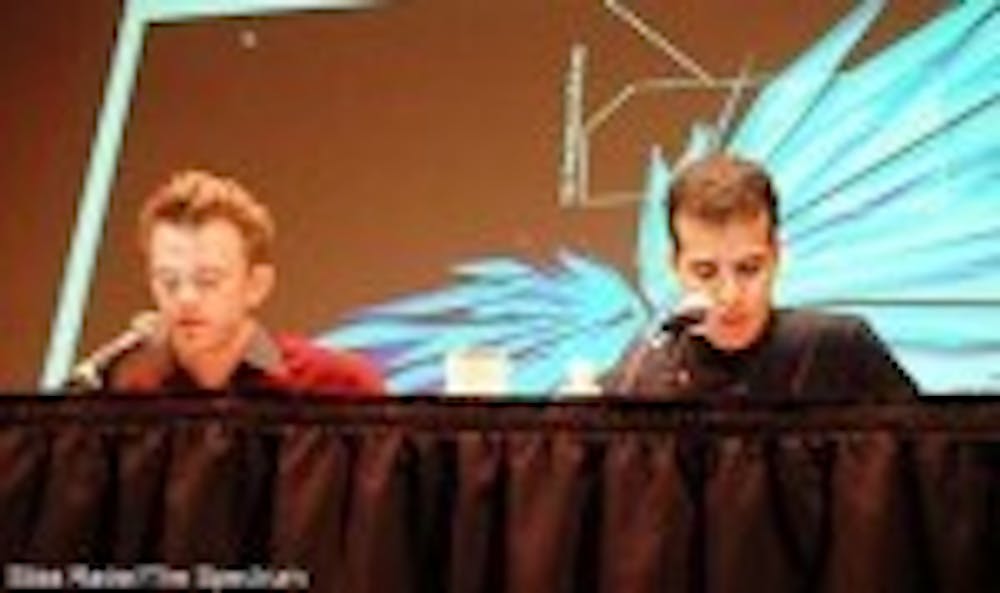
As U.S. media outlets continue daily broadcasts from the Iraq battleground, experts from across the world convened at the Center for the Arts for a conference on war and media.
The conference, held Monday and Tuesday, was designed to analyze the relationship between the media and war through cultural, artistic and academic perspectives.
In the context of world events, there was a clear focus to the conference -- media coverage of the terrorist attacks of recent wars in both Iraq and Afghanistan. Organizers estimate about 400 people attended the two-day conference.
Monday's itinerary consisted of the first of three panel discussions. Bruce Jackson, a distinguished professor of English at UB and Samuel P. Capen Professor of American Culture, who has also been an outspoken critic of the war, moderated the panel, "Challenges in Covering the War in Iraq."
Jackson, who runs an alternative press Web site, The Buffalo Report, said he feels questioning the media's role has great importance.
"I think it's one of the most important questions we have," he said. "We get our primary information from the media, and this is where we analyzed it."
Journalists such as Ian Kalushner, television news producer for the Canadian Broadcasting Corporation, and Jerry Zremski of The Buffalo News discussed their first-hand experiences of the war, the challenges they faced, and different ways and styles of reporting the conflict.
The second day of the conference kicked off on Tuesday with artist, graduate teaching assistant and assistant professor of media study Trebor Scholz, who presented a documentary project called "79 Days" that examined media coverage of the wars in Iraq and Kosovo.
Holly Johnson, media study adjunct instructor, moderated the conference's second panel, "War and Media Resistance."
For this portion of the conference, video artist Abdelali Dahrouch, Buffalo State professor of journalism and media studies Michael Niman and Italian sociologist Pierluigi Boda examined a diverse range of issues that included an analysis of reality and the media after the Sept. 11, 2001 attacks.
Niman, who is a writer for the local magazine Artvoice, could not attend the conference because of a legal engagement. He sent in a self-filmed video of the material he was going to cover.
In the film Niman criticized Zremski -- The Buffalo News reporter who was embedded in a military unit -- as a writer who casually covers war. He said some reporters were able to venture into Iraq without being embedded.
The third and final panel, entitled "The Dialectics of the Media," was made up of several international academicians and journalists.
Michael Freund, managing editor of the weekend supplement of the Vienna-based daily Der Standard, Louann Haarman, professor of English linguistics at the University of Bologna, and Linda Lombardo, professor of English language and linguistics at the Luiss Guido Carli University in Rome spoke on a range of issues.
Topics ranged from TV coverage of the Iraq war to a comparative study of U.S. and Italian war coverage.
John O'Hara, a graduate student studying English, attended both days of the conference and said it offered an interesting perspective on world issues.
"I thought the videos were an intriguing selection," he said. "The panel wasn't as diversified as I would have liked, but it was an all around solid presentation."
The conference, which was organized by Bernadette Wegenstein, wrapped up with closing remarks.
"I think everything went well," Wegenstein said. "The panels were diverse, and the student turnout was good."



